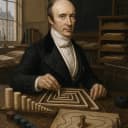
1666 CEGeneralized in seventeenth-century England and the German states by Newton and Leibniz, on precedents from several earlier mathematical traditions
This voyage is an editorial path for understanding, not a claim of direct historical influence or sole invention.
Understand it in one breath
Differentiation studies instantaneous change near a point, while integration studies accumulation across an interval. Under suitable conditions such as continuity, the Fundamental Theorem of Calculus connects the two processes. Building on earlier methods from several mathematical traditions, Newton and Leibniz independently developed general procedures and notation in the seventeenth century.
At a glance
f(x) = x²
Concept
The mathematics of change (derivatives) and accumulation (integrals).
Key formula
dxd∫axf(t)dt=f(x)(Fundamental Theorem of Calculus)
Worked examples
1
Q.d/dx(x²)
2
Q.∫ x dx
Ports in time
This concept was not invented in one instant
Follow the scenes to see problems, notation, standards of proof, and applications changing across different times and places.
1
BC 250Scene 1 / 5Syracuse
Archimedes — a prehistory of integration
In Syracuse, Archimedes found the area between a parabola and a chord through a geometric series of successively smaller triangles and a bounding proof. It is a powerful precedent, not the modern definition of an integral.
During the Cambridge closure of 1665–1666, Newton developed ideas about series, tangents, areas, fluxions, optics, and gravitation at Woolsthorpe and nearby. Their exact dates, locations, completion, and publication do not collapse into one miracle day.
Leibniz’s independent discovery in Paris — published in 1684
Leibniz tested d and ∫ in private Paris manuscripts in 1675. His differential method appeared in Leipzig in 1684, followed by printed integral notation in 1686; the Bernoullis and teaching networks helped the notation spread.
Cauchy moves limits and convergence conditions to the foreground
The Cours d’analyse made limits, continuity, sequences, and convergence more explicit. It was a decisive stage of rigor, not the final modern foundation of the real numbers or every epsilon–delta quantifier.
Weierstrass’s Berlin lectures — replace pictures with conditions
His 1859–1864 lectures rebuilt analysis around arithmetic conditions; in 1872, a continuous nowhere-differentiable function exposed the limits of assuming that every curve is locally smooth.
Gradient descent in machine learning, tomographic reconstruction in medical imaging, marginal analysis in economics, rocket trajectories, and differential equations for heat, fluids, and electromagnetic fields all use calculus to model continuous change and accumulation.
Beyond MathVoyage
Curated sources and problems. Bring one discovery back from OEIS, Project Euler, MathOverflow, or arXiv.