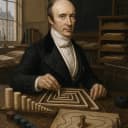
This voyage is an editorial path for understanding, not a claim of direct historical influence or sole invention.
Understand it in one breath
Complex-valued functions exhibit remarkable rigidity. Differentiability at one isolated point is not enough. A function that is complex-differentiable at every point of an open region is analytic there: it is infinitely differentiable and locally represented by a power series. Euler's identity e^(iπ) + 1 = 0 displays the link between the complex exponential and trigonometric functions.
At a glance
Real analysis
Complex analysis
Why it matters
Differentiable at one point
One point alone does not imply analyticity
An open neighborhood is required
Complex-differentiable throughout an open region
Analytic = infinitely differentiable + local power series
A much stronger condition than for real functions
An integral can depend on its path
Integral around a closed path in a suitable domain = 0
The hypotheses of Cauchy’s theorem matter
Absolute value offers limited structure
Maximum modulus principle
The boundary controls the interior
The number of real roots varies
Fundamental theorem of algebra — n complex roots counting multiplicity
Several earlier arguments and Gauss
e^x, sin x, and cos x appear separate
e^(iθ) = cos θ + i sin θ
Euler’s bridge
Once the complex plane adds another dimension, calculus becomes a far more rigid and elegant subject — which is why the Riemann hypothesis asks about the zeros of ζ(s) in the complex plane.
Concept
Calculus extended to complex numbers — surprisingly elegant: once differentiable means infinitely differentiable.
Key formula
∮Cf(z)dz=2πi∑Res(f)
Ports in time
This concept was not invented in one instant
Follow the scenes to see problems, notation, standards of proof, and applications changing across different times and places.
1
AD 1748Scene 1 / 4Continue through the world of this year
Euler — calculus with complex numbers
Euler’s formula e^(iθ)=cosθ+i·sinθ revealed that exponential and trigonometric functions are facets of one complex-analytic structure.
No reliable place is given, so time continues without an invented pin
Cauchy established that the integral of a holomorphic function around a closed contour vanishes under appropriate conditions, a foundation of complex analysis.
Electrical engineering and impedance, signal processing, quantum mechanics, two-dimensional fluid flow, airfoil design through the Joukowski transform, and analytic number theory.
Beyond MathVoyage
Curated sources and problems. Bring one discovery back from OEIS, Project Euler, MathOverflow, or arXiv.