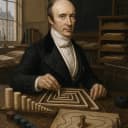
This voyage is an editorial path for understanding, not a claim of direct historical influence or sole invention.
Understand it in one breath
"Can making x sufficiently close to a force f(x) as close to L as desired?" Seventeenth-century limit intuitions were refined through nineteenth-century work by Bolzano, Cauchy, Weierstrass, and others into ε-δ language. Continuity at a point means that the limit there equals the function value. Limits are central to analysis, though not every theory of differentiation or integration is built from this one definition alone.
At a glance
sin(5x)
Concept
The rigorous formalization of "approaching" via ε-δ — the foundation of all of calculus.
Key formula
x→alimf(x)=L⟺∀ε>0,∃δ>0:0<∣x−a∣<δ⇒∣f(x)−L∣<ε
Worked examples
1
Q.lim_{x→0} sin(x)/x
2
Q.f(x) = 1/x as x → 0
Ports in time
This concept was not invented in one instant
Follow the scenes to see problems, notation, standards of proof, and applications changing across different times and places.
1
BC 250Scene 1 / 4Continue through the world of this year
Archimedes — a precursor to limits
The method of exhaustion trapped areas between increasingly accurate polygonal bounds, anticipating the logic of limits centuries before modern notation.
No reliable place is given, so time continues without an invented pin
AD 1665Scene 2 / 4Continue through the world of this year
Newton — the ambiguity of fluxions
Newton described calculus through flowing and vanishing quantities. The method was powerful, but critics such as Bishop Berkeley attacked its “ghosts of departed quantities.”
No reliable place is given, so time continues without an invented pin
Completeness of the real numbers, convergence in numerical analysis, asymptotic statistics, and probability limit theorems — the concepts that removed ambiguity from calculus.
Beyond MathVoyage
Curated sources and problems. Bring one discovery back from OEIS, Project Euler, MathOverflow, or arXiv.