Another viewpoint3/13
Non-Euclidean Geometry
If one rule about parallel lines changes, does the shape of the universe change too?
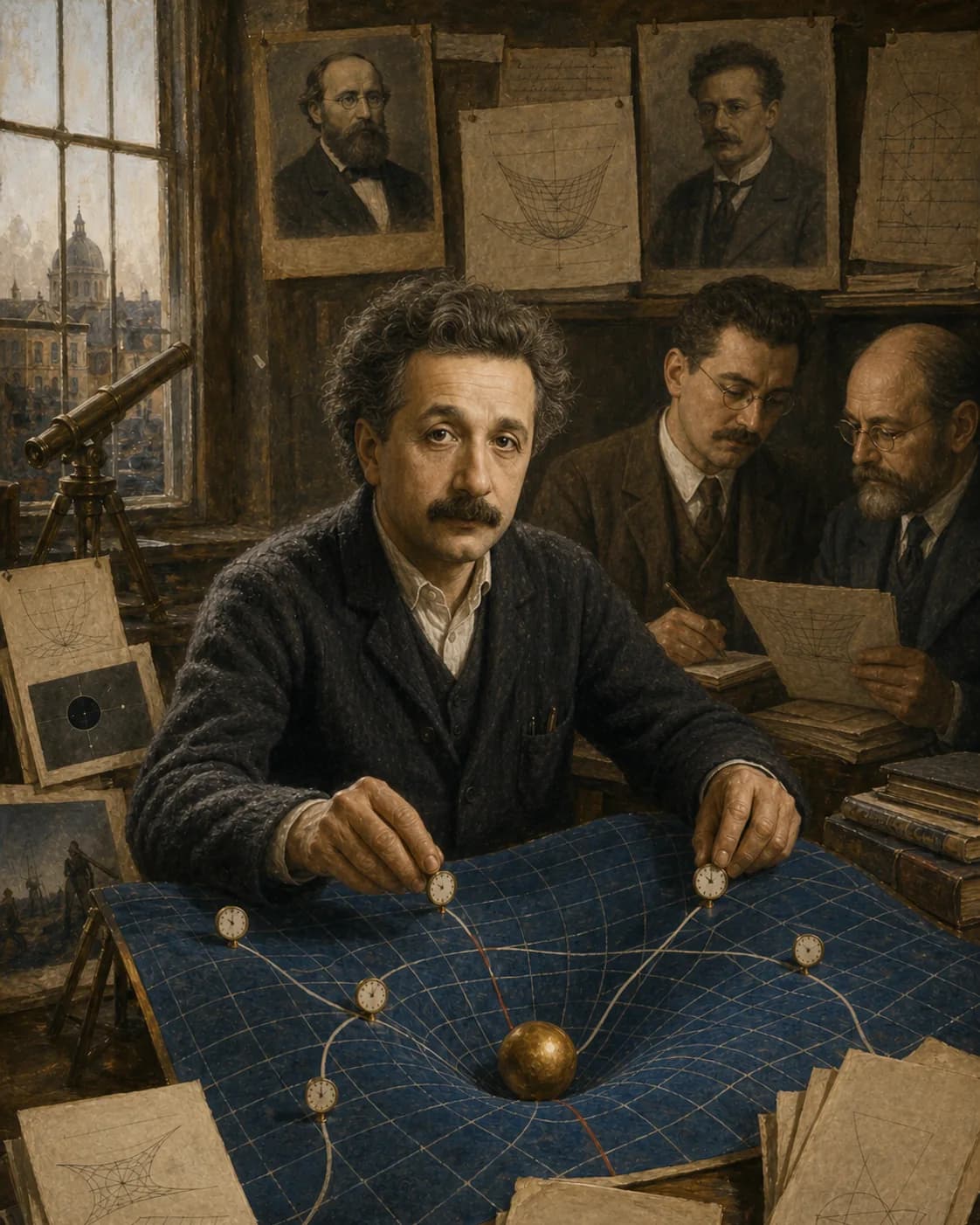
Recasting gravity from a pull into spacetime geometry
Known photographic cues are re-aged toward Einstein at about 36 in 1915. The room and collaborators are not a record of one moment, and the scene does not erase Riemann, Minkowski, Grossmann, or observational communities to make general relativity an isolated flash by one person.
MathVoyage editorial direction · OpenAI image generation · historical photograph identity reference · age, collaborator, and generated-text correction · 2026-08-07
Remember the mind, not only the dates
The idea to carry forward
God does not play dice with the universe.Enter through one scene
As a clerk at the patent office he produced four papers in a single year — photoelectric effect, Brownian motion, special relativity, E = mc² — rewriting physics in one sweep.
Questions this person helps open
These are reverse projections of existing editorial routes, not claims of direct influence or sole invention.
If one rule about parallel lines changes, does the shape of the universe change too?
PROFILE 02 · DEEP VOYAGE
Instead of memorizing more dates, follow the world that shaped this mind, the scenes that changed its direction, and the questions carried onward.
CHAPTER 01 · PERSON AND PERIOD
Before the finished achievement, read what this person treated as a problem and where the surviving evidence reaches its limit.
Not a mathematician but a physicist — yet to build general relativity (1915), the theory that spacetime itself is curved, he had to spend three years studying Riemannian geometry with his friend Marcel Grossmann. He thereby showed that mathematics itself is the universe's native language. His 1921 Nobel Prize was for the photoelectric effect — the committee found relativity too mathematical to honor.
CHAPTER 02 · TURNING SCENES
Follow the moments when the idea moved one step further. Every scene continues through an evidenced place or an honestly labelled time context.
Scene 1 / 3
As a clerk at the patent office he produced four papers in a single year — photoelectric effect, Brownian motion, special relativity, E = mc² — rewriting physics in one sweep.
Scene 2 / 3
After 8 years of struggle in Berlin, the field equation G_μν = 8πT_μν: gravity is the curvature of spacetime. Confirmed by the 1919 eclipse observation of bending starlight, he became a global celebrity overnight.
Scene 3 / 3
When Hitler rose, he emigrated to the U.S. and settled at Princeton's Institute for Advanced Study. He spent the rest of his life chasing a unified field theory — and never finished it.
THOUGHT EXPERIMENT · NOT A FACT CLAIM
This is a thought experiment about influence, not a verified historical fact.
Not a mathematician but a physicist — yet to build general relativity (1915), the theory that spacetime itself is curved, he had to spend three years studying Riemannian geometry with his friend Marcel Grossmann. He thereby showed that mathematics itself is the universe's native language. His 1921 Nobel was for the photoelectric effect — the committee found relativity too mathematical to honor.
STANDING ON SHOULDERS · EVIDENCED CONNECTIONS
We do not draw a line merely because two people shared an era. Only connections traced through works, problems, or teaching appear with an explanation and evidence.
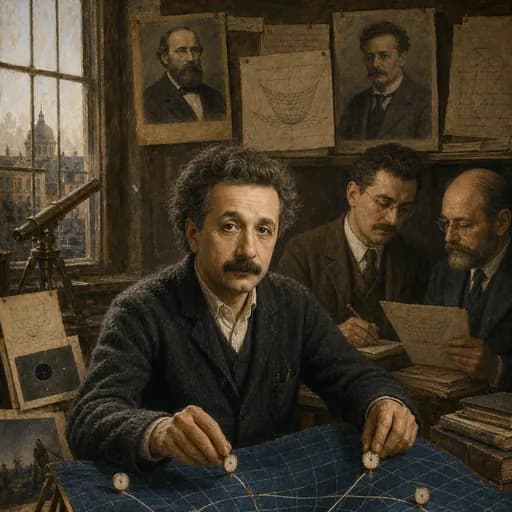
Albert Einstein
Nineteenth-Century Mathematics
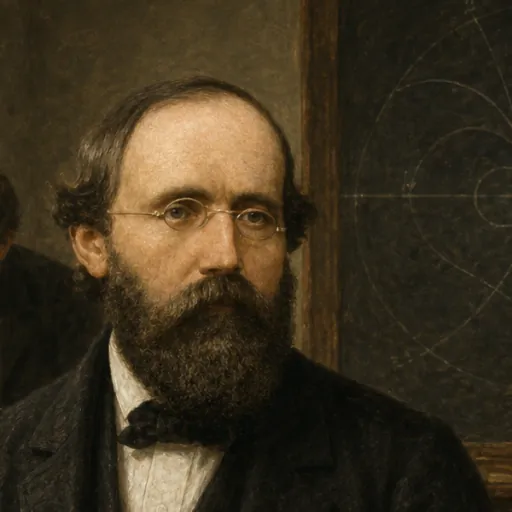
Curved space explains gravity
Riemannian metric and curvature became the mathematical language in which Einstein expressed gravitation as the curvature of spacetime.
Evidence for this connection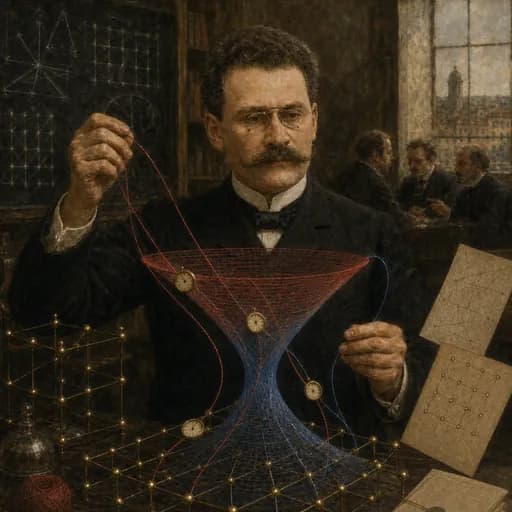
A former teacher unites space and time
Minkowski, who had taught Einstein in Zürich, recast special relativity as four-dimensional spacetime geometry, an essential bridge toward general relativity.
Evidence for this connection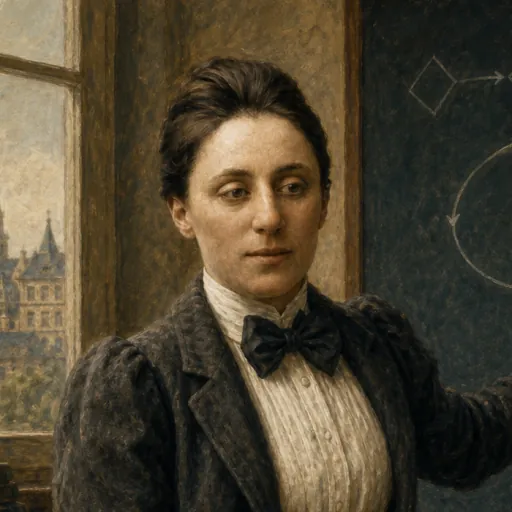
From conservation problems in relativity to Noether’s theorem
Questions about conservation in general relativity helped motivate Noether’s work, yielding the theorem linking symmetries and conservation laws across modern physics.
Evidence for this connectionCurated sources and problems. Bring one discovery back from OEIS, Project Euler, MathOverflow, or arXiv.