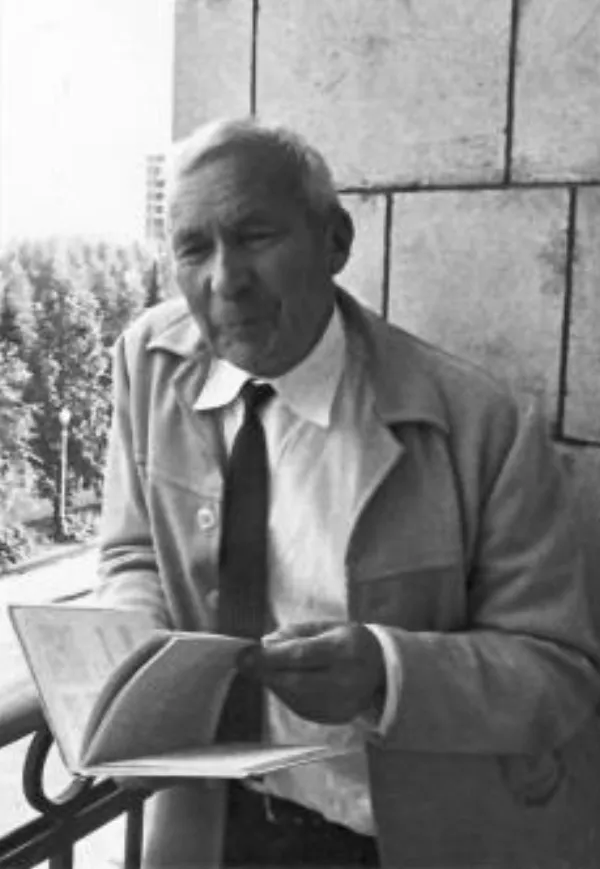
Andrey Kolmogorov
Life
A mathematician who clarified what can be proved from stated assumptions across probability, turbulence, mechanics, and information. At age 30, his 1933 Foundations of the Theory of Probability treated events as sets in a sample space and probability as a measure. It synthesized earlier work by Borel, Lebesgue, Fréchet, and others; the preceding two centuries of probability were not simply nonrigorous. His 1941 turbulence theory predicts spectral scaling under assumptions such as high Reynolds number and local homogeneity and isotropy. His 1954 idea that some invariant tori of a nearly integrable Hamiltonian system survive small perturbations became KAM theory through later work by Arnold and Moser. In the 1960s, independently alongside Solomonoff and Chaitin, he developed a way to measure an individual string’s complexity by the length of its shortest program. He also mentored students including Arnold and supported mathematical schooling, without one person constituting all of Soviet mathematics.
Decisive moments
Foundations of the Theory of Probability
MoscowIt axiomatized probability in measure-theoretic language and organized conditional probability, independence, and random variables. Rather than replacing all prior work, it supplied a widely reusable common foundation.
K41 turbulence theory
Assuming local homogeneity and isotropy at high Reynolds number, it predicts the 5/3 spectral law in the inertial range. Real turbulence requires corrections for intermittency and boundaries.
Algorithmic complexity
He developed a measure of information as the length of the shortest program producing a string. Different universal machines change it only by a fixed additive constant, but the value is not computable in general.
If this person hadn't existed
This is a thought experiment about influence, not a verified historical fact.
Beginners list die outcomes as a set; intermediate learners calculate unions of events and countable additivity. Advanced learners treat random variables as measurable functions and distinguish the hypotheses of K41 scaling or KAM theory. Experts continue to conditional expectation, stochastic processes, and the uncomputability of Kolmogorov complexity.
Influence network
Beyond MathVoyage
Loading…