Central anchor4/11
Markov Chains
Through Markov Chains: How can repeated signals emerge from a single uncertain event?
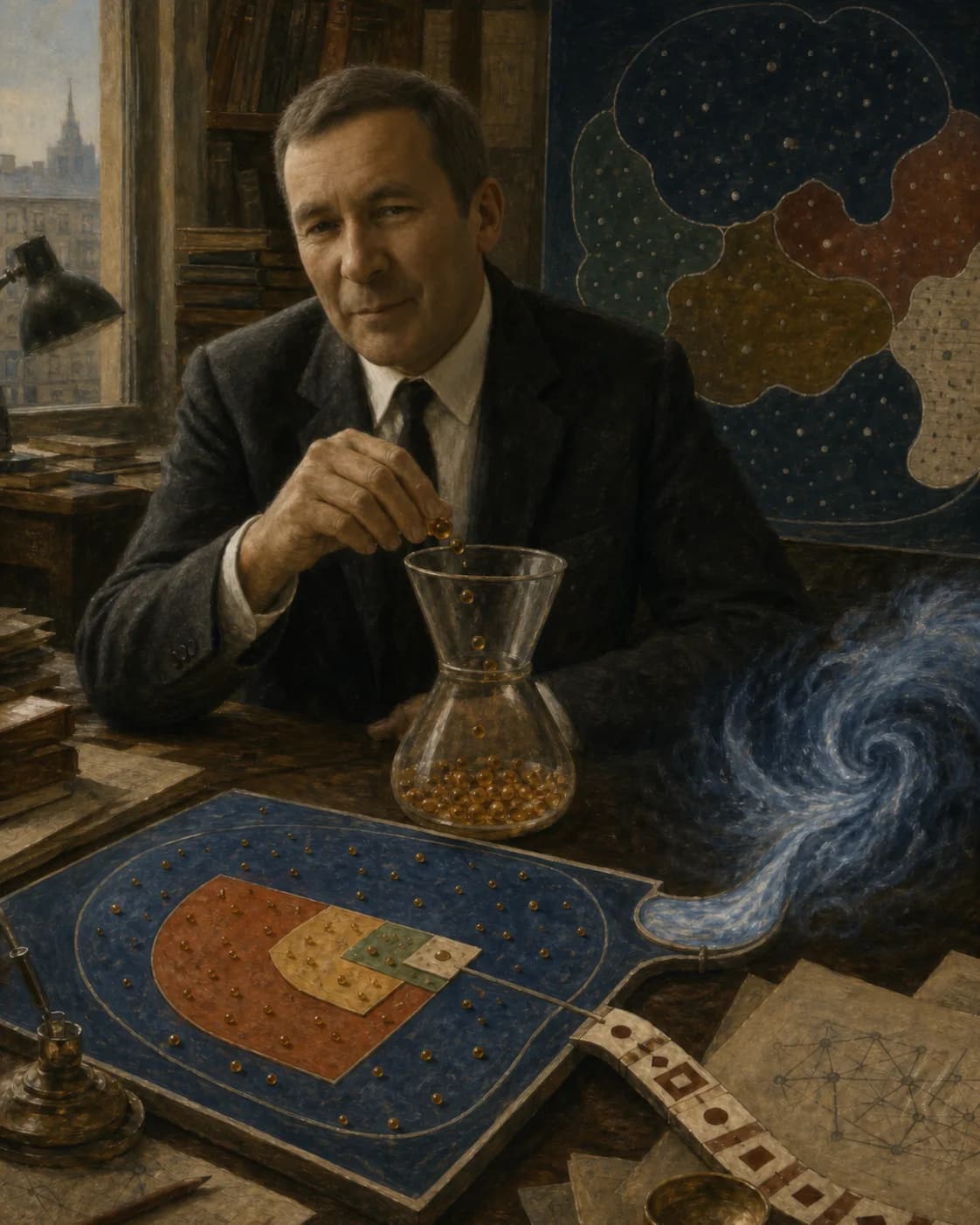
Turning chance from stories into a measurable structure
The appearance from a known later photograph is cautiously re-aged toward about 30 in 1933. The sample space, vessel, eddy, and pattern strip divide probability axioms and later turbulence and complexity work within one metaphorical room; they are not one recorded room or single unified theory. The scene does not assign all probability to one person or infer politics or private life.
MathVoyage editorial direction · OpenAI image generation · historical photograph identity reference · age correction · 2026-08-07
Remember the mind, not only the dates
The idea to carry forward
A probability model begins by specifying a sample space, events, and a measure.Enter through one scene
It axiomatized probability in measure-theoretic language and organized conditional probability, independence, and random variables. Rather than replacing all prior work, it supplied a widely reusable common foundation.
Questions this person helps open
These are reverse projections of existing editorial routes, not claims of direct influence or sole invention.
Through Markov Chains: How can repeated signals emerge from a single uncertain event?
Through Stochastic Differential Equations: How can instantaneous change and long accumulation become one language?
Why can thousands of trials be predictable when one trial is not?
Can uncertainty be measured without reading what a message means?
PROFILE 02 · DEEP VOYAGE
Instead of memorizing more dates, follow the world that shaped this mind, the scenes that changed its direction, and the questions carried onward.
CHAPTER 01 · PERSON AND PERIOD
Before the finished achievement, read what this person treated as a problem and where the surviving evidence reaches its limit.
A mathematician who clarified what can be proved from stated assumptions across probability, turbulence, mechanics, and information. At age 30, his 1933 Foundations of the Theory of Probability treated events as sets in a sample space and probability as a measure. It synthesized earlier work by Borel, Lebesgue, Fréchet, and others; the preceding two centuries of probability were not simply nonrigorous. His 1941 turbulence theory predicts spectral scaling under assumptions such as high Reynolds number and local homogeneity and isotropy. His 1954 idea that some invariant tori of a nearly integrable Hamiltonian system survive small perturbations became KAM theory through later work by Arnold and Moser. In the 1960s, independently alongside Solomonoff and Chaitin, he developed a way to measure an individual string’s complexity by the length of its shortest program. He also mentored students including Arnold and supported mathematical schooling, without one person constituting all of Soviet mathematics.
CHAPTER 02 · TURNING SCENES
Follow the moments when the idea moved one step further. Every scene continues through an evidenced place or an honestly labelled time context.
Scene 1 / 3
It axiomatized probability in measure-theoretic language and organized conditional probability, independence, and random variables. Rather than replacing all prior work, it supplied a widely reusable common foundation.
Scene 2 / 3
Assuming local homogeneity and isotropy at high Reynolds number, it predicts the 5/3 spectral law in the inertial range. Real turbulence requires corrections for intermittency and boundaries.
Scene 3 / 3
He developed a measure of information as the length of the shortest program producing a string. Different universal machines change it only by a fixed additive constant, but the value is not computable in general.
THOUGHT EXPERIMENT · NOT A FACT CLAIM
This is a thought experiment about influence, not a verified historical fact.
Beginners list die outcomes as a set; intermediate learners calculate unions of events and countable additivity. Advanced learners treat random variables as measurable functions and distinguish the hypotheses of K41 scaling or KAM theory. Experts continue to conditional expectation, stochastic processes, and the uncomputability of Kolmogorov complexity.
STANDING ON SHOULDERS · EVIDENCED CONNECTIONS
We do not draw a line merely because two people shared an era. Only connections traced through works, problems, or teaching appear with an explanation and evidence.
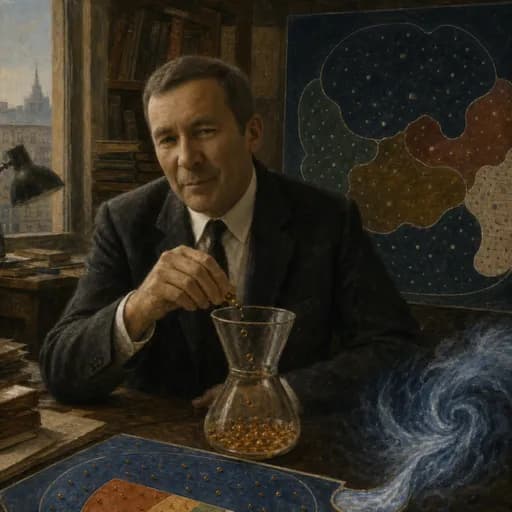
Andrey Kolmogorov
Modern Era
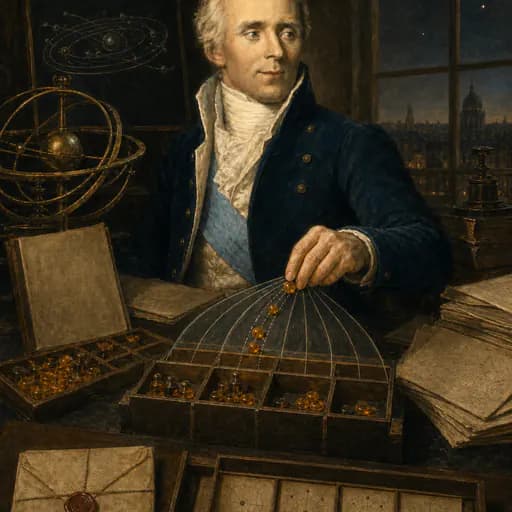
Classical probability becomes an axiomatic theory
After Laplace built a vast computational theory of classical probability, Kolmogorov’s 1933 axioms placed probability on measure theory and created its modern common foundation.
Evidence for this connectionCurated sources and problems. Bring one discovery back from OEIS, Project Euler, MathOverflow, or arXiv.