Central anchor2/18
Limit and Continuity
Through Limit and Continuity: How can instantaneous change and long accumulation become one language?
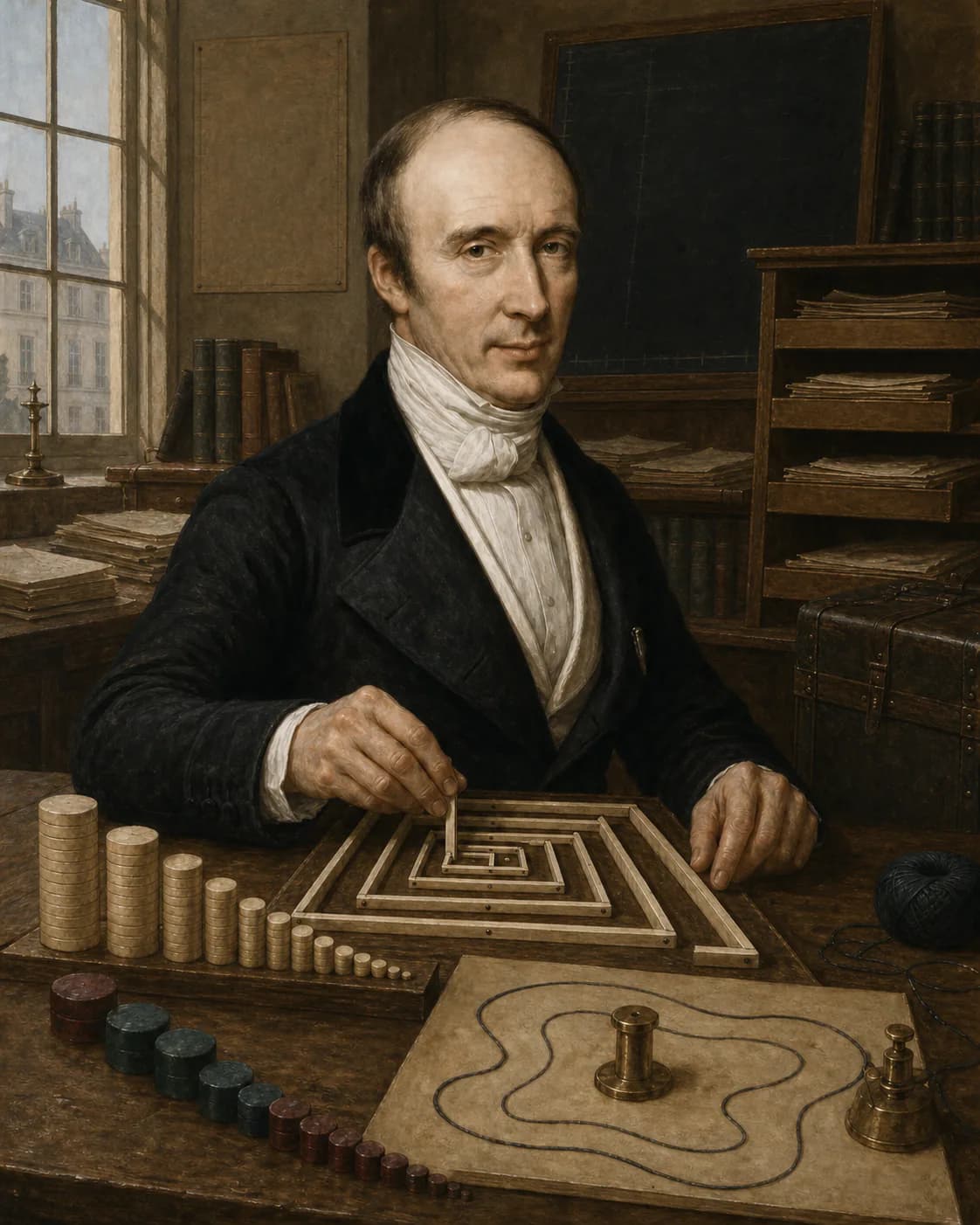
Giving ‘almost close’ conditions that can be checked
The face draws on the nineteenth-century portrait tradition, while the 1821 Paris-style lecture room editorially compresses definitions and institutional review. It does not claim that Cauchy alone completed the modern epsilon-delta framework or solely caused the Abel and Galois manuscript controversies.
MathVoyage editorial direction · OpenAI image generation · historical lithograph identity reference · precise generated-text removal edit · 2026-08-07
Remember the mind, not only the dates
The idea to carry forward
Rigor is the soul of mathematics.Enter through one scene
He explicitly defined limits, continuity, and convergence and foregrounded hypotheses. Weierstrass and others later refined the modern formalism.
Questions this person helps open
These are reverse projections of existing editorial routes, not claims of direct influence or sole invention.
Through Limit and Continuity: How can instantaneous change and long accumulation become one language?
Through Eigenvalues and Eigenvectors: How can we recognize the same structure inside different problems?
How can instantaneous speed and distance over time become the same calculation?
Why do stricter rules emerge after imaginary numbers are allowed?
PROFILE 02 · DEEP VOYAGE
Instead of memorizing more dates, follow the world that shaped this mind, the scenes that changed its direction, and the questions carried onward.
CHAPTER 01 · PERSON AND PERIOD
Before the finished achievement, read what this person treated as a problem and where the surviving evidence reaches its limit.
A major architect of rigorous analysis and complex integration whose definitions and inequalities sharpened calculus. Later mathematicians completed the modern epsilon-delta framework, and manuscript controversies involved institutions as well as Cauchy.
CHAPTER 02 · TURNING SCENES
Follow the moments when the idea moved one step further. Every scene continues through an evidenced place or an honestly labelled time context.
Scene 1 / 3
He explicitly defined limits, continuity, and convergence and foregrounded hypotheses. Weierstrass and others later refined the modern formalism.
Scene 2 / 3
He developed results making closed-contour integrals vanish under suitable conditions; later work sharpened the hypotheses on paths, domains, and holomorphicity.
Scene 3 / 3
Refusing to swear loyalty to the new regime, he lost his chair and spent 8 years in Turin and Prague.
THOUGHT EXPERIMENT · NOT A FACT CLAIM
This is a thought experiment about influence, not a verified historical fact.
Cauchy's textbooks made rigor a set of conditions to check during calculation, not only a philosophical ideal. The manuscript disputes also show that mathematics depends on editorial, review, and archival institutions.
STANDING ON SHOULDERS · EVIDENCED CONNECTIONS
We do not draw a line merely because two people shared an era. Only connections traced through works, problems, or teaching appear with an explanation and evidence.
Augustin-Louis Cauchy
Enlightenment
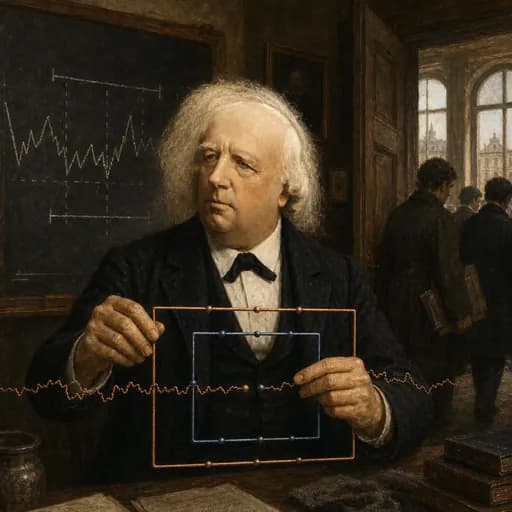
Pushing the rigor of limits to its endpoint
After Cauchy made limits and continuity central to analysis, Weierstrass completed the rigorization with epsilon-delta language and counterexamples that defeated geometric intuition.
Evidence for this connectionCurated sources and problems. Bring one discovery back from OEIS, Project Euler, MathOverflow, or arXiv.