Another viewpoint11/13
Graph Theory
What can we learn after erasing distance and shape, leaving only connections?
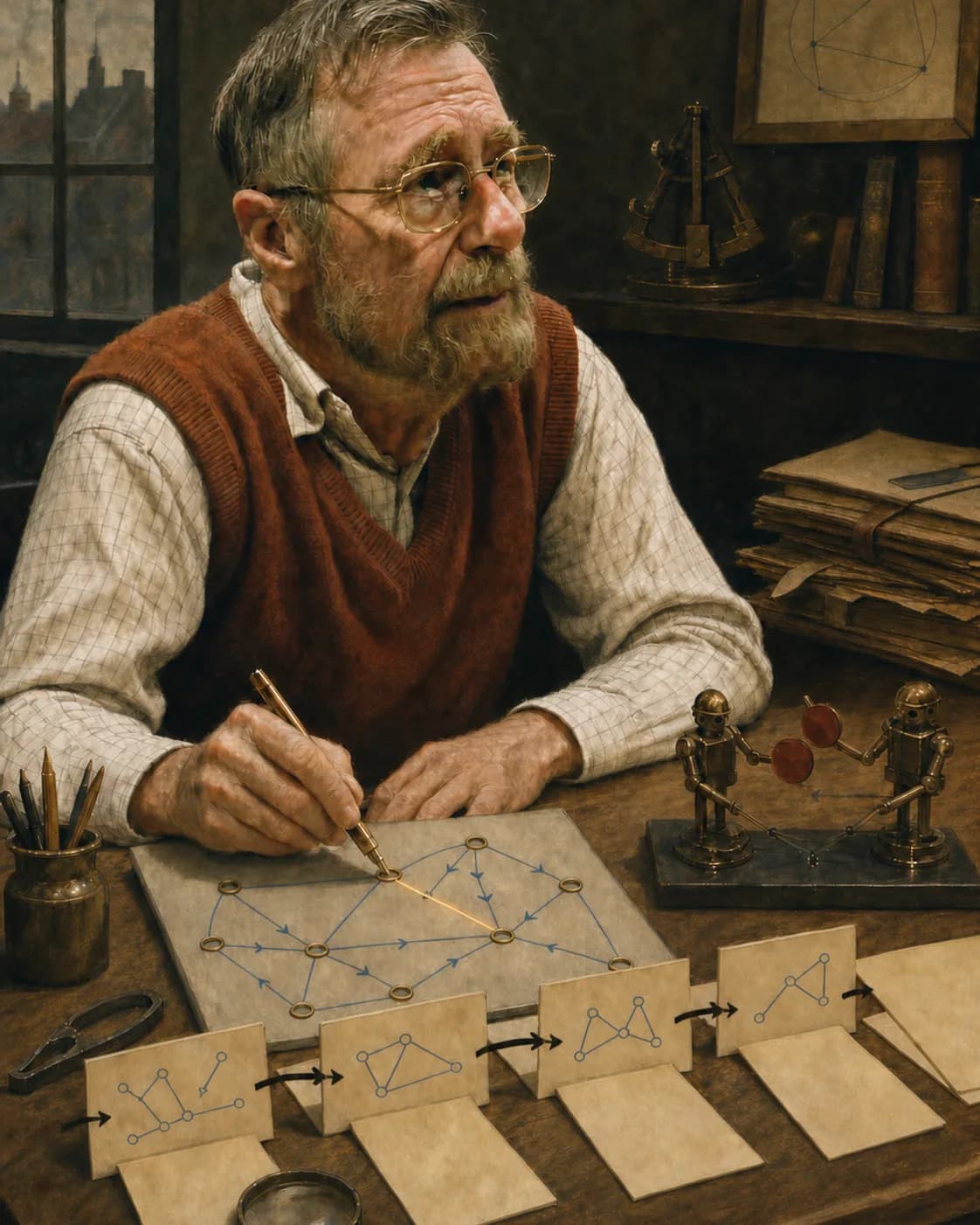
From running computation to understanding and verifying it
The face uses a public photograph. The room editorially gathers shortest paths, concurrency, handwritten EWD manuscripts, and proof-oriented programming from different periods. It does not reduce Dijkstra to one anti-goto line or assign all structured programming, concurrency, and correctness work to him alone.
MathVoyage editorial direction · OpenAI image generation · historical photograph identity reference · three-stage generated-text correction · 2026-08-07
Remember the mind, not only the dates
The idea to carry forward
GOTO statement considered harmful.Enter through one scene
For a public computer demonstration he chose the understandable task of routes among 64 Dutch cities. The quick café insight comes from his recollection; publication followed in 1959.
Questions this person helps open
These are reverse projections of existing editorial routes, not claims of direct influence or sole invention.
What can we learn after erasing distance and shape, leaving only connections?
PROFILE 02 · DEEP VOYAGE
Instead of memorizing more dates, follow the world that shaped this mind, the scenes that changed its direction, and the questions carried onward.
CHAPTER 01 · PERSON AND PERIOD
Before the finished achievement, read what this person treated as a problem and where the surviving evidence reaches its limit.
A Dutch computer scientist who designed a shortest-path procedure in 1956 for a demonstration on a 64-city graph and published it in 1959. His later café recollection does not mention a napkin. The algorithm assumes nonnegative edge weights; real navigation and routing systems combine many methods.
CHAPTER 02 · TURNING SCENES
Follow the moments when the idea moved one step further. Every scene continues through an evidenced place or an honestly labelled time context.
Scene 1 / 3
For a public computer demonstration he chose the understandable task of routes among 64 Dutch cities. The quick café insight comes from his recollection; publication followed in 1959.
Scene 2 / 3
A CACM letter that launched the structured-programming movement — a paradigm shift in computer programming.
Scene 3 / 3
He was recognized for fundamental contributions that helped establish programming as a high intellectual challenge; the official award and citation are more precise than the informal “Nobel of computing” label.
THOUGHT EXPERIMENT · NOT A FACT CLAIM
This is a thought experiment about influence, not a verified historical fact.
The engaging core is proving why “finalize the nearest unsettled vertex” never needs to be undone. A negative-edge counterexample leads to intermediate study, then priority queues, complexity, and comparison with other shortest-path algorithms.
Curated sources and problems. Bring one discovery back from OEIS, Project Euler, MathOverflow, or arXiv.