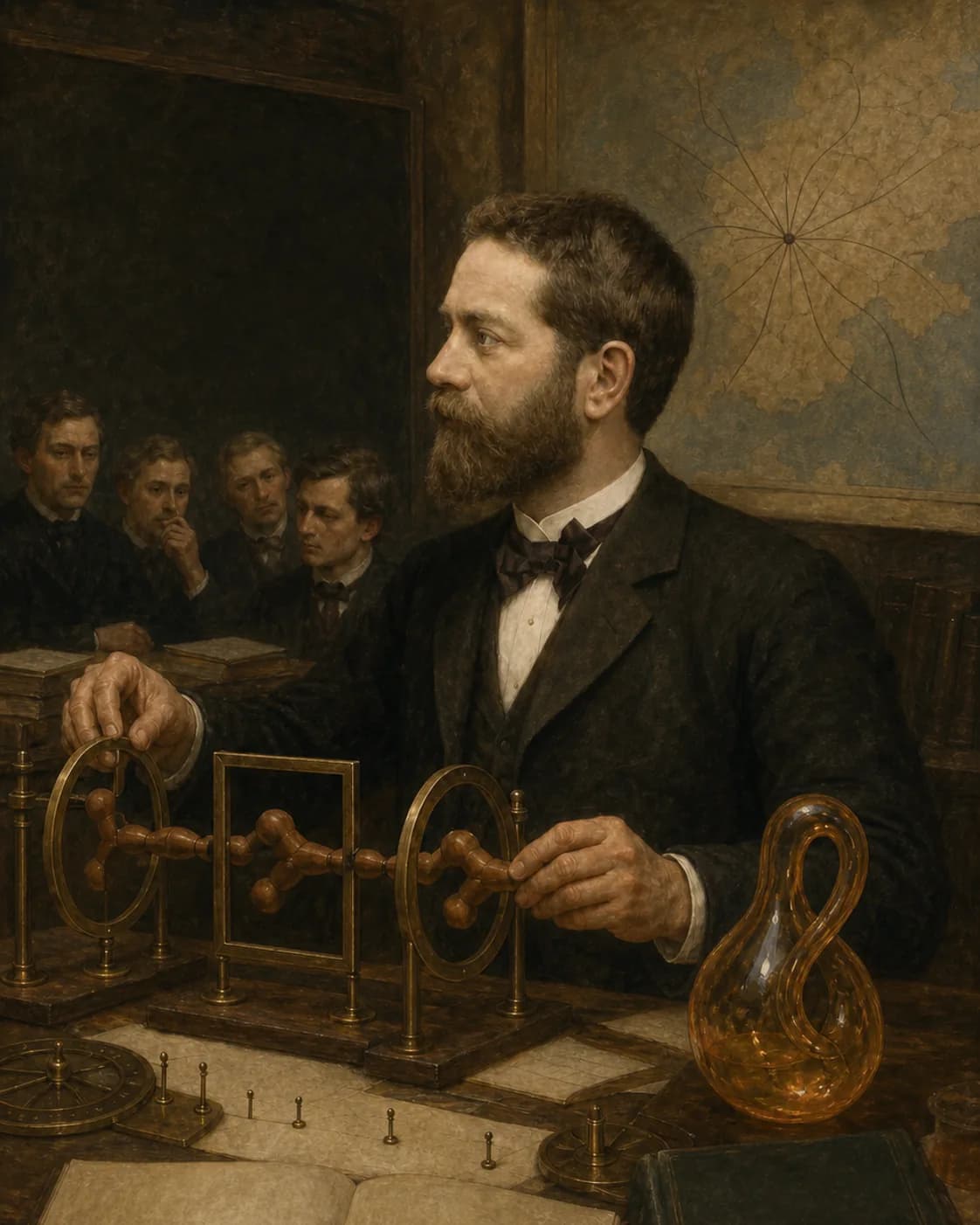
A likeness-informed AI editorial scene of Felix Klein passing one wooden form through transformation frames while comparing invariants and an academic network
AI editorial interpretation

Classifying geometries by what survives transformation

The face uses a surviving photograph. The scene compresses the 1872 Erlangen program with Klein's later Göttingen educational network; it does not claim the program completed all geometry or that Klein alone invented the glass model.

MathVoyage editorial direction · OpenAI image generation · historical photograph identity reference · precise generated-text removal edit · 2026-08-07

Remember the mind, not only the dates

Felix Klein

AD 1849 - AD 1925
Thinking ground · Göttingen
Nineteenth-Century MathematicsInvariants surviving transformationsA classification connecting geometriesAn international network converging on Göttingen

The idea to carry forward

Geometry is the study of invariants under groups of transformations.

Enter through one scene

AD 1872

At 23 — the Erlangen Program

On taking his Erlangen chair he published a program classifying geometries through invariants of transformation groups.

Questions this person helps open

Concept ports to revisit, not another achievement list

These are reverse projections of existing editorial routes, not claims of direct influence or sole invention.

No concept port has yet been reviewed for this person.

Browse every concept route

PROFILE 02 · DEEP VOYAGE

How Felix Klein’s ideas moved

Instead of memorizing more dates, follow the world that shaped this mind, the scenes that changed its direction, and the questions carried onward.

CHAPTER 01 · PERSON AND PERIOD

What questions surrounded Felix Klein?

Before the finished achievement, read what this person treated as a problem and where the surviving evidence reaches its limit.

About 1 min read

Builder of the Göttingen school. His 1872 Erlangen Program defined geometry as the study of invariants under a group of transformations — unifying Euclidean, projective, and non-Euclidean geometry under one banner. The Klein bottle is his contribution to topology.

CHAPTER 02 · TURNING SCENES

3 turning scenes

Follow the moments when the idea moved one step further. Every scene continues through an evidenced place or an honestly labelled time context.

  1. Scene 1 / 3

    AD 1872Erlangen

    At 23 — the Erlangen Program

    On taking his Erlangen chair he published a program classifying geometries through invariants of transformation groups.

  2. Scene 2 / 3

    AD 1882Göttingen· Geographic context

    The Klein bottle

    A closed nonorientable surface with one side. Its familiar three-dimensional model self-intersects, while it can be embedded without self-intersection in four dimensions.

  3. Scene 3 / 3

    AD 1893Göttingen· Geographic context

    Institutions and international exchange at Göttingen

    Through recruitment, seminars, publishing, and applied-mathematics education he made Göttingen one major international center among several in Europe and the United States.

THOUGHT EXPERIMENT · NOT A FACT CLAIM

Erase Felix Klein from the map

This is a thought experiment about influence, not a verified historical fact.

Beginners can ask which of length, angle, or cross-ratio survives a transformation; intermediate learners compare transformation groups. Advanced learners study group actions and homogeneous spaces, and experts examine where the Erlangen viewpoint extends—or needs replacement—in topology, Riemannian geometry, and algebraic geometry.

Beyond MathVoyage

Curated sources and problems. Bring one discovery back from OEIS, Project Euler, MathOverflow, or arXiv.