Central anchor8/8
Fuzzy Logic
Through Fuzzy Logic: How far can mathematics control its own infinities, paradoxes, and limits of proof?
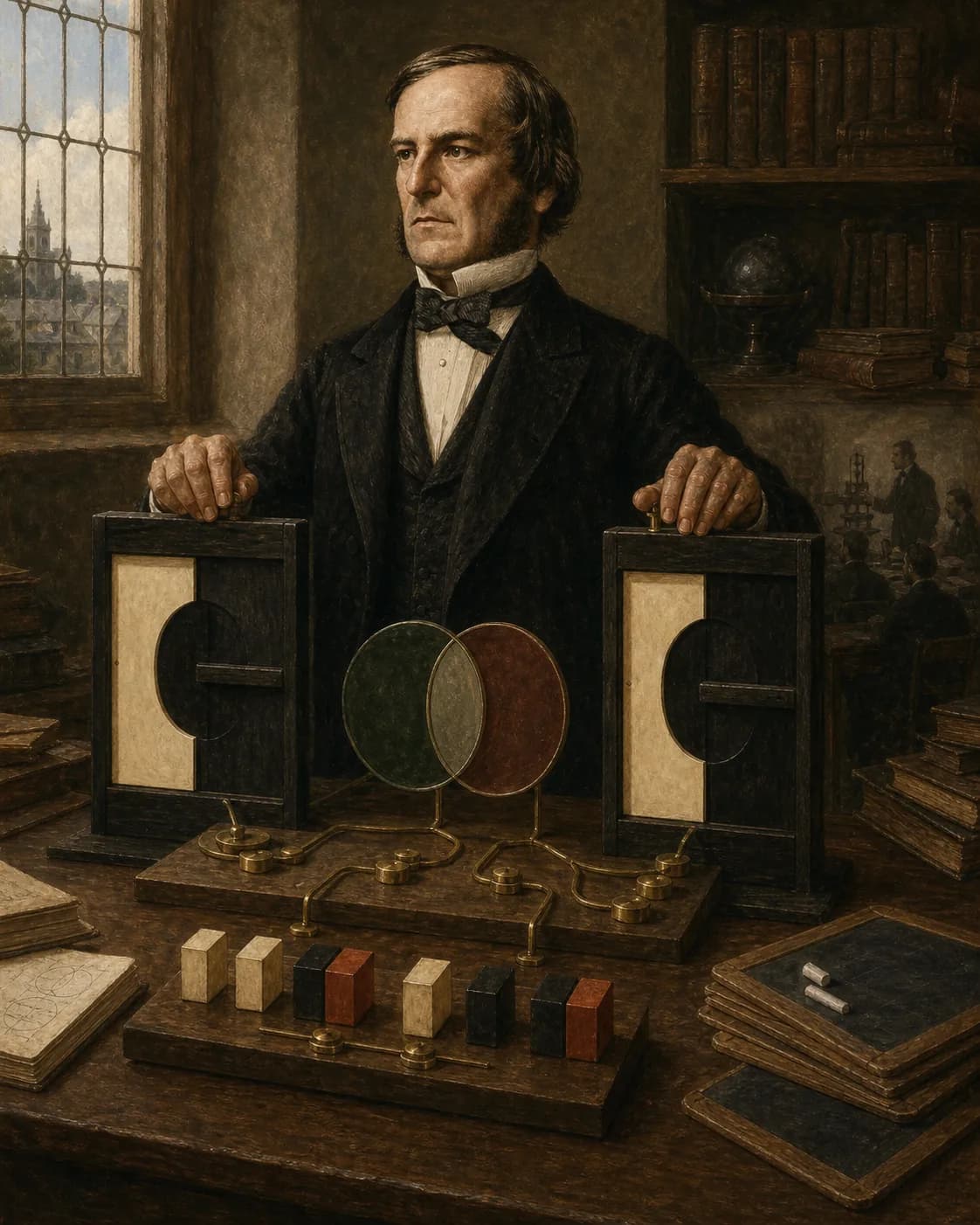
Truth and falsity become composable rules of calculation
The face uses the established engraving tradition. The shutters and counters are a modern visual metaphor for the 1854 algebra of logic, not a claim that Boole invented electronic switches, binary computers, or today's notation.
MathVoyage editorial direction · OpenAI image generation · historical engraving identity reference · 2026-08-07
Remember the mind, not only the dates
The idea to carry forward
No matter how correct a mathematical theorem may appear to be, one ought never to be satisfied that there was not something imperfect about it.Enter through one scene
Son of a poor cobbler. School ended at 16; everything after that was complete self-instruction.
Questions this person helps open
These are reverse projections of existing editorial routes, not claims of direct influence or sole invention.
Through Fuzzy Logic: How far can mathematics control its own infinities, paradoxes, and limits of proof?
Through Boolean Algebra: How can we recognize the same structure inside different problems?
PROFILE 02 · DEEP VOYAGE
Instead of memorizing more dates, follow the world that shaped this mind, the scenes that changed its direction, and the questions carried onward.
CHAPTER 01 · PERSON AND PERIOD
Before the finished achievement, read what this person treated as a problem and where the surviving evidence reaches its limit.
A largely self-educated teacher and mathematician without a university degree. His 1847 and 1854 works developed an algebraic treatment of logic. Shannon later applied Boolean algebra to the analysis and simplification of relay switching circuits; the historical relation is an adaptation, not a literal identity.
CHAPTER 02 · TURNING SCENES
Follow the moments when the idea moved one step further. Every scene continues through an evidenced place or an honestly labelled time context.
Scene 1 / 3
Son of a poor cobbler. School ended at 16; everything after that was complete self-instruction.
Scene 2 / 3
It represented classes of propositions and their combinations with symbols and operational laws. It is not identical to modern gate notation, but it was a major step toward mathematical logic and switching theory.
Scene 3 / 3
After lecturing in wet clothes, his illness worsened and he died of pneumonia. A cold-water-treatment story appears in later family biography, but it is not central to understanding his mathematics.
THOUGHT EXPERIMENT · NOT A FACT CLAIM
This is a thought experiment about influence, not a verified historical fact.
The path from Boole to Shannon is not the equation “logic = electricity.” It is a translation: laws for combining true and false statements can model open and closed switches, allowing a complex circuit to be simplified algebraically.
STANDING ON SHOULDERS · EVIDENCED CONNECTIONS
We do not draw a line merely because two people shared an era. Only connections traced through works, problems, or teaching appear with an explanation and evidence.
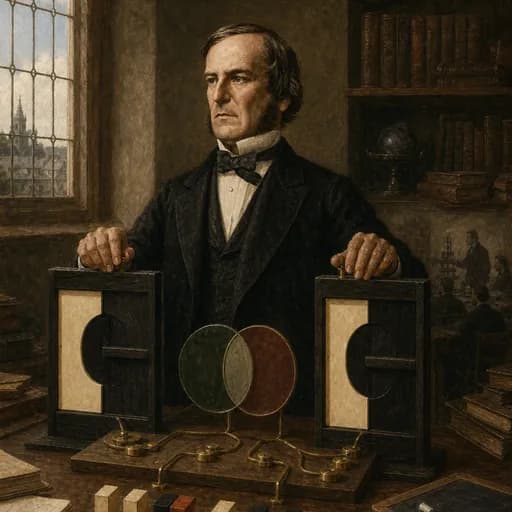
George Boole
Nineteenth-Century Mathematics
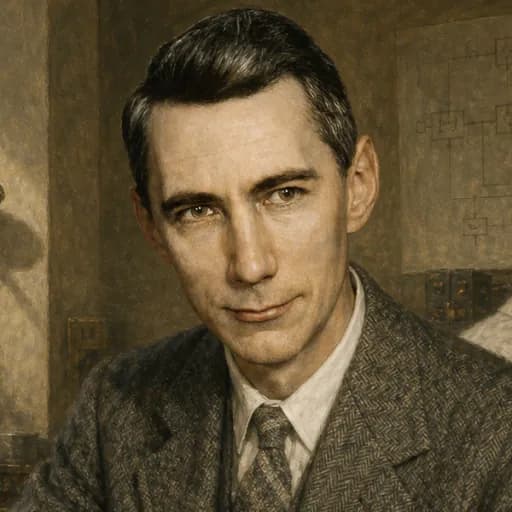
Logical algebra becomes a tool for switching circuits
In his 1937 master’s thesis, Shannon applied Boolean algebra to the combination and simplification of relay and switching circuits. That connection became a central tool of digital logic design, alongside device physics, electrical engineering, and fabrication.
Evidence for this connectionCurated sources and problems. Bring one discovery back from OEIS, Project Euler, MathOverflow, or arXiv.