Central anchor12/18
Measure and Lebesgue Integration
Through Measure and Lebesgue Integration: How can instantaneous change and long accumulation become one language?
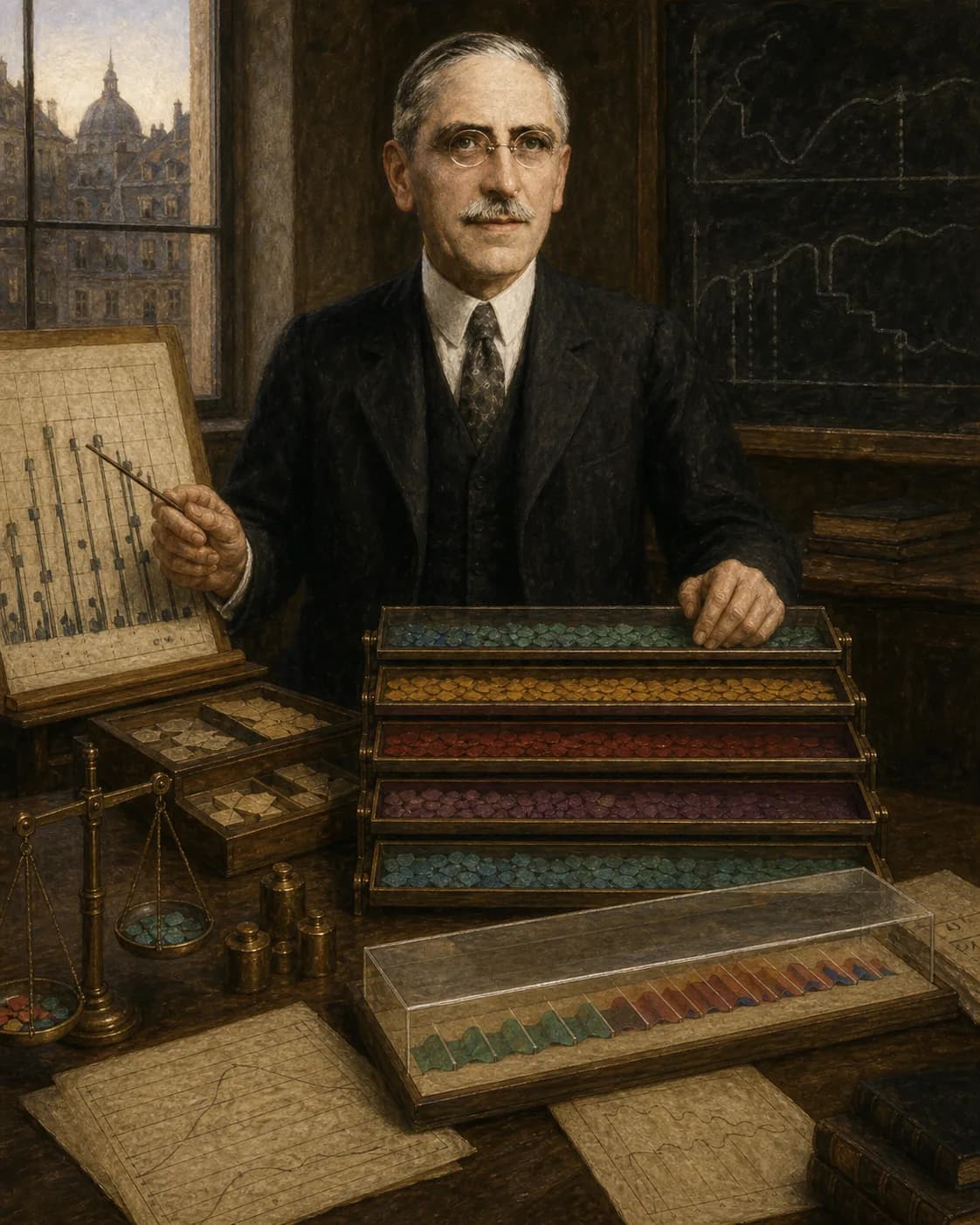
Measuring the sets carrying each value before chasing points
The face uses a surviving photograph. The colored trays editorially visualize Lebesgue integration around the 1902 thesis without erasing Borel and Jordan's measure work or claiming every function is Lebesgue integrable.
MathVoyage editorial direction · OpenAI image generation · historical photograph identity reference · 2026-08-07
Remember the mind, not only the dates
The idea to carry forward
Instead of inspecting points one by one, first measure the size of the sets carrying each value.Enter through one scene
Extending prior work on measure, including Borel’s, he systematized measurable sets and integration. New tools for limits of function sequences widened the reach of analysis.
Questions this person helps open
These are reverse projections of existing editorial routes, not claims of direct influence or sole invention.
Through Measure and Lebesgue Integration: How can instantaneous change and long accumulation become one language?
PROFILE 02 · DEEP VOYAGE
Instead of memorizing more dates, follow the world that shaped this mind, the scenes that changed its direction, and the questions carried onward.
CHAPTER 01 · PERSON AND PERIOD
Before the finished achievement, read what this person treated as a problem and where the surviving evidence reaches its limit.
A mathematician who developed an integral that first measures sets of points sharing comparable function values. Building on earlier work including Borel’s measure of sets, Lebesgue systematized measure and integration in his 1902 thesis Integral, Length, Area. It is too crude to say that Riemann integration handles only nearly continuous functions: precisely, a bounded function on a closed interval is Riemann integrable exactly when its discontinuity set has measure zero. Lebesgue integration also supplies stronger theorems for exchanging limits and integrals. The function equal to 1 on rationals and 0 on irrationals is discontinuous everywhere and not Riemann integrable, yet its Lebesgue integral is 0. Calculating that contrast makes the power of measure in analysis and probability tangible.
CHAPTER 02 · TURNING SCENES
Follow the moments when the idea moved one step further. Every scene continues through an evidenced place or an honestly labelled time context.
Scene 1 / 3
Extending prior work on measure, including Borel’s, he systematized measurable sets and integration. New tools for limits of function sequences widened the reach of analysis.
Scene 2 / 3
He organized research on measure and integration into lectures, helping the new methods circulate through the research community.
Scene 3 / 3
Lecturer at France's most prestigious institution. He remained there for 19 years until his death in 1941, mentoring successors. His measure and integration would bear fruit in Kolmogorov's 1933 probability axiomatisation.
THOUGHT EXPERIMENT · NOT A FACT CLAIM
This is a thought experiment about influence, not a verified historical fact.
Beginners add areas over small intervals; intermediate learners see why a function mixing rationals and irrationals everywhere is not Riemann integrable. Advanced learners use measurable functions and monotone or dominated convergence. Experts continue to Lᵖ spaces, the Radon–Nikodym theorem, and probability measures.
Curated sources and problems. Bring one discovery back from OEIS, Project Euler, MathOverflow, or arXiv.