Central anchor4/18
Multivariable Calculus
Through Multivariable Calculus: How can instantaneous change and long accumulation become one language?
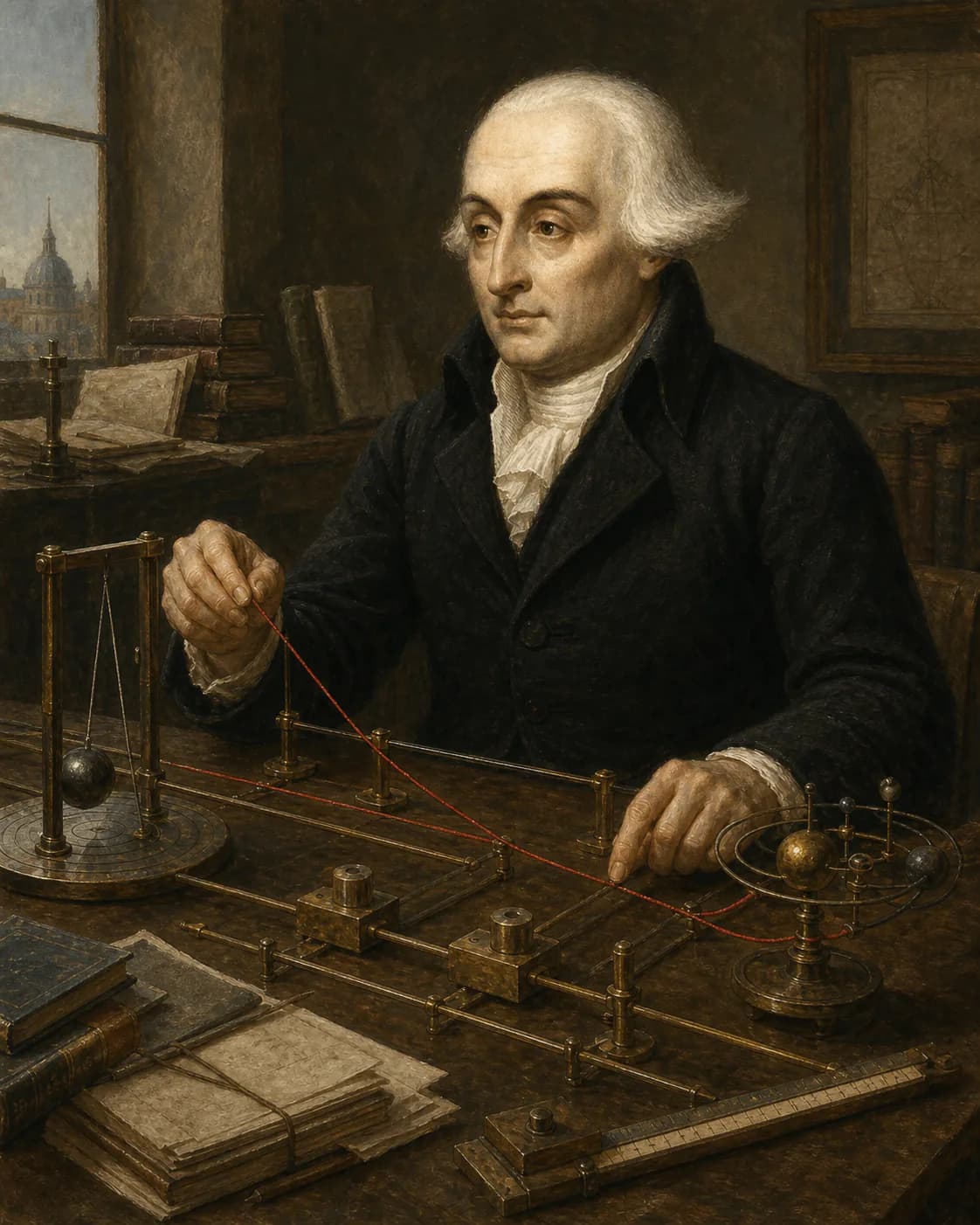
Turning many motions into one reusable analytical procedure
The face uses the established Lagrange portrait tradition for recognition. The Paris-style room compresses methods developed across Turin, Berlin, and Paris with the 1788 Mécanique analytique; it is not a record of modern Lagrangian notation or a claim that one person invented all variational methods.
MathVoyage editorial direction · OpenAI image generation · historical portrait-tradition identity reference · 2026-08-07
Remember the mind, not only the dates
The idea to carry forward
Newton was a lucky man, for the system of the world can be discovered only once.Enter through one scene
In the restricted three-body problem he found the triangular equilibrium points L4 and L5 (the collinear L1·L2·L3 had been found earlier by Euler, c. 1750). The James Webb Space Telescope sits at L2 — one of Euler's points.
Questions this person helps open
These are reverse projections of existing editorial routes, not claims of direct influence or sole invention.
Through Multivariable Calculus: How can instantaneous change and long accumulation become one language?
Through Calculus of Variations: How can instantaneous change and long accumulation become one language?
Through Optimization: How can instantaneous change and long accumulation become one language?
PROFILE 02 · DEEP VOYAGE
Instead of memorizing more dates, follow the world that shaped this mind, the scenes that changed its direction, and the questions carried onward.
CHAPTER 01 · PERSON AND PERIOD
Before the finished achievement, read what this person treated as a problem and where the surviving evidence reaches its limit.
An Italian-born mathematician who worked in Turin, Berlin, and Paris and connected number theory, analysis, and celestial mechanics. His 1788 Mécanique analytique organized mechanics through general principles and generalized coordinates, helping establish what is now called Lagrangian mechanics.
CHAPTER 02 · TURNING SCENES
Follow the moments when the idea moved one step further. Every scene continues through an evidenced place or an honestly labelled time context.
Scene 1 / 3
In the restricted three-body problem he found the triangular equilibrium points L4 and L5 (the collinear L1·L2·L3 had been found earlier by Euler, c. 1750). The James Webb Space Telescope sits at L2 — one of Euler's points.
Scene 2 / 3
The preface announces a mechanics developed through general principles and analysis rather than geometrical constructions. Its notation is not identical to the modern Lagrangian, but it laid crucial groundwork.
Scene 3 / 3
He joined other French scientists in designing a new system of measures and supported decimalization. The metric system was a collective scientific and institutional project.
THOUGHT EXPERIMENT · NOT A FACT CLAIM
This is a thought experiment about influence, not a verified historical fact.
Lagrange’s importance is not that he invented everything anew. By organizing methods associated with Euler, d’Alembert, and others around general coordinates and variational principles, he made very different mechanical problems share a reusable procedure—from a pendulum’s energy to modern action principles.
STANDING ON SHOULDERS · EVIDENCED CONNECTIONS
We do not draw a line merely because two people shared an era. Only connections traced through works, problems, or teaching appear with an explanation and evidence.
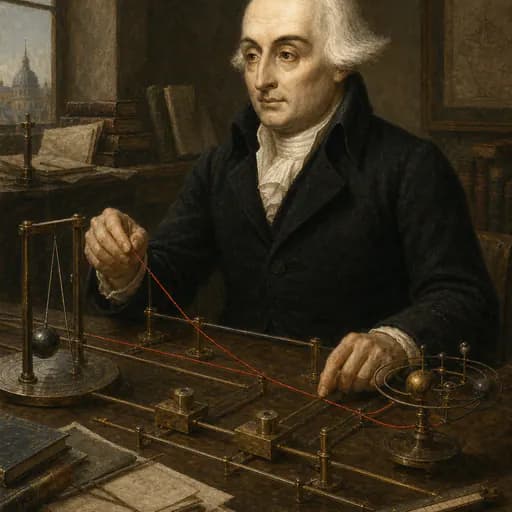
Joseph-Louis Lagrange
Enlightenment
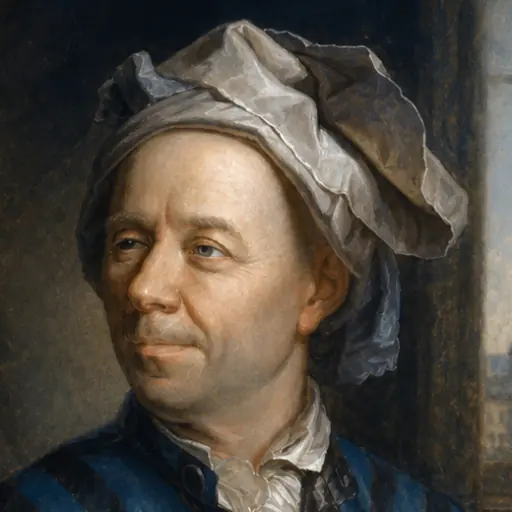
Passing on variation—and the Berlin chair
Euler immediately recognized and encouraged the young Lagrange’s work on the calculus of variations. Lagrange later succeeded him in Berlin and built analytical mechanics.
Evidence for this connection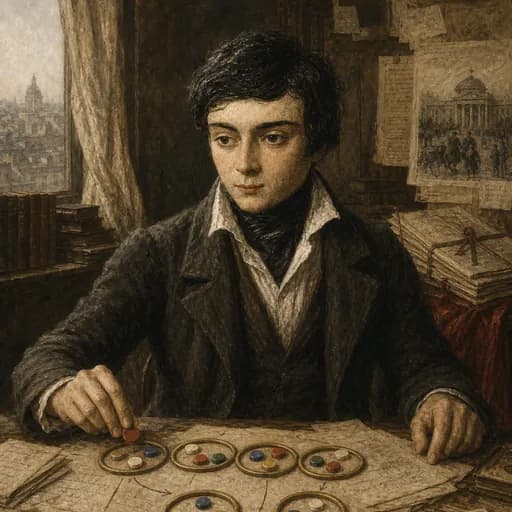
Looking at permutations rather than formulas
Lagrange exposed the central role of permutations of roots in equations. Galois pushed that viewpoint into a structural criterion for solvability by radicals.
Evidence for this connectionCurated sources and problems. Bring one discovery back from OEIS, Project Euler, MathOverflow, or arXiv.