Central anchor1/16
Combinatorics
Can we count exploding possibilities without listing every one?
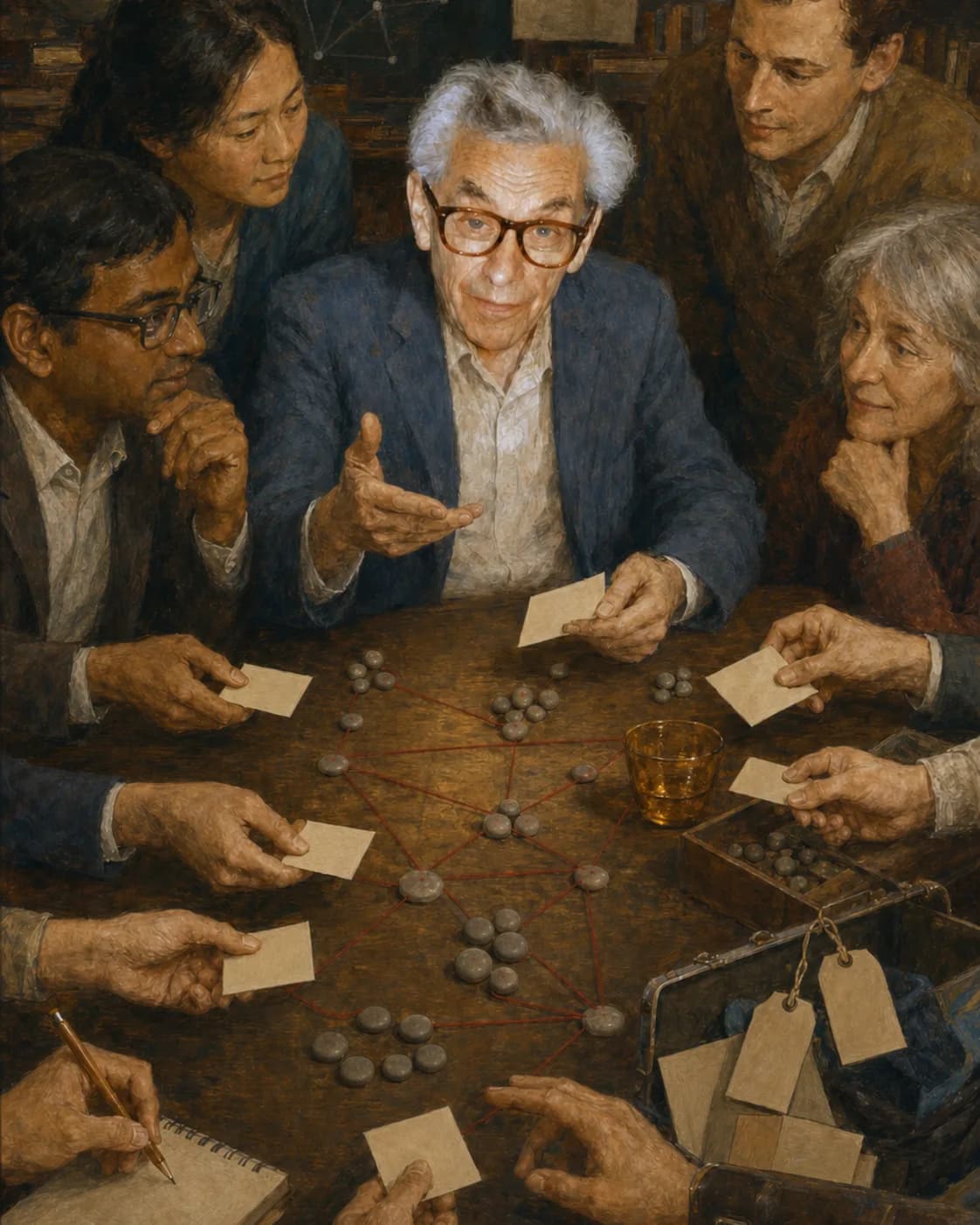
A travelling problem network larger than any one desk
The face uses a public photograph. The common room compresses decades of visits, problem exchange, and collaboration across continents; it is not one documented gathering. It does not make itinerancy, prizes, or stimulant anecdotes the first identity or absorb joint results into Erdős alone.
MathVoyage editorial direction · OpenAI image generation · historical photograph identity reference · generated-numeral correction · 2026-08-07
Remember the mind, not only the dates
The idea to carry forward
A good problem need not belong to one person; it can become an invitation to collaborate.Enter through one scene
After his doctorate he visited researchers across Britain, the United States, and Europe, developing problem-centered collaboration. War and antisemitism also shaped those movements.
Questions this person helps open
These are reverse projections of existing editorial routes, not claims of direct influence or sole invention.
Can we count exploding possibilities without listing every one?
Through Pigeonhole Principle: How can we find hidden order without counting everything?
Through Inclusion-Exclusion Principle: How can we find hidden order without counting everything?
Through Graph Coloring: What survives when shapes change, and which rules divide one world from another?
Through Four Color Theorem: What survives when shapes change, and which rules divide one world from another?
What can we learn after erasing distance and shape, leaving only connections?
PROFILE 02 · DEEP VOYAGE
Instead of memorizing more dates, follow the world that shaped this mind, the scenes that changed its direction, and the questions carried onward.
CHAPTER 01 · PERSON AND PERIOD
Before the finished achievement, read what this person treated as a problem and where the surviving evidence reaches its limit.
A mathematician who traveled among researchers with open problems and turned collaborative problem solving into a way of life. Erdős left a vast body of joint papers and questions across combinatorics, graph theory, number theory, and probabilistic methods. His long travels without a conventional permanent position or home were real, but repeating legends about one suitcase, country counts, or laundry can make the mathematics disappear. An Erdős number is a playful measure of coauthorship distance, not a measure of research quality or personal closeness. The line about mathematicians turning coffee into theorems is usually attributed to Alfréd Rényi, not Erdős. In 1948–1949 Erdős contributed, alongside Selberg, to an elementary proof of the prime number theorem, amid a dispute over priority and joint publication. He died during a Warsaw conference in 1996; the fact should be distinguished from embellishments that he was literally proving a theorem at his last breath.
CHAPTER 02 · TURNING SCENES
Follow the moments when the idea moved one step further. Every scene continues through an evidenced place or an honestly labelled time context.
Scene 1 / 3
After his doctorate he visited researchers across Britain, the United States, and Europe, developing problem-centered collaboration. War and antisemitism also shaped those movements.
Scene 2 / 3
Selberg’s elementary formula and Erdős’s arguments produced a route to the prime number theorem without complex analysis. Conflict over contribution and publication also raises questions about the ethics of joint discovery.
Scene 3 / 3
He died of a heart attack at 83. He remained engaged in conferences and problem discussions, without the need to embellish his exact final moments.
THOUGHT EXPERIMENT · NOT A FACT CLAIM
This is a thought experiment about influence, not a verified historical fact.
Beginners draw a friendship graph and count coauthorship-style distances. Intermediate learners experiment with proving existence by choosing a random object. Advanced learners study threshold phenomena in Erdős–Rényi random graphs. Experts trace how his problems built research networks across probabilistic methods, extremal combinatorics, and additive number theory.
Curated sources and problems. Bring one discovery back from OEIS, Project Euler, MathOverflow, or arXiv.