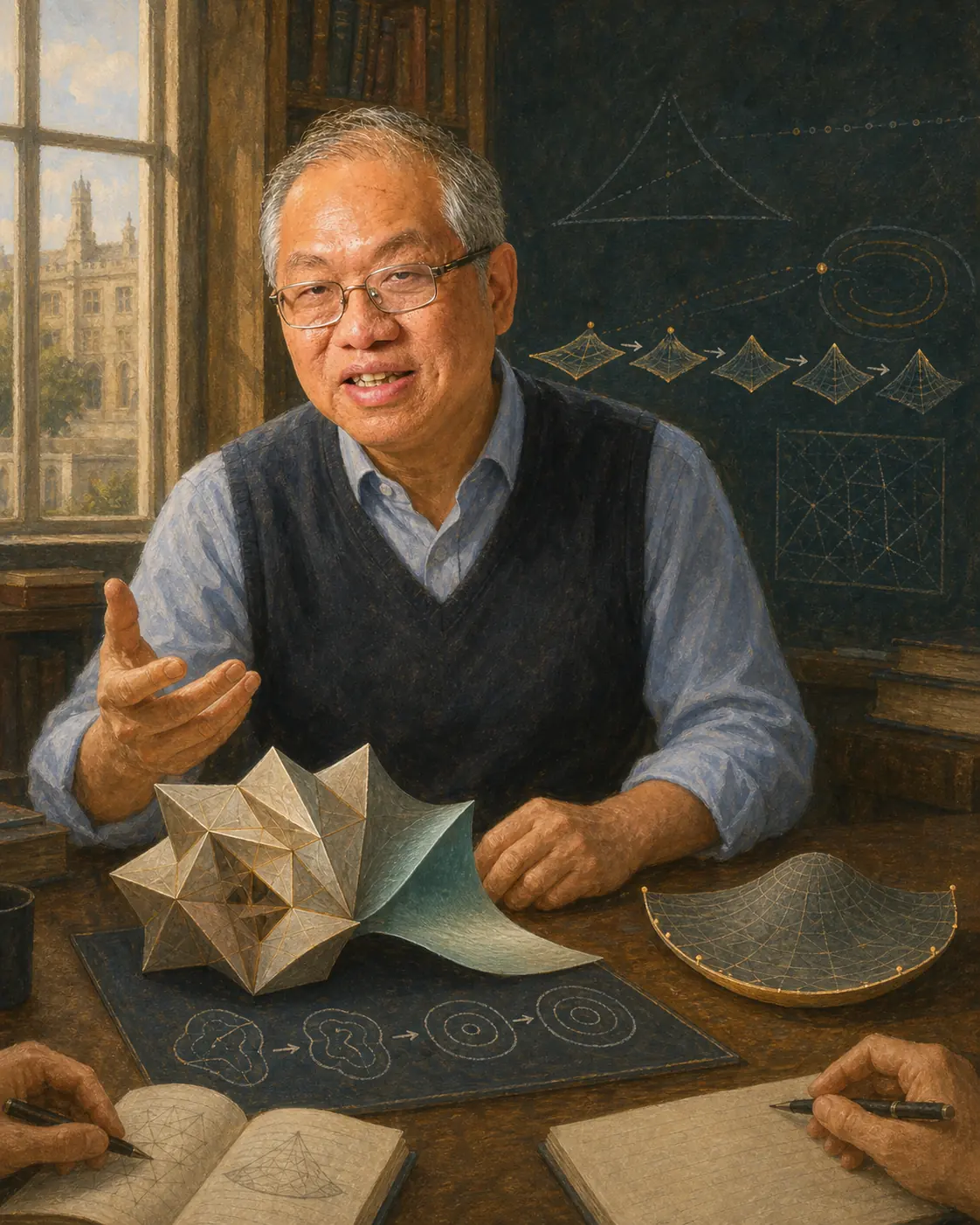
Shing-Tung Yau
Life
A mathematician who helped build geometric analysis by linking complex geometry with nonlinear partial differential equations. Born in Shantou in 1949, Yau moved to Hong Kong as a child and earned his 1971 Berkeley PhD under Shiing-Shen Chern. His proof of the Calabi conjecture established, in a fixed Kähler class on a compact Kähler manifold, a unique Kähler metric with prescribed Ricci form; the vanishing-first-Chern-class case gives a Ricci-flat metric. Such manifolds later became important in some string compactifications. With Richard Schoen he proved the positive mass theorem under specified hypotheses for general-relativistic initial data. His 1982 Fields Medal recognized this work and broader advances in differential geometry and nonlinear PDE.
Decisive moments
Proof of the Calabi conjecture — at age 27
Cambridge, MAHe proved existence and uniqueness of a metric with prescribed Ricci form in a fixed Kähler class on a compact Kähler manifold. A priori estimates for the complex Monge–Ampère equation were central; the Ricci-flat case later entered some string compactifications.
Positive Mass Theorem — with Schoen
Cambridge, MAWith Richard Schoen, Yau proved nonnegativity of total mass for asymptotically flat general-relativistic initial data under specified geometric and energy conditions. This is not a blanket stability theorem for every spacetime.
1982 Fields Medal — geometric analysis
Cambridge, MAAt the Warsaw ICM he was recognized for the Calabi conjecture, the positive mass theorem, real and complex Monge–Ampère equations, and differential geometry. The mathematical citation matters more than ranking identities of origin.
If this person hadn't existed
This is a thought experiment about influence, not a verified historical fact.
Beginners can compare curvature on a flat torus and a curved surface; intermediate learners separate Kähler metrics, Ricci curvature, and Chern classes. Advanced learners study the complex Monge–Ampère equation and a priori estimates, while experts connect existence, uniqueness, moduli, and the additional conditions required in physical compactification.
Beyond MathVoyage
Loading…