Central anchor12/16
Continued Fractions
Through Continued Fractions: How can we find hidden order without counting everything?
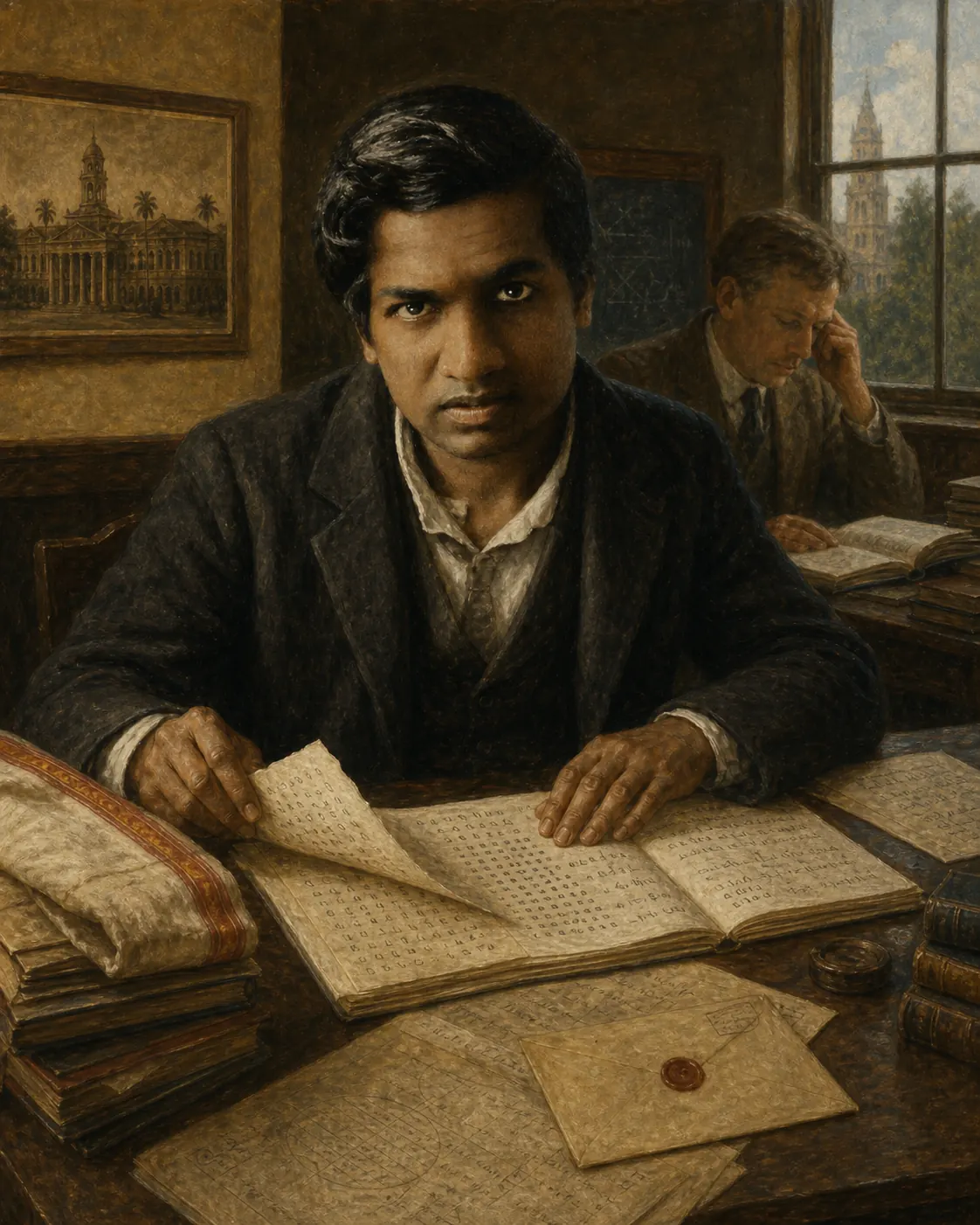
A notebook and a letter connecting two mathematical worlds
The face draws on surviving photographs of Ramanujan, but this scene compresses his Madras Port Trust period, 1913 letter, and Cambridge collaboration into one editorial setting. The notebooks and letter are not facsimiles, nor do they imply that Hardy created or validated every result. The scene does not reduce Ramanujan’s mathematics to mystical revelation or the 1729 anecdote.
MathVoyage editorial direction · OpenAI image generation · historical photograph reference · 2026-08-07
Remember the mind, not only the dates
The idea to carry forward
An equation for me has no meaning, unless it expresses a thought of God.Enter through one scene
In Kumbakonam he encountered a compendium of thousands of results with abbreviated proofs. Rather than merely memorising them, he reconstructed results in his own way and began building his notebooks.
Ramanujan’s notebooks overflow with remarkable formulas, but their appeal is not a simple intuition-versus-proof contrast. It lies in a long cycle of reconstructing patterns from limited resources, calculating, and refining conditions and proofs with collaborators.
What should happen after a powerful pattern appears?
Compare three attitudes and see why discovery and verification form a cycle rather than a contest.
Questions this person helps open
These are reverse projections of existing editorial routes, not claims of direct influence or sole invention.
Through Continued Fractions: How can we find hidden order without counting everything?
PROFILE 02 · DEEP VOYAGE
Instead of memorizing more dates, follow the world that shaped this mind, the scenes that changed its direction, and the questions carried onward.
CHAPTER 01 · PERSON AND PERIOD
Before the finished achievement, read what this person treated as a problem and where the surviving evidence reaches its limit.
A mathematician who rebuilt number theory in his own language under severe educational constraints. Born in Erode and raised in Kumbakonam, Ramanujan used G. S. Carr's Synopsis to reconstruct results for himself and filled notebooks with thousands of formulas. His 1913 letter from Madras led to collaboration with G. H. Hardy at Cambridge and major work on partitions, infinite series, and modular forms. His health deteriorated in Britain; he returned to India in 1919 and died at 32. Contemporary diagnoses and modern reassessments differ, so a single certain cause should not be imposed. His notebooks remain active objects of proof and discovery.
CHAPTER 02 · TURNING SCENES
Follow the moments when the idea moved one step further. Every scene continues through an evidenced place or an honestly labelled time context.
Scene 1 / 4
In Kumbakonam he encountered a compendium of thousands of results with abbreviated proofs. Rather than merely memorising them, he reconstructed results in his own way and began building his notebooks.
Scene 2 / 4
He became a clerk at the Madras Port Trust in 1912 and continued research with help from supporters who recognised his talent. The notebooks and papers of this period prepared his connection to mathematicians abroad.
Scene 3 / 4
In January 1913 he sent G. H. Hardy at Cambridge a letter containing mathematical results. The claims were initially difficult to assess, but Hardy and Littlewood recognised their originality.
Scene 4 / 4
Visiting an ailing Ramanujan, Hardy mentioned a dull taxi number — 1729. Instantly: "No, it's the smallest number expressible as a sum of two cubes in two different ways."
THOUGHT EXPERIMENT · NOT A FACT CLAIM
This is a thought experiment about influence, not a verified historical fact.
Reducing Ramanujan to an 'unproved genius' misses how he refined methods and built proofs with Hardy and Littlewood. The durable legacy is not a dramatic theorem count but a research programme in which intuition and proof keep sharpening one another.
Curated sources and problems. Bring one discovery back from OEIS, Project Euler, MathOverflow, or arXiv.