AB
Analysis · Concept hubDeep story

Bayes' Theorem

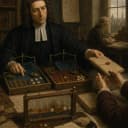
1763 CE18th-century Britain (Bayes)

Through Bayes' Theorem: How can repeated signals emerge from a single uncertain event?

Travel from dice and insurance to data, noise, and learning algorithms—measuring uncertainty and turning it into decisions.

This voyage is an editorial path for understanding, not a claim of direct historical influence or sole invention.

Understand it in one breath

How should the probability of a hypothesis change after new evidence is observed? The theorem developed from Bayes's posthumously published essay and Laplace's later generalization. It reverses conditional probabilities and supports medical testing, spam classification, and scientific inference, but a poor prior or model can still produce a poor conclusion.

At a glance

Step

Calculation

Value

Assumptions

Prevalence 1%; sensitivity 99%; specificity 99%

True positives among patients

P(+|disease) × P(disease) = 0.99 × 0.01

0.0099

False positives among non-patients

P(+|¬disease) × P(¬disease) = 0.01 × 0.99

0.0099

All positive results

0.0099 + 0.0099

0.0198

Probability of disease given a positive result

0.0099 / 0.0198

50% — contrary to intuition!

Under these assumptions, the probability of disease after a positive result is 50%. Even with equal sensitivity and specificity, low prevalence can make false positives as numerous as true positives. Real interpretation requires test-specific performance and patient context.

Concept

Updating beliefs with evidence — from an 18th century reverend to AI today.

Key formula

P(AB)=P(BA)P(A)P(B)P(A \mid B) = \dfrac{P(B \mid A)\, P(A)}{P(B)}

Worked examples

  1. 1

    Q.A disease has 1% prevalence. A test has 99% sensitivity and 99% specificity. After a positive result, what is the probability of actually having the disease?

Ports in time

This concept was not invented in one instant

Follow the scenes to see problems, notation, standards of proof, and applications changing across different times and places.

1
AD 1763Scene 1 / 4Continue through the world of this year

Bayes’s work is published posthumously

After Thomas Bayes’s death, Richard Price presented his essay on inverse probability. It attracted limited attention at the time.

No reliable place is given, so time continues without an invented pin

Continue through the world of this year
2
AD 1812Scene 2 / 4Continue through the world of this year

Laplace — a general theory

Laplace developed Bayesian reasoning into a broad method for inference from effects to causes across astronomy and science.

No reliable place is given, so time continues without an invented pin

Continue through the world of this year
3
AD 1990Scene 3 / 4Continue through the world of this year

A revolution in medical diagnosis

Questions such as the meaning of a positive HIV test made base rates and posterior probability central to clear medical decision-making.

No reliable place is given, so time continues without an invented pin

Continue through the world of this year
4
AD 2010Scene 4 / 4Continue through the world of this year

Bayesian machine learning

Bayesian neural networks and variational inference grew alongside modern machine learning, providing tools for representing uncertainty in predictions.

No reliable place is given, so time continues without an invented pin

Continue through the world of this year

Modern applications

Medical diagnosis, spam filters, A/B tests, Bayesian networks, earthquake forecasting, and the evaluation of legal evidence.

Beyond MathVoyage

Curated sources and problems. Bring one discovery back from OEIS, Project Euler, MathOverflow, or arXiv.

No concept belongs to one person

Follow people who played different roles

These are not inventor credits. They are different ports: opening a problem, sharpening a language, or carrying it into another world.

Number lenses

A concept looks different when its world of numbers changes

These numbers are editorial lenses for the voyage, not required prerequisites.

Concept genealogy

What supports it, and what does it open?

Concepts arriving from before

Current port

Bayes' Theorem

Concepts opened from here

Only direct editorial links are shown; this is not a complete learning order or historical influence line.