Concept
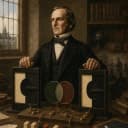
An algebra of true/false relations, later connected by Shannon to switching-circuit design and now central to digital logic.
Understand it in one breath
An algebra of relations between two logical values, true (1) and false (0). Boole's nineteenth-century system was extended by later logicians, and in 1937 Shannon showed how Boolean algebra could analyze and design relay switching circuits. A functionally complete gate such as NAND can express any finite Boolean function, although a physical computer also depends on timing, storage, devices, and architecture.
At a glance
A | B | A AND B | A OR B | A XOR B | NOT A |
|---|---|---|---|---|---|
| 0 | 0 | 0 | 0 | 0 | 1 |
| 0 | 1 | 0 | 1 | 1 | 1 |
| 1 | 0 | 0 | 1 | 1 | 0 |
| 1 | 1 | 1 | 1 | 0 | 0 |
A truth table — just four input cases define every one of these logic gates.
Key formula
Key moments
Boole — The Laws of Thought
Self-taught Irish mathematician George Boole published a system for calculating with logic as though it were algebra. It attracted little attention at the time.
Shannon — Boolean algebra becomes circuitry
In his MIT master’s thesis at age 21, Claude Shannon showed that Boolean algebra could describe electrical switching circuits — one of the most influential master’s theses ever written.
ENIAC — a computer built from Boolean circuits
The pioneering general-purpose digital computer used 17,468 vacuum tubes as switching elements for logical operations.
Intel 4004 — Boolean logic on a chip
The Intel 4004 compressed a complete processing unit of roughly 2,300 transistors onto one chip, opening the microprocessor era.
Modern applications
Every digital circuit (AND/OR/NOT gates), database WHERE clauses, search queries, and if statements in programs.
Beyond MathVoyage
Loading…