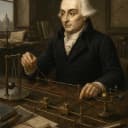
Analysis · Concept hubDeep story

Calculus of Variations

1696 CE17th-century Switzerland and Italy (Johann Bernoulli and Lagrange)

Through Calculus of Variations: How can instantaneous change and long accumulation become one language?

Follow the languages built to calculate a world that will not stand still, from planets and fluids to waves, optimization, and chaos.

This voyage is an editorial path for understanding, not a claim of direct historical influence or sole invention.

Understand it in one breath

Which path makes the first-order change of a quantity vanish under small variations? This stationarity condition can describe a minimum, maximum, or saddle point. It appears in minimal surfaces, geometrical optics, Lagrangian mechanics, and action principles in relativity, with different admissible paths and boundary conditions in each case.

At a glance

Problem

Quantity minimized

Solution

Contributor · year

Brachistochrone

Descent time

Cycloid

Bernoulli, 1696

Shortest path between two points

Distance ∫ds

Straight line (plane) / geodesic (surface)

Euclid

Largest area for a fixed perimeter

−area

Circle

Queen Dido (legend)

Shape of a soap film

Area ∫dA

Minimal surface (mean curvature 0)

Plateau, 1849

Path of light through a varying refractive index

Stationary optical travel time

Fermat’s principle

Fermat, 1662

Planetary orbit

∫(T − V)dt (action)

Newton’s equations of motion

Hamilton, 1834

General relativity

∫R√−g d⁴x (constants omitted)

Einstein field equations

Einstein and Hilbert, 1915

The calculus of variations asks when an entire admissible path, rather than a single number, is stationary under small changes. Additional conditions decide whether a physical solution is actually a minimum.

Concept

Optimization where the unknown is itself a function — the foundation of physical "principle of least action".

Key formula

δS=δ ⁣L(q,q˙,t)dt=0\delta S = \delta\!\int L(q,\dot{q},t)\,dt = 0

Ports in time

This concept was not invented in one instant

Follow the scenes to see problems, notation, standards of proof, and applications changing across different times and places.

1
AD 1696Scene 1 / 4Continue through the world of this year

Johann Bernoulli — the brachistochrone challenge

Which curve carries a sliding body between two points in the least time? Bernoulli challenged Europe’s mathematicians; the answer is a cycloid.

No reliable place is given, so time continues without an invented pin

Continue through the world of this year
2
AD 1697Scene 2 / 4Continue through the world of this year

Newton answers overnight

Newton solved the brachistochrone problem rapidly and submitted his answer anonymously. Bernoulli reportedly recognized him “by the lion’s claw.”

No reliable place is given, so time continues without an invented pin

Continue through the world of this year
3
AD 1736Scene 3 / 4Continue through the world of this year

The Euler–Lagrange equation

Work by Euler and later Lagrange produced a general method for variational problems, opening a path to expressing physical laws through stationary action.

No reliable place is given, so time continues without an invented pin

Continue through the world of this year
4
AD 1788Scene 4 / 4Continue through the world of this year

Lagrange — Mécanique analytique

Lagrange rebuilt mechanics in an analytic form centered on generalized coordinates and variational principles, a language later extended throughout physics.

No reliable place is given, so time continues without an invented pin

Continue through the world of this year

Modern applications

Lagrangian and Hamiltonian physics, geodesics in general relativity, loss minimization in machine learning, Fermat’s principle in optics, and economics.

Beyond MathVoyage

Curated sources and problems. Bring one discovery back from OEIS, Project Euler, MathOverflow, or arXiv.

No concept belongs to one person

Follow people who played different roles

These are not inventor credits. They are different ports: opening a problem, sharpening a language, or carrying it into another world.

Number lenses

A concept looks different when its world of numbers changes

These numbers are editorial lenses for the voyage, not required prerequisites.

Concept genealogy

What supports it, and what does it open?

Concepts arriving from before

Current port

Calculus of Variations

Concepts opened from here

No direct successor port is curated yet.

Only direct editorial links are shown; this is not a complete learning order or historical influence line.