Central anchor1/5
Computability
If a procedure is exact, will it eventually solve every question?
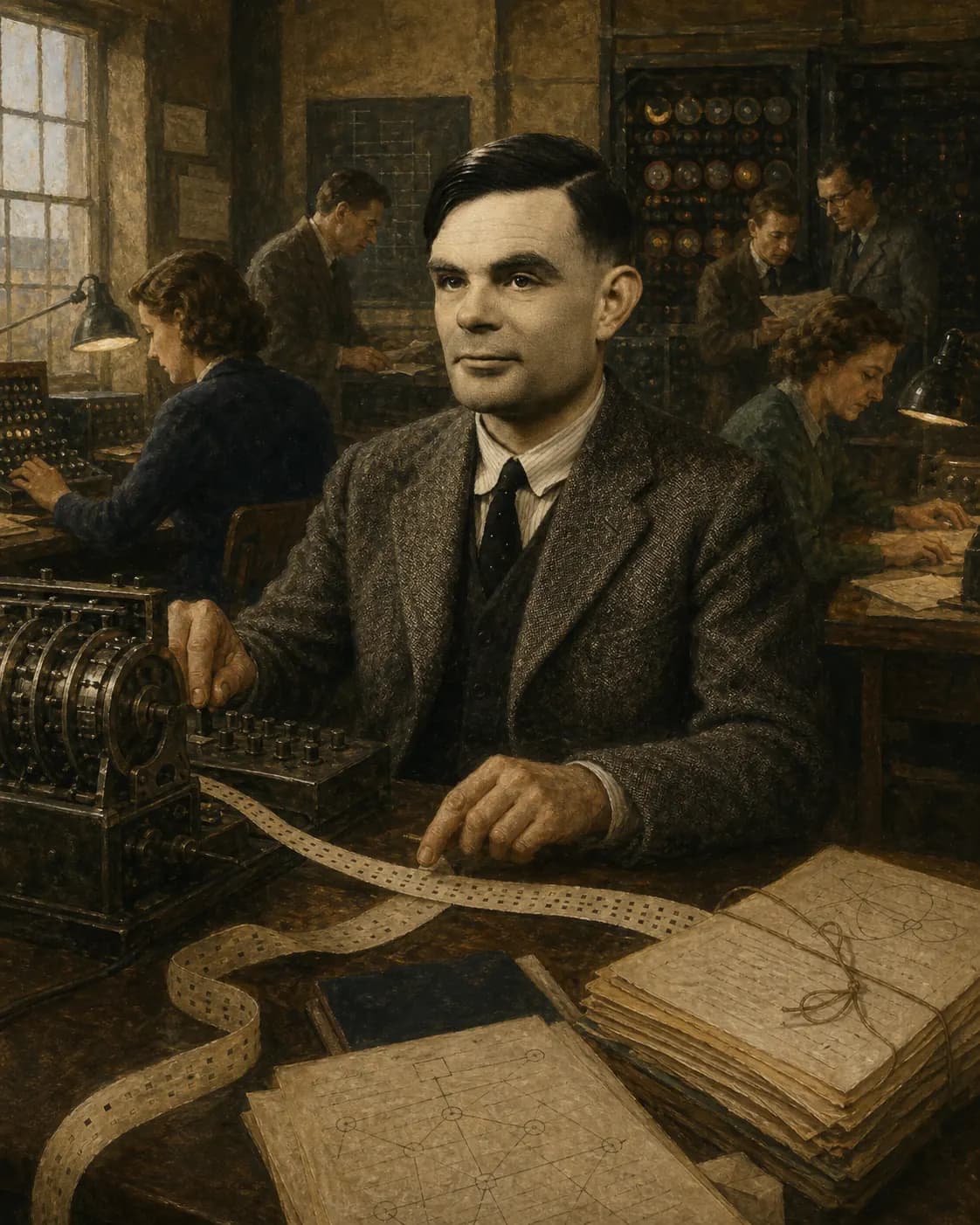
When rules of computation become machines and cryptanalysis becomes team work
The face draws on surviving photographs of Turing, but this is not a record joining his 1936 abstract paper and wartime Bletchley Park work into one instant. It includes Polish antecedents and the work of women operators and fellow cryptanalysts, and avoids numerical claims that one man or machine shortened the war by an exact number of years or imagery about the manner of his death.
MathVoyage editorial direction · OpenAI image generation · historical photograph reference · 2026-08-07
Remember the mind, not only the dates
The idea to carry forward
Can machines think?Enter through one scene
On Computable Numbers modelled a rule-following human manipulating symbols as an abstract machine, clarifying both what can and what cannot be computed.
Turing’s machine was less a blueprint for a future computer than a thought experiment reducing a rule-following human calculator to minimal steps. Its simplicity made limits of computation provable too.
Execute one tiny rule in three stages.
Follow how state, symbol, and movement determine the next action.
Questions this person helps open
These are reverse projections of existing editorial routes, not claims of direct influence or sole invention.
If a procedure is exact, will it eventually solve every question?
Through Numerical Computation: How can instantaneous change and long accumulation become one language?
Through Computer-Assisted Proofs: What can an exact procedure solve, and what can it never decide?
Through Quantum Algorithms: What can an exact procedure solve, and what can it never decide?
Through Universal Approximation Theorem: What can an exact procedure solve, and what can it never decide?
PROFILE 02 · DEEP VOYAGE
Instead of memorizing more dates, follow the world that shaped this mind, the scenes that changed its direction, and the questions carried onward.
CHAPTER 01 · PERSON AND PERIOD
Before the finished achievement, read what this person treated as a problem and where the surviving evidence reaches its limit.
A mathematician who changed what it means to ask whether a problem is mechanically solvable. His 1936 abstract machine clarified computability and its limits. At Bletchley Park he made central contributions to Bombe design and Enigma cryptanalysis within a large collaborative effort; exact claims about years shortened or lives saved are estimates, not settled measurements. He later worked on computers, machine intelligence, and morphogenesis in Manchester. Convicted in 1952 for a homosexual relationship, he was forced to undergo hormonal treatment. He died from cyanide poisoning in 1954. The inquest ruled suicide, while his mother maintained that it was an accident; the apple beside him was never tested.
CHAPTER 02 · TURNING SCENES
Follow the moments when the idea moved one step further. Every scene continues through an evidenced place or an honestly labelled time context.
Scene 1 / 4
On Computable Numbers modelled a rule-following human manipulating symbols as an abstract machine, clarifying both what can and what cannot be computed.
Scene 2 / 4
Building on Polish work and collaborating with British cryptanalysts, Turing made central contributions to Bombe logic and procedures for Naval Enigma. Exact numerical claims about the effect on the war remain estimates.
Scene 3 / 4
In Computing Machinery and Intelligence, instead of defining thought directly, he proposed the imitation game: can an interrogator distinguish a machine from a person through conversation?
Scene 4 / 4
He died from cyanide poisoning at his home in Wilmslow. The inquest ruled suicide, while his family raised the possibility of an accident. The apple was not tested for cyanide.
CHAPTER 03 · IDEAS IN MOTION
A city is not scenery but a condition where people, texts, institutions, and tools could meet. Each pin marks an evidenced activity window, not an entire life.
University of Cambridge
CHAPTER 04 · TOOLS LEFT BEHIND
The useful question is not a star rating, but what remained available for solving another problem.
A mathematical model of computation and a theoretical foundation of computer science.
THOUGHT EXPERIMENT · NOT A FACT CLAIM
This is a thought experiment about influence, not a verified historical fact.
Turing did not single-handedly invent the computer or codebreaking. His distinctive legacy is a set of tools across different fields: an abstract machine exposing limits of computation, practical cryptanalytic methods, the imitation game as a reframing of machine intelligence, and reaction–diffusion models of biological pattern.
STANDING ON SHOULDERS · EVIDENCED CONNECTIONS
We do not draw a line merely because two people shared an era. Only connections traced through works, problems, or teaching appear with an explanation and evidence.
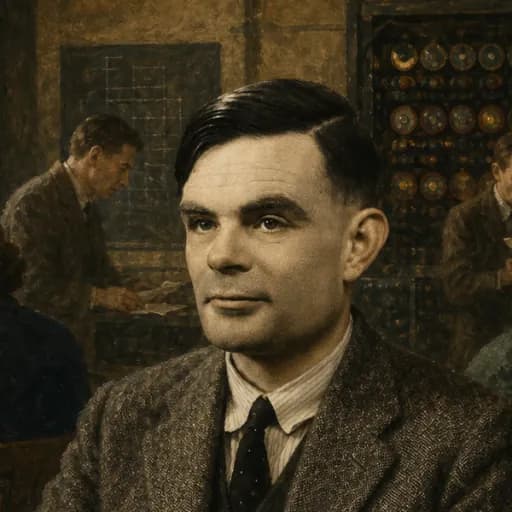
Alan Turing
Modern Era
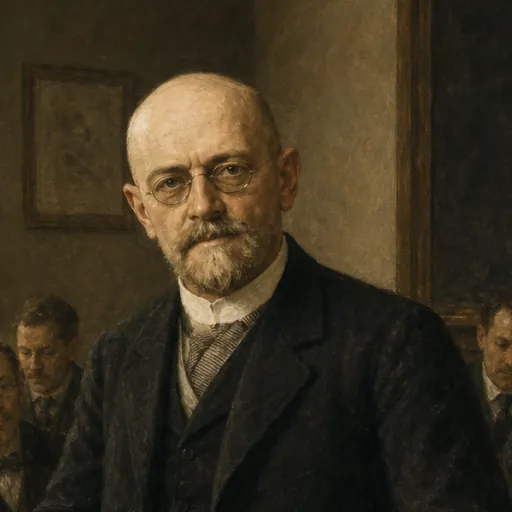
From the decision problem to a universal machine
While addressing Hilbert’s decision problem, Turing modeled a human following calculation rules as a machine. The proof of undecidability produced the concept of a universal computer.
Evidence for this connection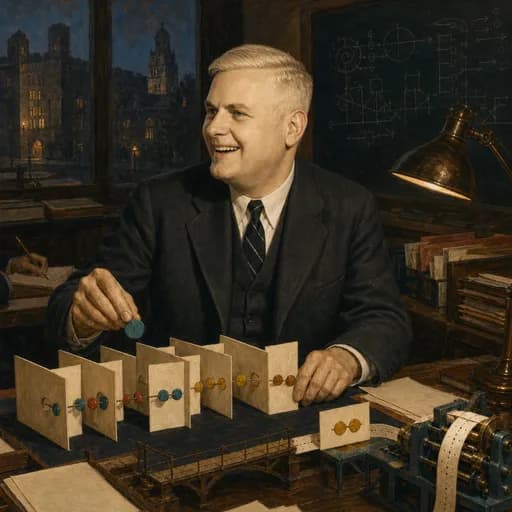
Independent theories of computation meet in doctoral study
Turing machines and Church’s lambda calculus independently captured the same boundary of computability. Turing then went to Princeton in 1936 and completed his PhD under Church.
Evidence for this connection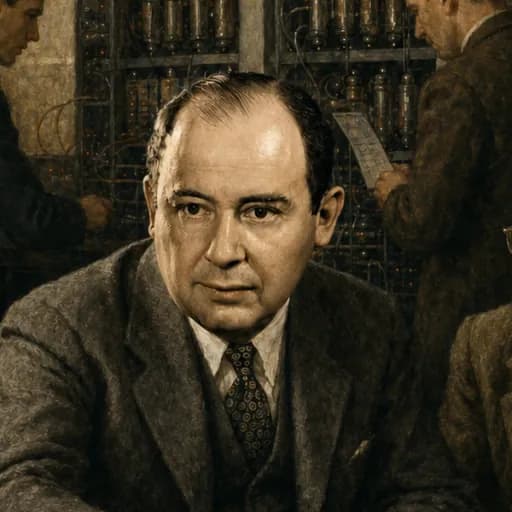
Models of computation meet stored-program design
Turing’s 1936 paper proposed a theoretical model for analysing universal computation. Mathematicians and engineers, including von Neumann, later developed stored-program designs through work such as the EDVAC discussions. The connection joins theory, circuitry, and memory rather than reducing the computer to one inventor and one document.
Evidence for this connectionCurated sources and problems. Bring one discovery back from OEIS, Project Euler, MathOverflow, or arXiv.