Another viewpoint1/5
Computability
If a procedure is exact, will it eventually solve every question?
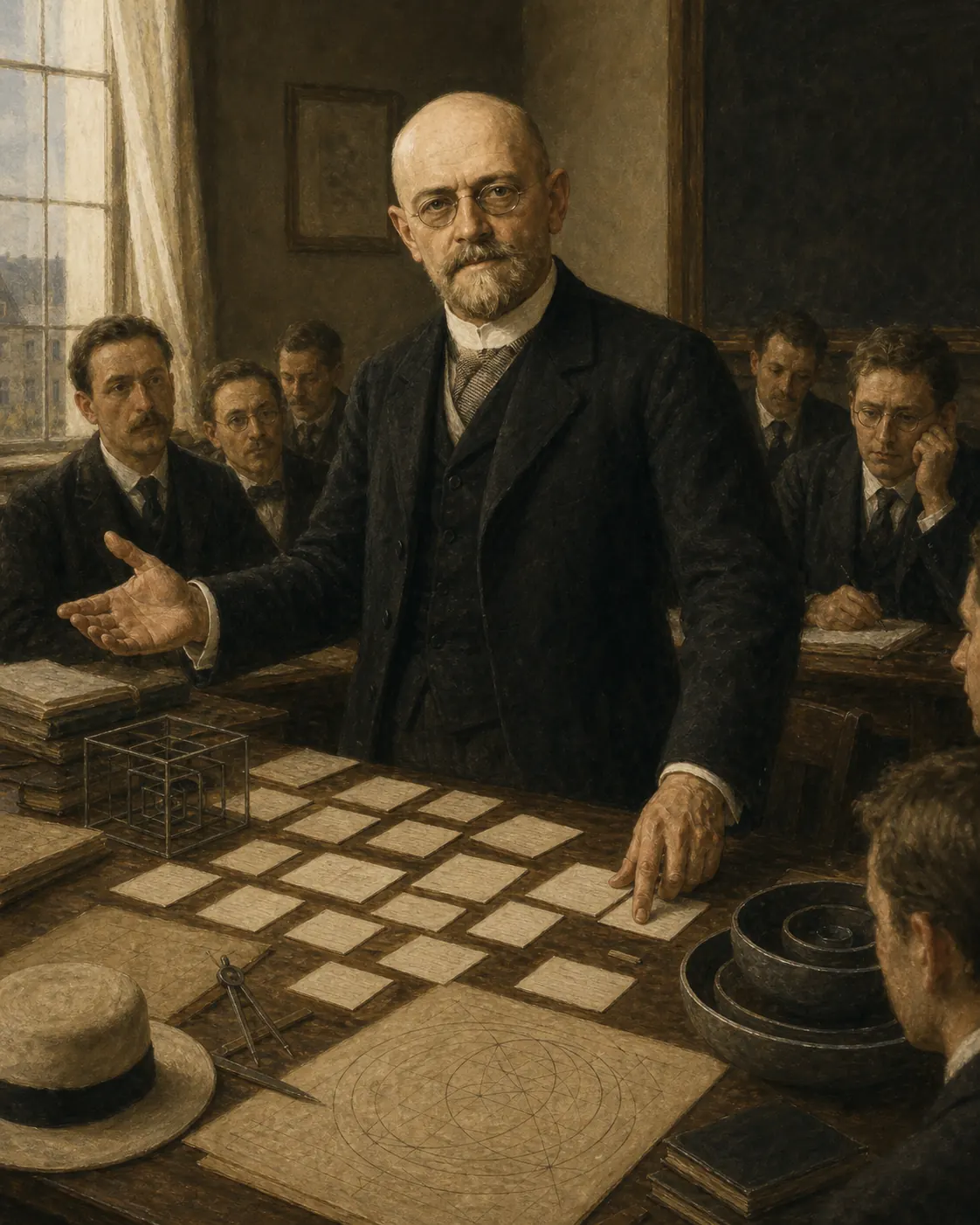
Before answers, laying out a map of questions for a century
The face draws on surviving photographs of Hilbert, but this Göttingen seminar is not a record of his 1900 Paris address. The oral talk covered ten problems and the published version presented all twenty-three; the cards and models also condense later Göttingen community and axiomatic work. The scene avoids a physical showdown with Gödel or a finished program made by one man alone.
MathVoyage editorial direction · OpenAI image generation · historical photograph reference · 2026-08-07
Remember the mind, not only the dates
The idea to carry forward
We must know — we will know.Enter through one scene
At the ICM lecture he discussed ten of the twenty-three problems orally; the published paper contained the full list. The program helped chart a century of research.
Questions this person helps open
These are reverse projections of existing editorial routes, not claims of direct influence or sole invention.
If a procedure is exact, will it eventually solve every question?
Can one endless thing be larger than another?
PROFILE 02 · DEEP VOYAGE
Instead of memorizing more dates, follow the world that shaped this mind, the scenes that changed its direction, and the questions carried onward.
CHAPTER 01 · PERSON AND PERIOD
Before the finished achievement, read what this person treated as a problem and where the surviving evidence reaches its limit.
A towering figure of twentieth-century mathematics. At the 1900 Paris ICM he discussed ten problems orally; the published paper contained the full list of twenty-three that helped chart a century of research. On 8 September 1930 in Königsberg he ended an address with "We must know — we will know" and soon recorded a shortened radio version. Gödel had informally announced his first incompleteness result in the same city the previous day.
CHAPTER 02 · TURNING SCENES
Follow the moments when the idea moved one step further. Every scene continues through an evidenced place or an honestly labelled time context.
Scene 1 / 3
At the ICM lecture he discussed ten of the twenty-three problems orally; the published paper contained the full list. The program helped chart a century of research.
Scene 2 / 3
His famous declaration defending Cantor's set theory against fierce attacks, delivered at Münster in June 1925 (Über das Unendliche, published 1926).
Scene 3 / 3
On 8 September 1930 he closed an address with "We must know — we will know" and soon recorded a shortened radio version. Gödel had informally announced his first incompleteness result in the same city the previous day.
CHAPTER 03 · IDEAS IN MOTION
A city is not scenery but a condition where people, texts, institutions, and tools could meet. Each pin marks an evidenced activity window, not an entire life.
Leader of the Göttingen school
THOUGHT EXPERIMENT · NOT A FACT CLAIM
This is a thought experiment about influence, not a verified historical fact.
The 1900 Paris lecture and the published list of twenty-three problems became a map for the next century. Hilbert's 1920s program systematized proof theory, and even after Gödel exposed limits to its aims, it remained a starting point for foundational research.
STANDING ON SHOULDERS · EVIDENCED CONNECTIONS
We do not draw a line merely because two people shared an era. Only connections traced through works, problems, or teaching appear with an explanation and evidence.
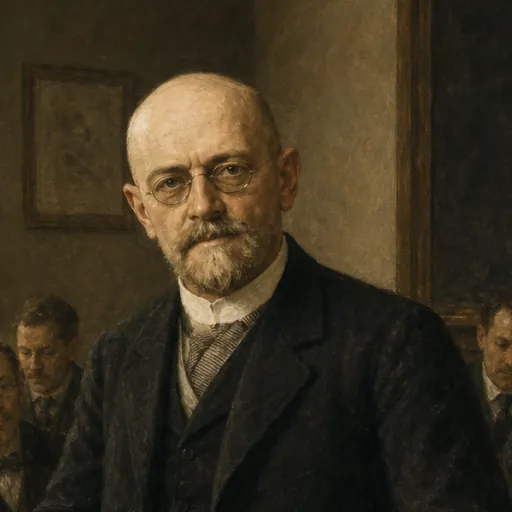
David Hilbert
Nineteenth-Century Mathematics
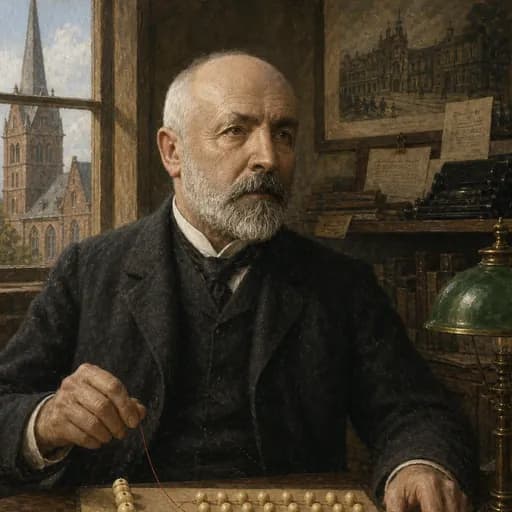
Making infinite sets a central mathematical problem
Hilbert strongly defended Cantor’s set theory and made the continuum hypothesis his first 1900 problem, placing sizes of infinity at the center of twentieth-century foundations.
Evidence for this connection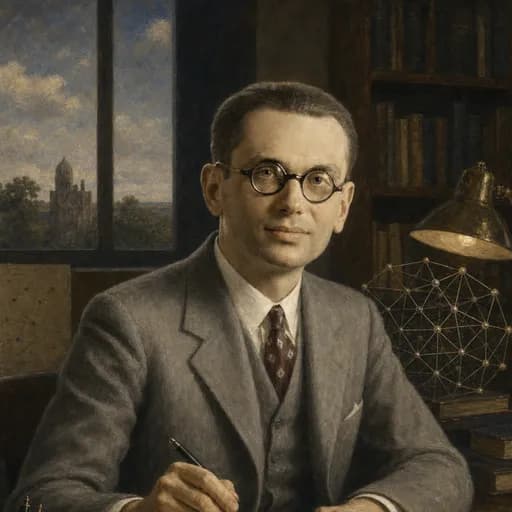
A dream of complete formalization reveals its limit
Hilbert’s program sought to formalize classical mathematics and justify its consistency by finitary methods. Gödel showed that sufficiently strong systems meeting the theorem’s conditions contain sentences unprovable within themselves, exposing limits to those aims.
Evidence for this connection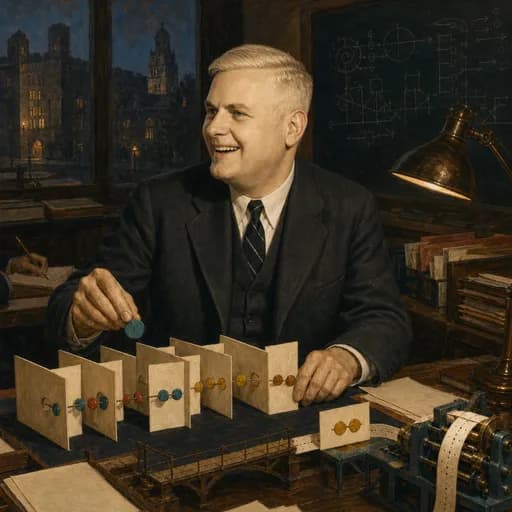
From the decision problem to lambda calculus
To answer Hilbert’s Entscheidungsproblem—whether a mechanical procedure could decide every statement—Church formalized effective calculation through lambda calculus.
Evidence for this connection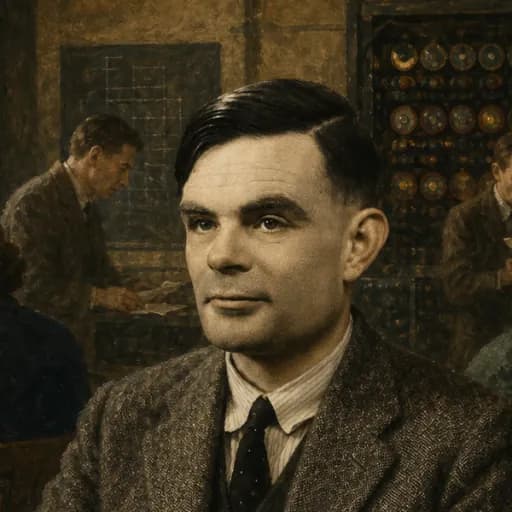
From the decision problem to a universal machine
While addressing Hilbert’s decision problem, Turing modeled a human following calculation rules as a machine. The proof of undecidability produced the concept of a universal computer.
Evidence for this connection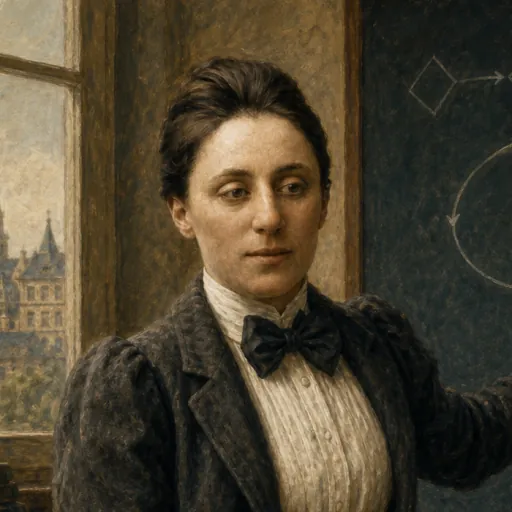
An invitation to Göttingen—and a fight to open its lecture rooms
Hilbert invited Noether to Göttingen to work on invariants in relativity and opposed rules barring women, even advertising her lectures under his own name.
Evidence for this connectionCurated sources and problems. Bring one discovery back from OEIS, Project Euler, MathOverflow, or arXiv.