Central anchor10/13
Algebraic Geometry
Through Algebraic Geometry: What survives when shapes change, and which rules divide one world from another?
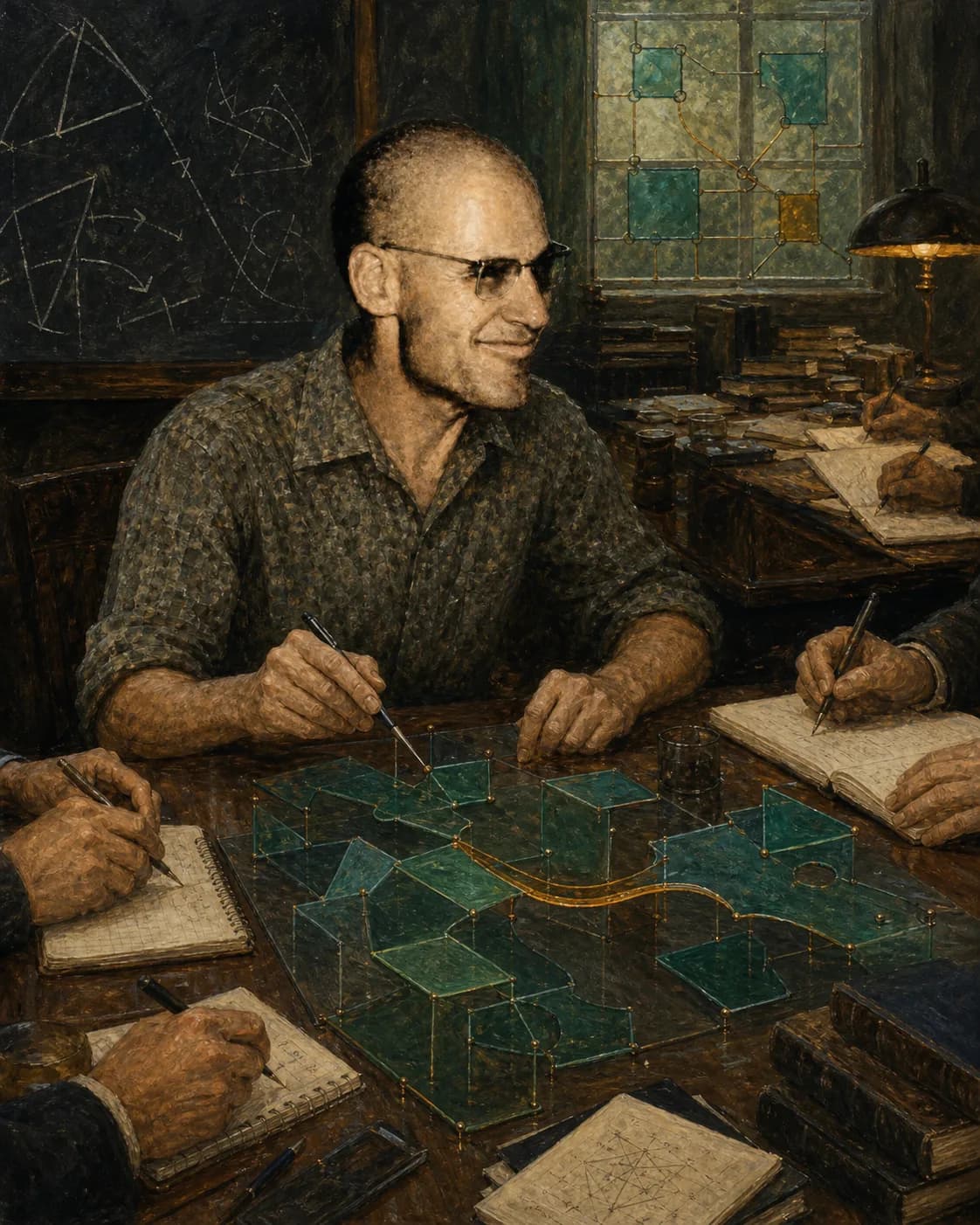
Enlarging the language that holds a problem before pushing its calculation
The face uses a surviving photograph. The IHÉS-style scene editorially compresses schemes, sheaves, cohomology, and years of seminar and collaborative redaction. It does not erase Dieudonné, students, and participants or turn wartime experience, political withdrawal, or later seclusion into the cause or whole identity of the mathematics.
MathVoyage editorial direction · OpenAI image generation · historical photograph identity reference · 2026-08-07
Remember the mind, not only the dates
The idea to carry forward
Often the route to solving problems is to bring new concepts out of the dark.Enter through one scene
With Dieudonné, students, and colleagues, he built seminars that developed and documented schemes and cohomological methods.
Questions this person helps open
These are reverse projections of existing editorial routes, not claims of direct influence or sole invention.
Through Algebraic Geometry: What survives when shapes change, and which rules divide one world from another?
Through Category Theory: How can we recognize the same structure inside different problems?
PROFILE 02 · DEEP VOYAGE
Instead of memorizing more dates, follow the world that shaped this mind, the scenes that changed its direction, and the questions carried onward.
CHAPTER 01 · PERSON AND PERIOD
Before the finished achievement, read what this person treated as a problem and where the surviving evidence reaches its limit.
A mathematician who often changed the language surrounding a problem. After wartime internment and study in Montpellier, Paris, and Nancy, he worked with a broad network at IHÉS. Schemes, étale cohomology, and topoi reorganized questions across algebraic geometry and number theory; seminars, students, and collaborative redaction were essential to that programme.
CHAPTER 02 · TURNING SCENES
Follow the moments when the idea moved one step further. Every scene continues through an evidenced place or an honestly labelled time context.
Scene 1 / 3
With Dieudonné, students, and colleagues, he built seminars that developed and documented schemes and cohomological methods.
Scene 2 / 3
He received the Fields Medal for work across algebra and topology but declined to attend the Moscow ICM as a pacifist protest against militarization.
Scene 3 / 3
He resigned after conflict over renewed military-linked funding, then shifted toward environmental and anti-war activism and different forms of mathematical work.
CHAPTER 03 · IDEAS IN MOTION
A city is not scenery but a condition where people, texts, institutions, and tools could meet. Each pin marks an evidenced activity window, not an entire life.
Research at IHÉS
THOUGHT EXPERIMENT · NOT A FACT CLAIM
This is a thought experiment about influence, not a verified historical fact.
Beginners can ask why polynomial solution sets need schemes; intermediate learners shift from points to morphisms and base change. Advanced learners connect sheaves, cohomology, and the étale topology, while experts can examine how the collaborative SGA seminars produced knowledge.
STANDING ON SHOULDERS · EVIDENCED CONNECTIONS
We do not draw a line merely because two people shared an era. Only connections traced through works, problems, or teaching appear with an explanation and evidence.
Alexander Grothendieck
Modern Era
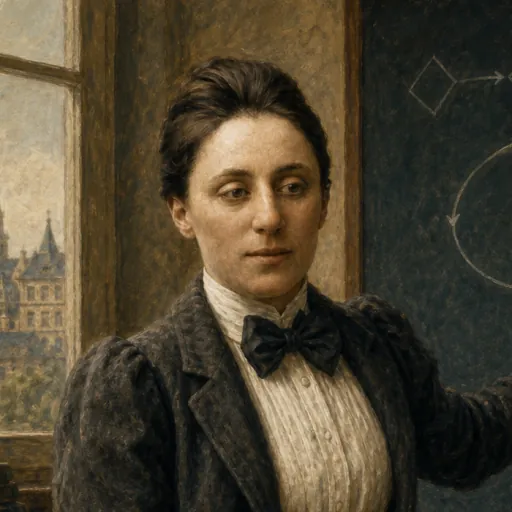
Study structures and maps, not isolated objects
Noether’s shift from element-wise calculation to structures and mappings passed through the Bourbaki tradition into Grothendieck’s category-, sheaf-, and scheme-centered geometry.
Evidence for this connection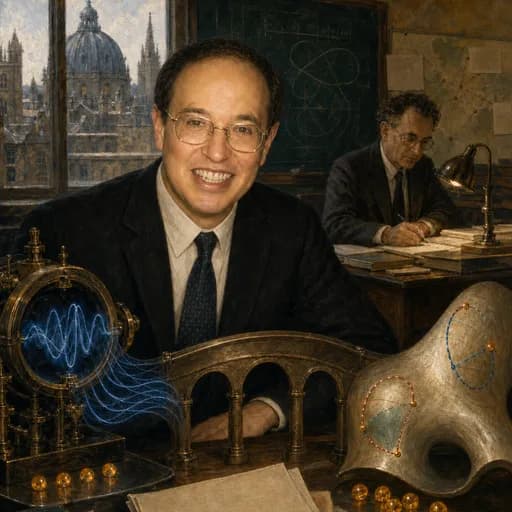
From algebraic K-theory to topological K-theory
Grothendieck’s K-groups and Riemann–Roch formulation provided the starting point for Atiyah and Hirzebruch’s topological K-theory.
Evidence for this connectionCurated sources and problems. Bring one discovery back from OEIS, Project Euler, MathOverflow, or arXiv.