Central anchor14/16
Elliptic Curves
Through Elliptic Curves: How can we find hidden order without counting everything?
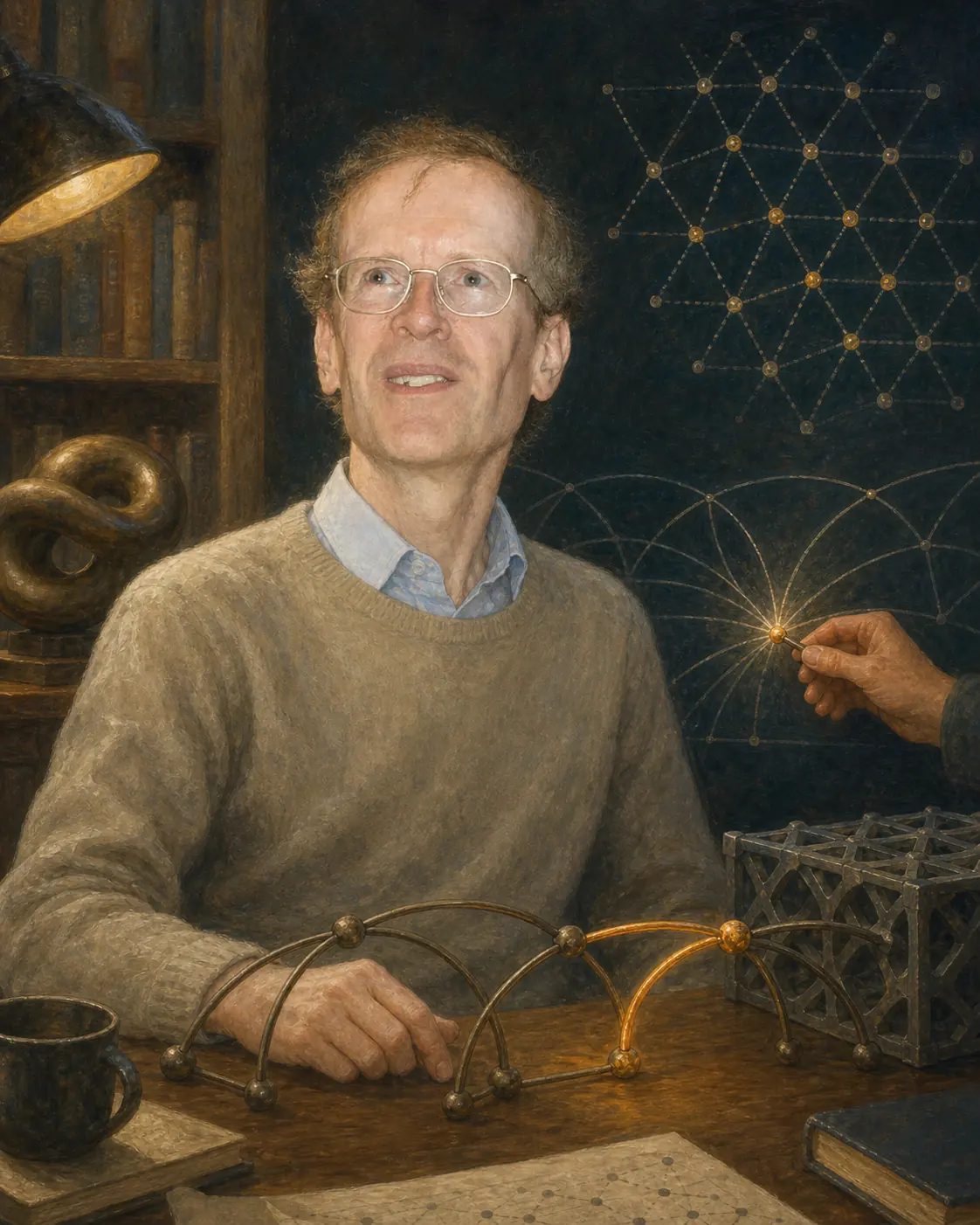
A 358-year-old sentence yielded to a new bridge between mature theories
A public photograph of the living Wiles was used only for his glasses, facial proportions, and hair silhouette. This is not a record of the 1993 Cambridge lecture, an attic, or the repair moment. The hand at right is an editorial cue preserving Taylor and the community's tools rather than a lone miracle.
MathVoyage editorial direction · OpenAI image generation · living-person photograph reference · local candidate gate · 2026-08-07
A mathematical scene preserving a public likeness
The idea to carry forward
Perhaps I can best describe my experience as entering a dark mansion.Enter through one scene
A local-library history book introduced a problem a child could understand but generations had failed to prove, and he began trying it himself.
Questions this person helps open
These are reverse projections of existing editorial routes, not claims of direct influence or sole invention.
Through Elliptic Curves: How can we find hidden order without counting everything?
Through Fermat's Last Theorem: How can we find hidden order without counting everything?
PROFILE 02 · DEEP VOYAGE
Instead of memorizing more dates, follow the world that shaped this mind, the scenes that changed its direction, and the questions carried onward.
CHAPTER 01 · PERSON AND PERIOD
Before the finished achievement, read what this person treated as a problem and where the surviving evidence reaches its limit.
The mathematician who proved Fermat's Last Theorem in 1995, ending a 358-year siege through modular forms and elliptic curves.
CHAPTER 02 · TURNING SCENES
Follow the moments when the idea moved one step further. Every scene continues through an evidenced place or an honestly labelled time context.
Scene 1 / 4
A local-library history book introduced a problem a child could understand but generations had failed to prove, and he began trying it himself.
Scene 2 / 4
Ribet proved that Taniyama–Shimura ⟹ Fermat. Wiles began secret work on Taniyama–Shimura for the next seven years.
Scene 3 / 4
At the final Isaac Newton Institute lecture he announced a modularity result implying Fermat's Last Theorem. A gap emerged during scrutiny of the manuscript.
Scene 4 / 4
A new connection between two approaches repaired the argument with Richard Taylor. Wiles's main paper and the Taylor–Wiles companion appeared together in the 1995 Annals of Mathematics.
THOUGHT EXPERIMENT · NOT A FACT CLAIM
This is a thought experiment about influence, not a verified historical fact.
The proof did more than close one problem. Its methods linking elliptic curves, modular forms, and Galois representations accelerated the full modularity theorem and later work around the Langlands program.
STANDING ON SHOULDERS · EVIDENCED CONNECTIONS
We do not draw a line merely because two people shared an era. Only connections traced through works, problems, or teaching appear with an explanation and evidence.
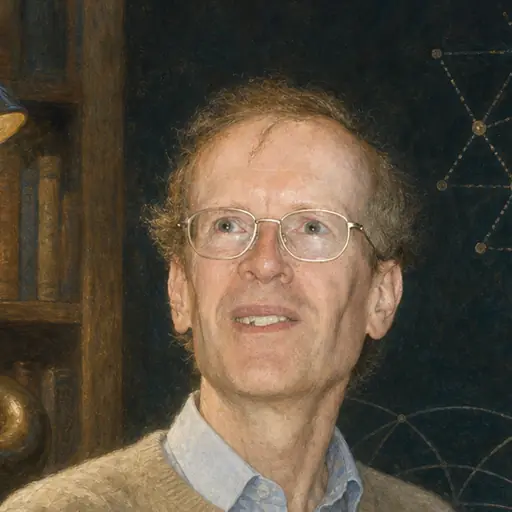
Andrew Wiles
Modern Era
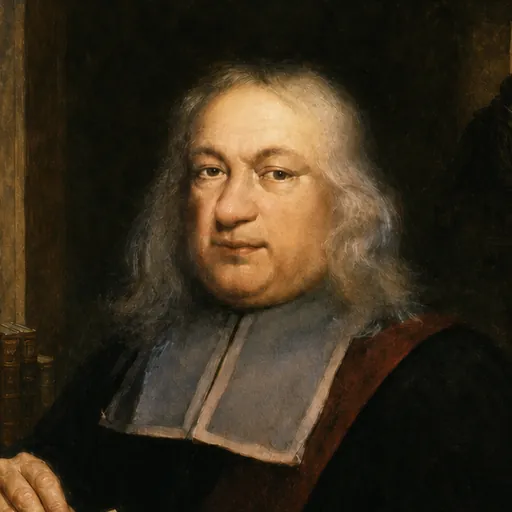
A marginal sentence becomes seven years of secret work
Wiles encountered Fermat’s Last Theorem as a child and made it a lifelong goal, eventually closing the 358-year problem by connecting elliptic curves and modular forms.
Evidence for this connectionCurated sources and problems. Bring one discovery back from OEIS, Project Euler, MathOverflow, or arXiv.