Apollonius of Perga
Life
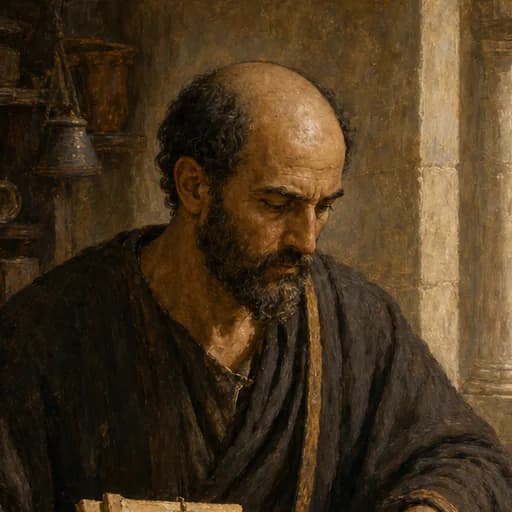
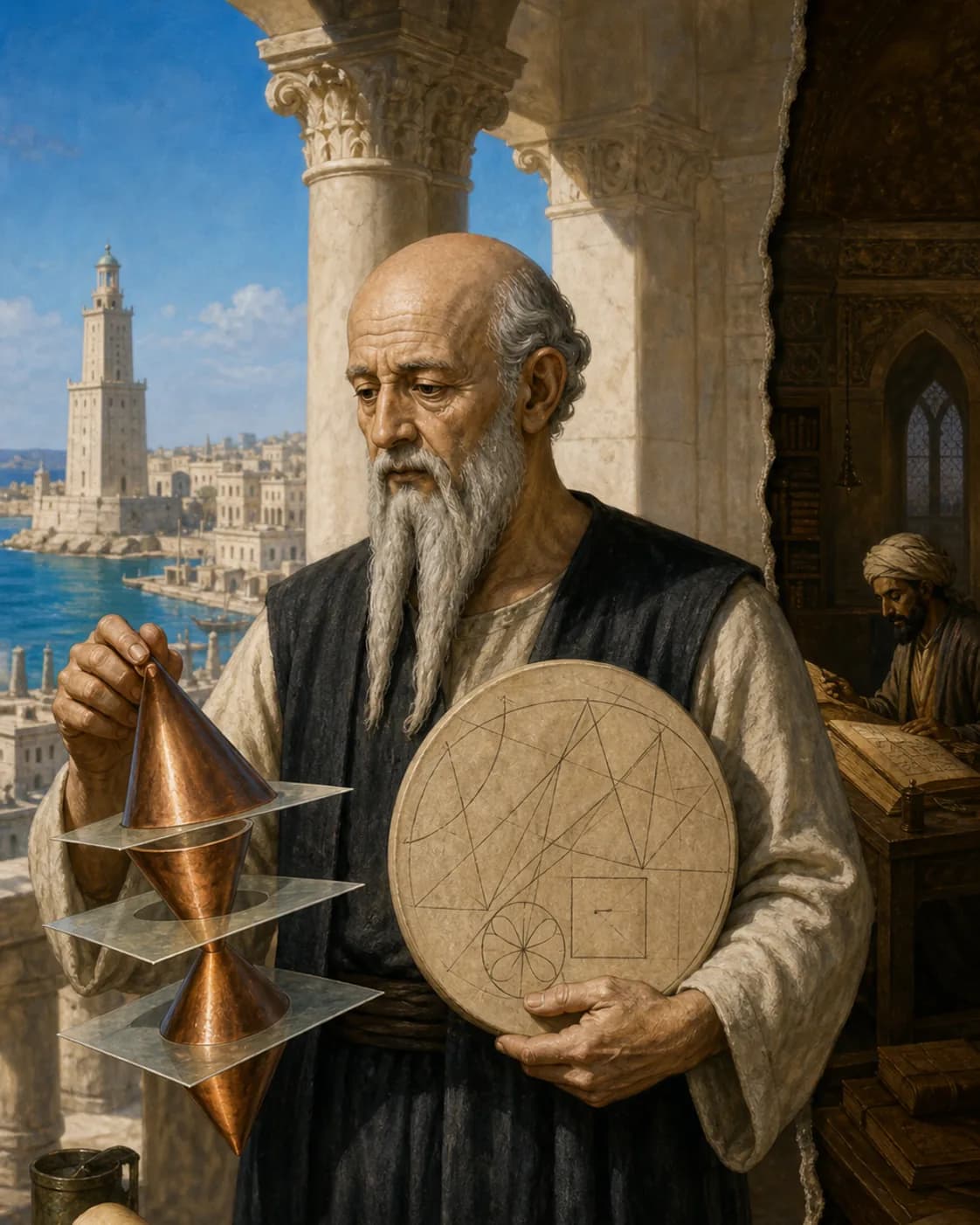
A Hellenistic mathematician who unified curves that had looked like products of different cones. Born in Perga, Apollonius studied and worked in Alexandria and wrote the eight-book Conics. Building on work including that of Menaechmus, he systematically treated ellipse, parabola, and hyperbola as sections of one double cone obtained by changing the cutting plane. The terms ellipse, parabola, and hyperbola became established through his work. Books I–IV survive in Greek, while V–VII survive through an Arabic translation tradition; Book VIII is lost. That translation history involves work associated with Hilal ibn Abi Hilal and Thabit ibn Qurra, so it is not a one-person rescue story. Kepler and Newton later used conic sections in astronomy, but their discoveries were not inevitable consequences of this one book.
Decisive moments
Conics I-IV — the unified geometry of conic sections
AlexandriaUsing one double cone and changing the cutting plane, he treated ellipse, parabola, and hyperbola together and developed properties of diameters, tangents, and asymptotes. Books I–IV survive through the Greek tradition.
Studying equivalence between eccentric and epicyclic models
AlexandriaLater sources connect Apollonius with geometric equivalence between eccentric and epicyclic models. These tools were developed in Ptolemaic astronomy, but one person did not establish the whole long-lived tradition.
Books V–VII — transmitted through Arabic translations
BaghdadBooks V–VII, whose Greek text is lost, were preserved in a ninth-century Arabic translation and revision tradition associated with Hilal and Thabit. They later passed into Latin editions and modern critical texts; Book VIII does not survive.
If this person hadn't existed
This is a thought experiment about influence, not a verified historical fact.
Beginners shine a conical beam obliquely onto a wall and look for circle-, ellipse-, or parabola-like traces. Intermediate learners compare the focus–directrix definitions. Advanced learners unify the curves through quadratic equations and projective geometry. Experts study Greek, Arabic, and Latin transmission together with the later recontextualization of conics by Kepler and Newton.
Influence network
Beyond MathVoyage
Loading…