Another viewpoint3/18
Calculus
How can instantaneous speed and distance over time become the same calculation?
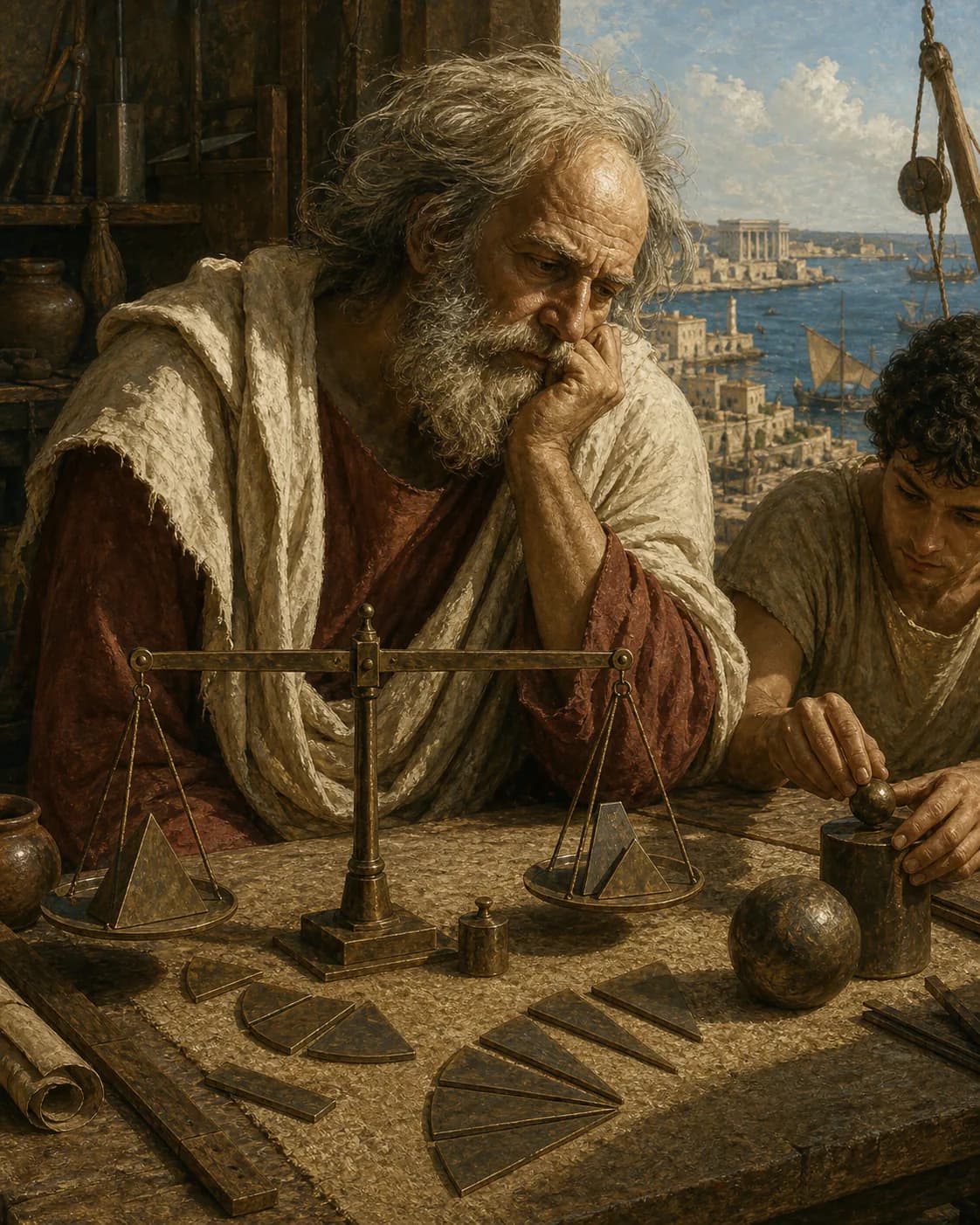
Turning an idea from the balance into a geometric proof
No verified lifetime portrait of Archimedes or record of this workshop survives. The unruly hair, heavy beard, and cheek-on-hand pose use the later 'Archimedes in thought' painting tradition only as an identifying convention. The balance evokes the Method and the repeated figures evoke exhaustion, without equating either with modern calculus or reenacting the bath, burning-mirror, or death legends as documented scenes.
MathVoyage editorial direction · OpenAI image generation · later Archimedes painting iconography reference · no verified lifetime likeness · 2026-08-07
Remember the mind, not only the dates
The idea to carry forward
“Do not disturb my circles” is a later tradition about his last words.Enter through one scene
On Floating Bodies preserves mathematical results about equilibrium in fluids. The crown, bath, and naked run are a famous story recorded later by Vitruvius.
Weight alone does not settle a lever. Multiply it by distance from the fulcrum and unequal forces can produce equal effects—or reveal exactly when balance breaks.
Compare the two effects of weight × distance.
Choose a setup and predict which way the lever will tilt.
6 : 6 · Balanced
Both effects equal 6. Different weights balance because distance compensates.
Archimedean mechanics is compelling because it turns position and effect—not objects alone—into a mathematical relation.
Questions this person helps open
These are reverse projections of existing editorial routes, not claims of direct influence or sole invention.
How can instantaneous speed and distance over time become the same calculation?
PROFILE 02 · DEEP VOYAGE
Instead of memorizing more dates, follow the world that shaped this mind, the scenes that changed its direction, and the questions carried onward.
CHAPTER 01 · PERSON AND PERIOD
Before the finished achievement, read what this person treated as a problem and where the surviving evidence reaches its limit.
The surviving works are more remarkable than the legends. Archimedes used exhaustion and mechanical reasoning to study spheres, cylinders, parabolic areas, and bounds for π; his results anticipate parts of later integration without being modern calculus. His work on floating bodies survives, while the bath, burning-mirror, and last-words stories come from much later accounts. The rediscovered Archimedes Palimpsest revealed more of how he reasoned.
CHAPTER 02 · TURNING SCENES
Follow the moments when the idea moved one step further. Every scene continues through an evidenced place or an honestly labelled time context.
Scene 1 / 3
On Floating Bodies preserves mathematical results about equilibrium in fluids. The crown, bath, and naked run are a famous story recorded later by Vitruvius.
Scene 2 / 3
He repeatedly inscribed and circumscribed figures to trap areas and volumes within bounds. The idea anticipates later integration, but it did not use modern definitions of infinitesimals or limits.
Scene 3 / 3
Later sources agree that a Roman soldier killed him during the capture of Syracuse, but differ over what he was doing and what, if anything, he said.
CHAPTER 03 · IDEAS IN MOTION
A city is not scenery but a condition where people, texts, institutions, and tools could meet. Each pin marks an evidenced activity window, not an entire life.
Mathematical research and inventions
CHAPTER 04 · TOOLS LEFT BEHIND
The useful question is not a star rating, but what remained available for solving another problem.
Calculated the area of a circle using the method of exhaustion, a forerunner of integration.
THOUGHT EXPERIMENT · NOT A FACT CLAIM
This is a thought experiment about influence, not a verified historical fact.
Archimedes was not a necessary single cause of calculus. His rigorous examples nevertheless show how far ancient mathematics reached in problems of curved area and volume. Without the surviving texts, it would be much harder to see the depth of pre-Newtonian reasoning about such problems.
STANDING ON SHOULDERS · EVIDENCED CONNECTIONS
We do not draw a line merely because two people shared an era. Only connections traced through works, problems, or teaching appear with an explanation and evidence.
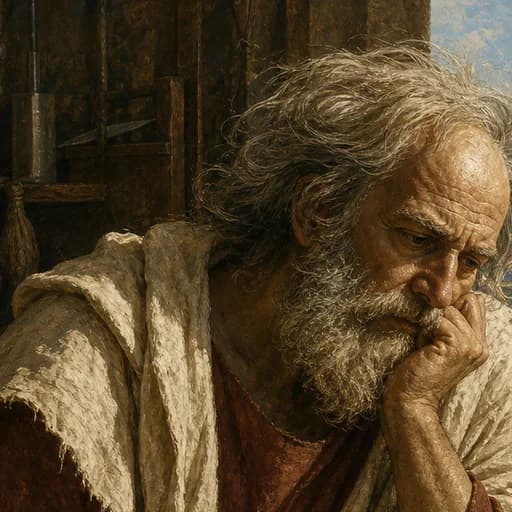
Archimedes
Greek Period
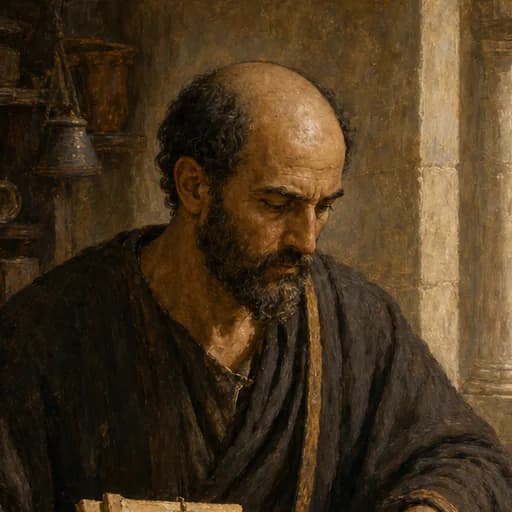
From axiomatic geometry to exhaustion
Archimedes worked within Euclid’s deductive framework and combined exhaustion with mechanical arguments to calculate areas and volumes, a decisive geometric ancestor of integration.
Evidence for this connection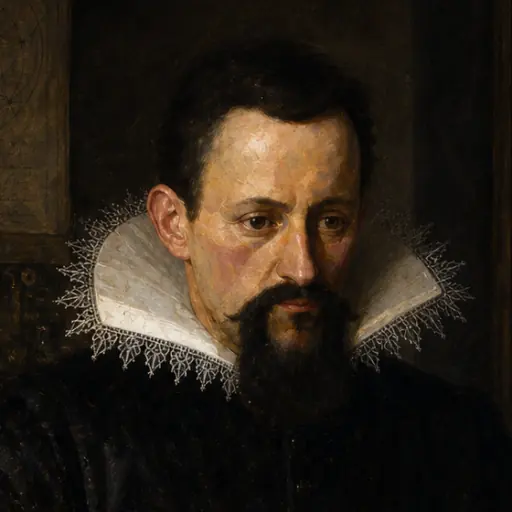
Ancient volume methods enter astronomy
Kepler extended the Archimedean tradition of solid measurement while studying wine-barrel volumes. His infinitesimal slicing became a bridge toward modern integration.
Evidence for this connectionCurated sources and problems. Bring one discovery back from OEIS, Project Euler, MathOverflow, or arXiv.