Central anchor5/8
Vectors and Matrices
How can one table hold a rule that moves many numbers at once?
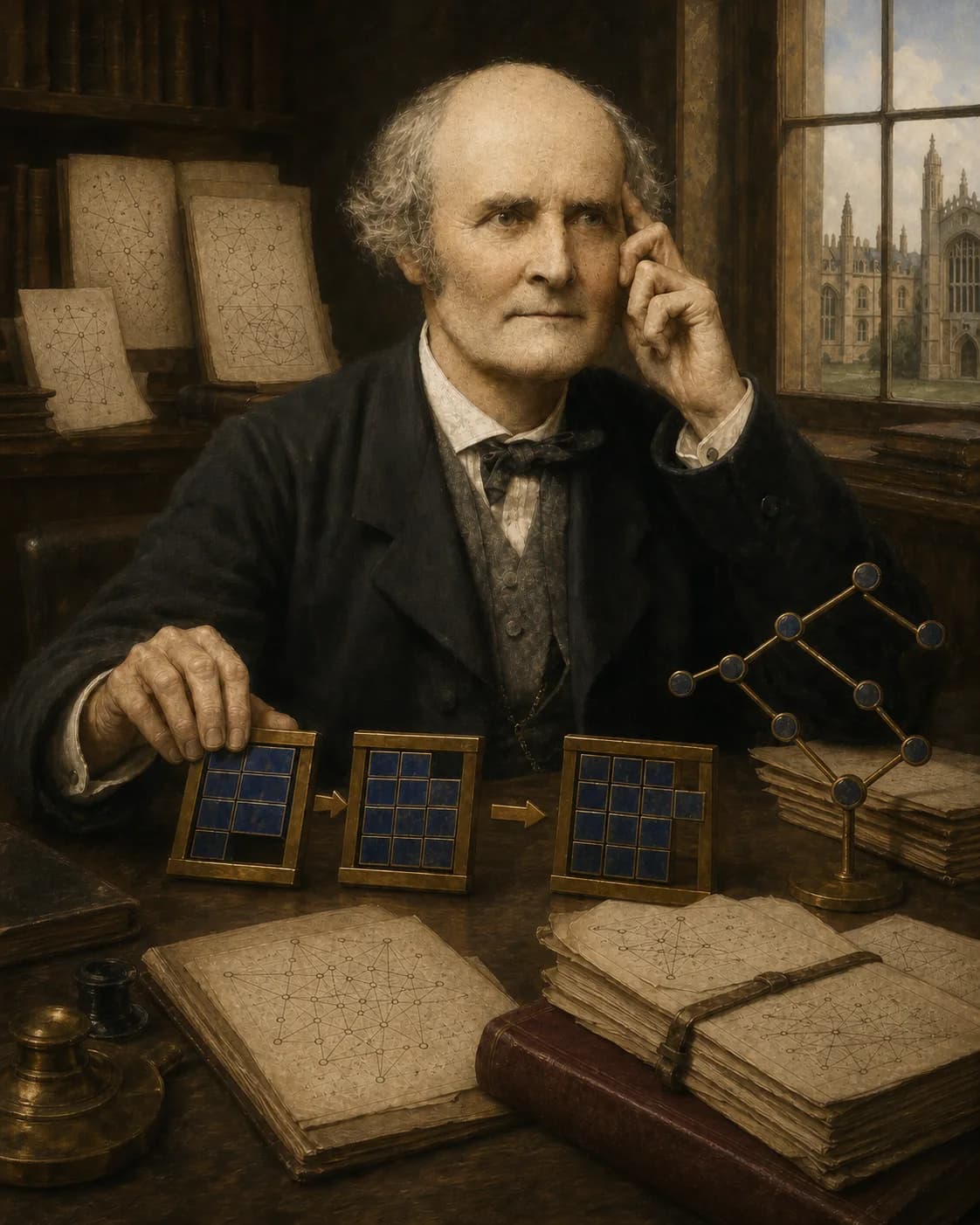
Making number arrays into composable algebraic objects
The face and characteristic hand pose use a surviving photograph. The three frames editorially evoke the 1858 matrix memoir without erasing Sylvester, determinant traditions, and earlier calculations or assigning all matrices to Cayley alone.
MathVoyage editorial direction · OpenAI image generation · historical photograph identity reference · precise generated-text removal edit · 2026-08-07
Remember the mind, not only the dates
The idea to carry forward
A mathematician must be more precise than a lawyer.Enter through one scene
After Cambridge he supported himself as a barrister for 14 years, writing math papers at lunch and in the evenings.
Questions this person helps open
These are reverse projections of existing editorial routes, not claims of direct influence or sole invention.
How can one table hold a rule that moves many numbers at once?
How can we calculate what remains while a shape changes?
PROFILE 02 · DEEP VOYAGE
Instead of memorizing more dates, follow the world that shaped this mind, the scenes that changed its direction, and the questions carried onward.
CHAPTER 01 · PERSON AND PERIOD
Before the finished achievement, read what this person treated as a problem and where the surviving evidence reaches its limit.
A British mathematician who combined legal practice with research for roughly fourteen years. Sylvester coined “matrix,” and earlier work existed on arrays and transformations; Cayley’s 1858 memoir was a major step in organizing matrix addition, multiplication, inverses, and characteristic equations into an algebraic theory.
CHAPTER 02 · TURNING SCENES
Follow the moments when the idea moved one step further. Every scene continues through an evidenced place or an honestly labelled time context.
Scene 1 / 3
After Cambridge he supported himself as a barrister for 14 years, writing math papers at lunch and in the evenings.
Scene 2 / 3
Building on determinants, transformations, and Sylvester’s terminology, the memoir systematized matrix composition, inverses, and characteristic equations. Matrices can be calculated with like numbers in some respects, but their multiplication is generally noncommutative.
Scene 3 / 3
Cambridge created a new mathematical chair to recruit him. He left the law and became a full-time mathematician.
THOUGHT EXPERIMENT · NOT A FACT CLAIM
This is a thought experiment about influence, not a verified historical fact.
Matrices did not appear in one isolated act: determinants, linear transformations, and Sylvester’s terminology came first. Cayley’s scene lets learners see why composing two transformations becomes ordered matrix multiplication.
Curated sources and problems. Bring one discovery back from OEIS, Project Euler, MathOverflow, or arXiv.