Banu Musa
Life
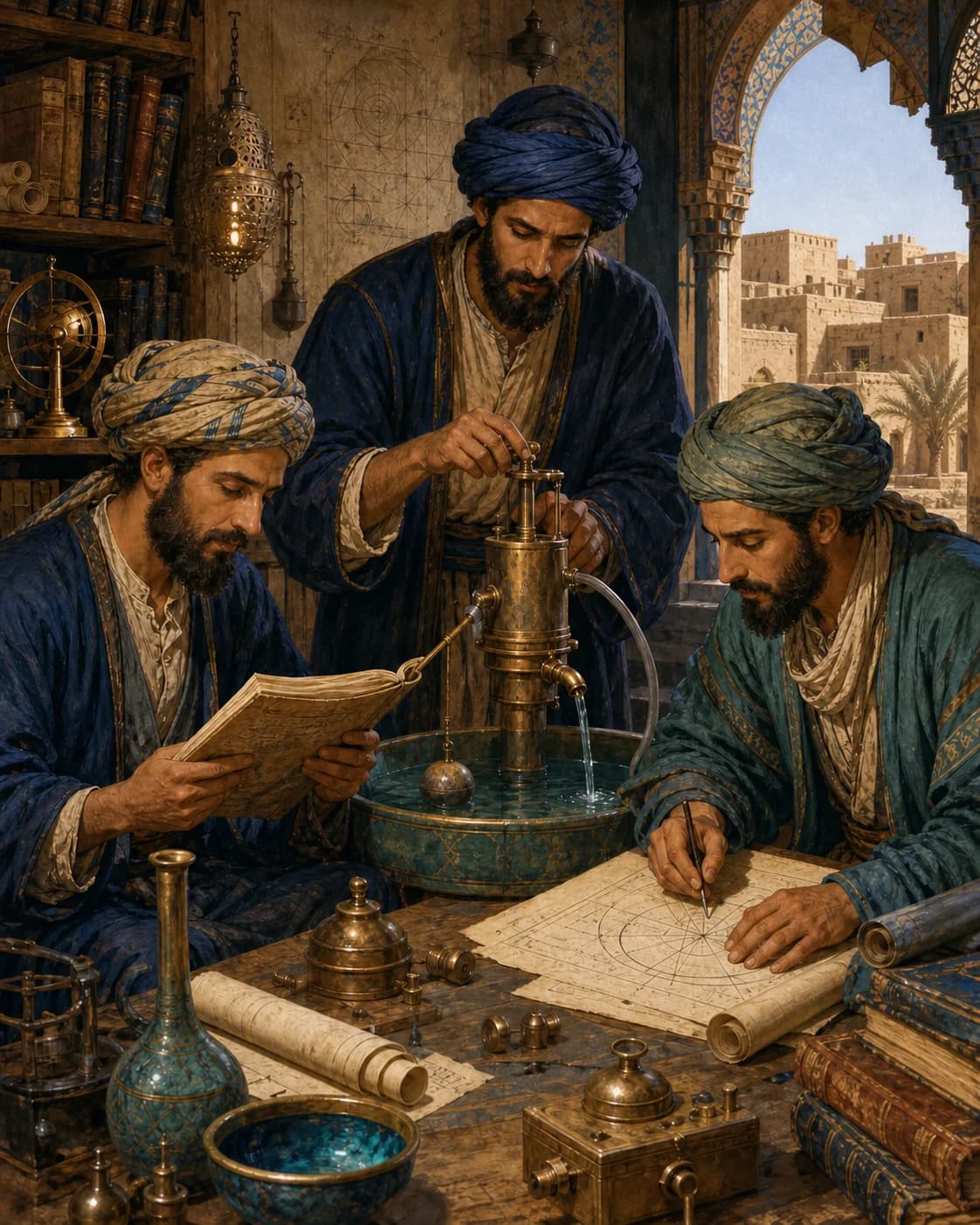
Muhammad, Ahmad, and al-Hasan were three brothers working within the scholarly and patronage networks of ninth-century Abbasid Baghdad. Their individual contributions are hard to separate, though Muhammad is associated especially with geometry and astronomy, Ahmad with mechanics, and al-Hasan with geometry. They sponsored the acquisition and Arabic translation of Greek mathematical works and connected with Thabit ibn Qurra. Their Book on the Measurement of Plane and Spherical Figures developed Archimedean geometry, while the Book of Ingenious Devices illustrated roughly one hundred fountains, vessels, and mechanisms. It is best described as a major early Arabic mechanical treatise, not an uncontested world first.
Decisive moments
Mission to Byzantium — physically acquiring Greek originals
BaghdadThey dispatched scholarly envoys to Byzantium to physically acquire Greek manuscripts. The need to translate Archimedes and Apollonius led them to discover Thabit ibn Qurra in Harran.
Book on the Measurement of Figures — systematising Archimedes
BaghdadA major geometric treatise on areas, volumes, and measurement, combining Archimedean methods with new arguments. Translation and original research belong in the same story.
Book of Ingenious Devices — roughly one hundred devices
BaghdadIt records fountains, vessels, and valve mechanisms through diagrams and operating descriptions, extending ancient pneumatic and hydraulic traditions with new combinations of control.
If this person hadn't existed
This is a thought experiment about influence, not a verified historical fact.
Beginners can trace how a self-regulating vessel changes state; intermediate learners model siphons, valves, and pressure differences. Advanced learners compare surviving manuscripts with devices attributed to Hero, and experts study how translation, patronage, and workshop craft jointly moved knowledge.
Beyond MathVoyage
Loading…