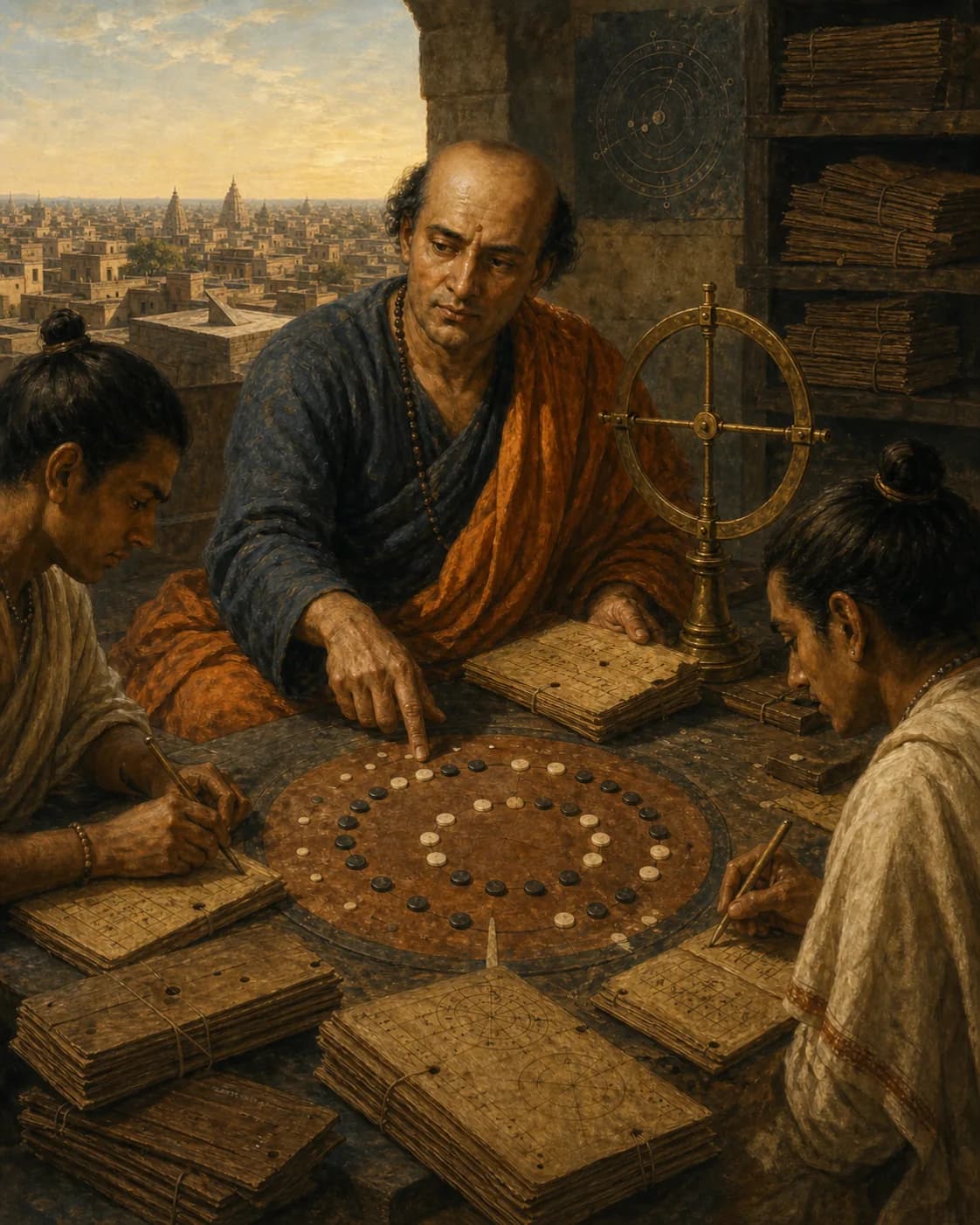
Bhaskara II

Bhaskara II

AD 1114 - AD 1185
Born in Bijapur
Active in Ujjain
Indian Mathematical Traditions

Life

A twelfth-century Indian mathematician who shows how beautiful a procedure can be, not only its answer. Bhaskara II wrote the arithmetic Lilavati, the algebraic Bijaganita, and major astronomical works, and led the Ujjain astronomical tradition. The famous story that Lilavati was his daughter appears much later and lacks contemporary evidence. His striking mathematics includes the cyclic chakravala method for quadratic indeterminate equations and passages on planetary motion that approach ideas of instantaneous velocity and extrema. These are important precursors, not a completed modern theory of limits and derivatives. He also described a positive number divided by zero as an infinite quantity; modern mathematics leaves division by zero undefined. Separating historical insight from a rule now known to fail makes his work clearer.

In one line
Chakravala is not a formula that guesses an answer, but a cycle returning to an easier problem.

Decisive moments

AD 1150

Works connecting arithmetic, algebra, and astronomy

Ujjain

Lilavati presents arithmetic and mensuration through verse problems, while Bijaganita treats algebra and indeterminate equations. Both circulated widely alongside his astronomical works. The story that Lilavati was his daughter is a later tradition.

AD 1150

Chakravala — an algorithm that advances by cycling

Ujjain

For equations such as x² − Ny² = 1, the method repeatedly transforms and composes nearby auxiliary equations. Its fascination lies in being a state-improving algorithm rather than a one-step formula.

AD 1150

Rate-of-change intuition in astronomy

Ujjain

In calculating planetary motion he used ideas close to instantaneous motion and maxima or minima. This was not a modern definition or general derivative theory, but it shows rate-of-change intuition emerging from astronomical problems.

If this person hadn't existed

This is a thought experiment about influence, not a verified historical fact.

We cannot claim that without chakravala a European solution must have been delayed by six centuries. The stronger lesson is that different mathematical cultures built very different algorithms for the same equations. Bhaskara’s astronomy also shows that reasoning close to rates of change grew outside the standard European genealogy of calculus.

Beyond MathVoyage

Loading…