Central anchor1/11
Probability
Why can thousands of trials be predictable when one trial is not?
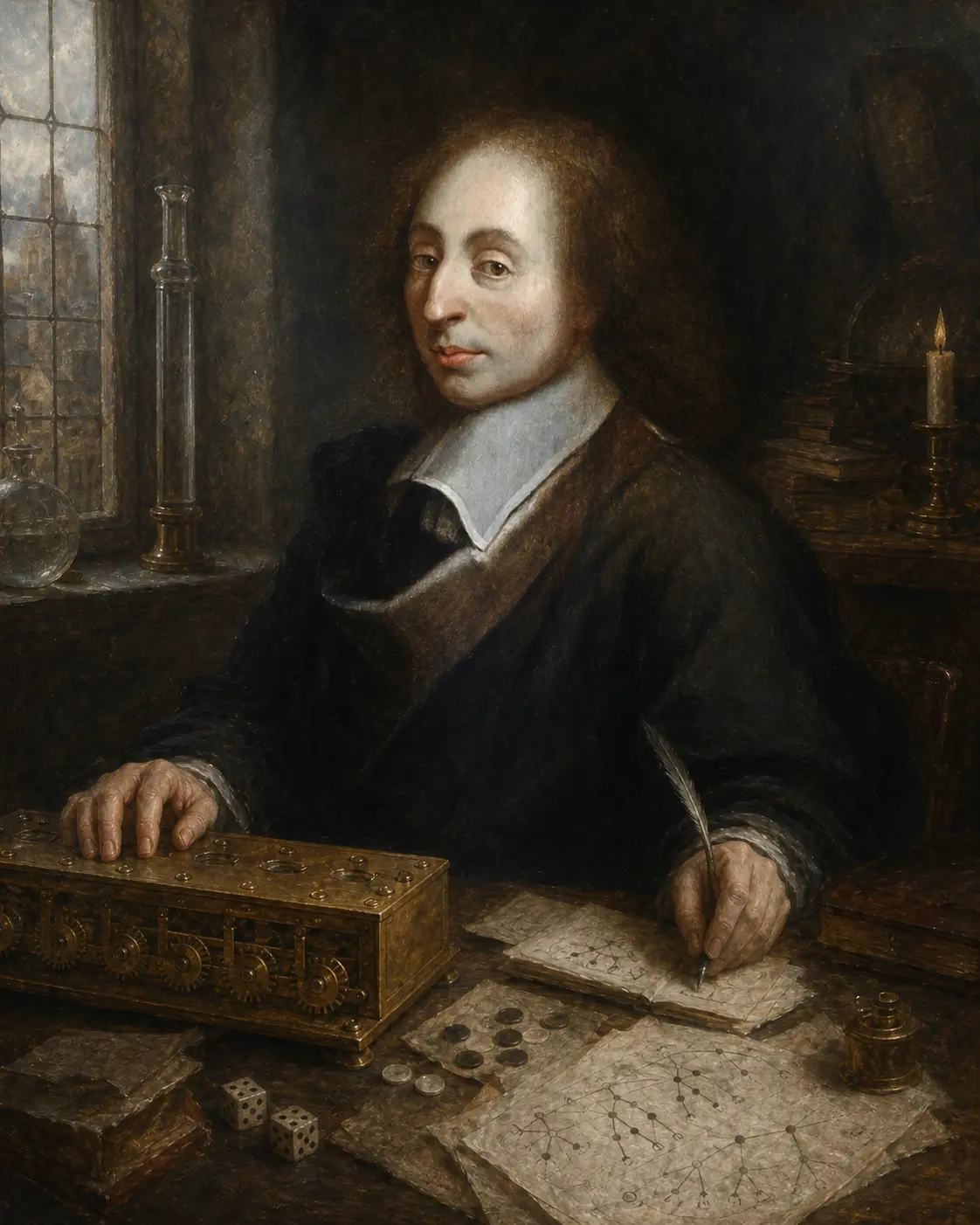
Once a machine can count, uncertainty becomes a new mathematical problem
The face draws on the surviving Pascal portrait tradition, but this room combines work from different moments in Paris and Rouen. The Pascaline first served tax calculation, while probability developed through Pascal’s 1654 correspondence with Fermat and older combinatorial traditions—not as Pascal’s solitary invention.
MathVoyage editorial direction · OpenAI image generation · historical likeness reference · 2026-08-07
Remember the mind, not only the dates
The idea to carry forward
The eternal silence of these infinite spaces frightens me.Enter through one scene
A gear-driven adding machine built to help his tax-collector father — a distant ancestor of the computer.
Questions this person helps open
These are reverse projections of existing editorial routes, not claims of direct influence or sole invention.
Why can thousands of trials be predictable when one trial is not?
Through Projective Geometry: What survives when shapes change, and which rules divide one world from another?
Can we count exploding possibilities without listing every one?
PROFILE 02 · DEEP VOYAGE
Instead of memorizing more dates, follow the world that shaped this mind, the scenes that changed its direction, and the questions carried onward.
CHAPTER 01 · PERSON AND PERIOD
Before the finished achievement, read what this person treated as a problem and where the surviving evidence reaches its limit.
Famous for probability theory and Pascal's triangle. He invented one of the first mechanical calculators at age 19.
CHAPTER 02 · TURNING SCENES
Follow the moments when the idea moved one step further. Every scene continues through an evidenced place or an honestly labelled time context.
Scene 1 / 3
A gear-driven adding machine built to help his tax-collector father — a distant ancestor of the computer.
Scene 2 / 3
They calculated future cases and expected shares in an interrupted game, linking earlier gaming mathematics with later probability theory.
Scene 3 / 3
He recorded a religious experience on parchment and kept it sewn into his clothing. Theology became central, but he still returned to mathematics, including cycloid work in 1658.
THOUGHT EXPERIMENT · NOT A FACT CLAIM
This is a thought experiment about influence, not a verified historical fact.
The Pascal–Fermat letters did not create probability from nothing. They turned earlier gaming calculations into a general division problem and formed an important node on the way to Huygens, Bernoulli, and Laplace.
STANDING ON SHOULDERS · EVIDENCED CONNECTIONS
We do not draw a line merely because two people shared an era. Only connections traced through works, problems, or teaching appear with an explanation and evidence.
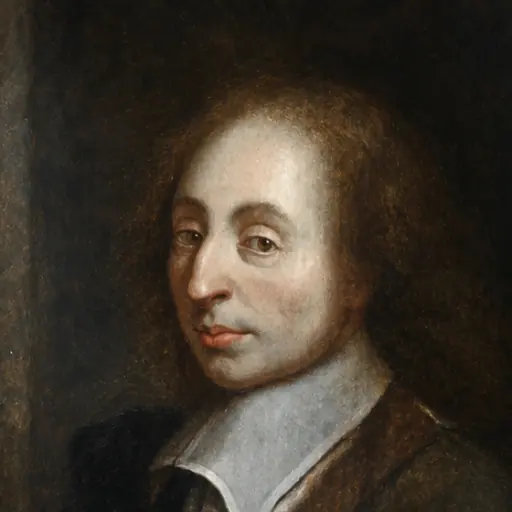
Blaise Pascal
Renaissance
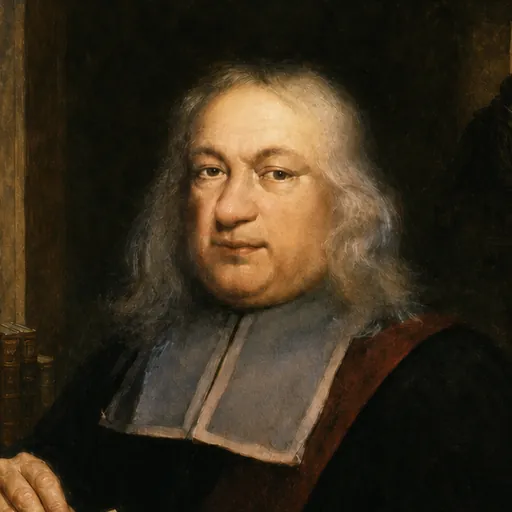
Letters about gambling create probability theory
In their 1654 correspondence on how to divide stakes in an interrupted game, Fermat and Pascal established foundations of expectation and combinatorial probability.
Evidence for this connection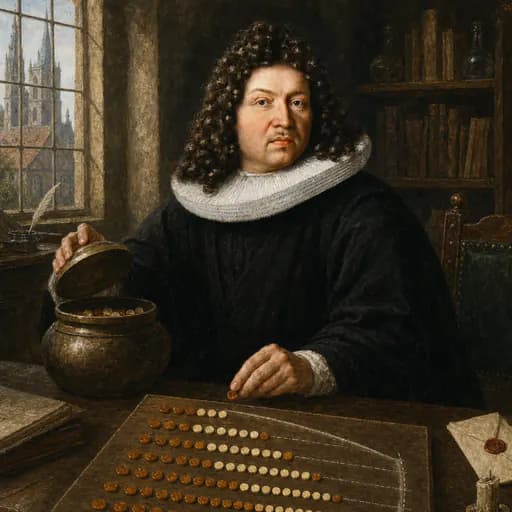
From expectation to the law of large numbers
Bernoulli systematized the probability calculus opened by Pascal and Fermat in Ars Conjectandi and proved that frequencies approach probabilities in repeated trials.
Evidence for this connectionCurated sources and problems. Bring one discovery back from OEIS, Project Euler, MathOverflow, or arXiv.