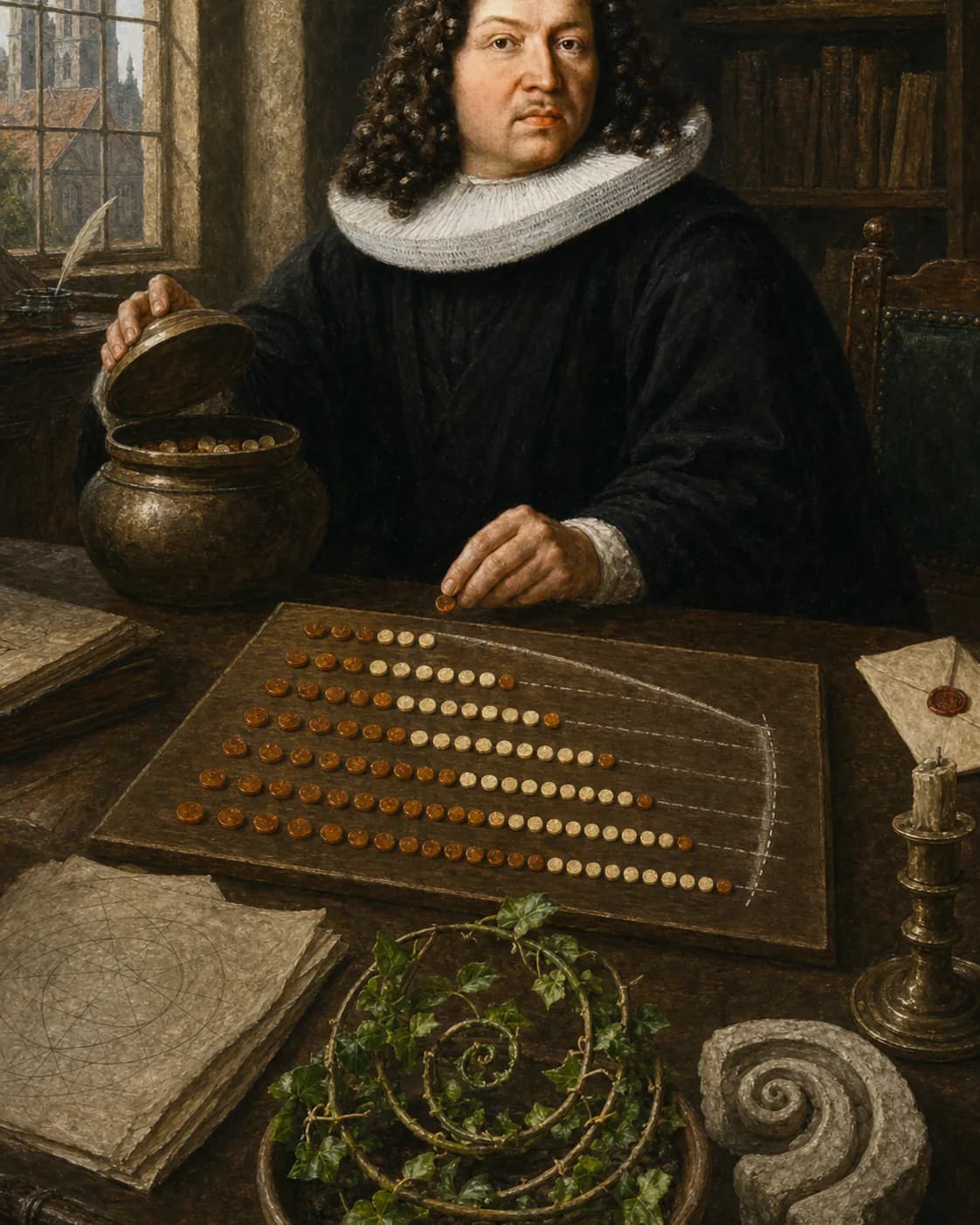
A likeness-informed AI editorial scene of Jakob Bernoulli comparing repeated trials, a narrowing uncertainty band, and two different spirals in a Basel-style study
AI editorial interpretation

Repeated chance yields an error bound, not instant certainty

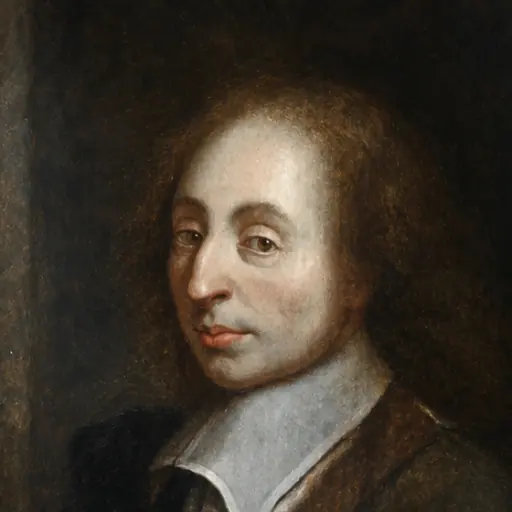
The face uses the established Jakob Bernoulli portrait tradition. The counters and uncertainty band are a modern visualization of the law of large numbers published posthumously in Ars Conjectandi in 1713, not a promise of certainty after a few trials. The living and stone spirals distinguish his requested logarithmic spiral from the different carving on his tomb.

MathVoyage editorial direction · OpenAI image generation · historical portrait identity reference · 2026-08-07

Remember the mind, not only the dates

Jakob Bernoulli

AD 1655 - AD 1705
Thinking ground · Basel
EnlightenmentRepetition settling through fluctuationA narrowing band of uncertaintyThe spiral requested and the spiral carved

The idea to carry forward

Eadem mutata resurgo (I rise again, changed yet the same).

Enter through one scene

AD 1689

Work toward Ars Conjectandi

He developed a connected treatment of combinations, expectation, and repeated trials. The book appeared posthumously in 1713.

Questions this person helps open

Concept ports to revisit, not another achievement list

These are reverse projections of existing editorial routes, not claims of direct influence or sole invention.

No concept port has yet been reviewed for this person.

Browse every concept route

PROFILE 02 · DEEP VOYAGE

How Jakob Bernoulli’s ideas moved

Instead of memorizing more dates, follow the world that shaped this mind, the scenes that changed its direction, and the questions carried onward.

CHAPTER 01 · PERSON AND PERIOD

What questions surrounded Jakob Bernoulli?

Before the finished achievement, read what this person treated as a problem and where the surviving evidence reaches its limit.

About 1 min read

The first-generation mathematician of the Bernoulli dynasty in Basel. His posthumous Ars Conjectandi (1713) proved the Law of Large Numbers — that observed frequencies converge to true probability with enough trials. A lifelong rival of his younger brother Johann.
CHAPTER 02 · TURNING SCENES

3 turning scenes

Follow the moments when the idea moved one step further. Every scene continues through an evidenced place or an honestly labelled time context.

  1. Scene 1 / 3

    AD 1689Basel

    Work toward Ars Conjectandi

    He developed a connected treatment of combinations, expectation, and repeated trials. The book appeared posthumously in 1713.

  2. Scene 2 / 3

    AD 1690Basel· Geographic context

    Collaboration and rivalry with Johann

    The brothers studied Leibnizian calculus in close contact yet disputed solutions and priority. Their mutual influence matters as much as the family conflict.

  3. Scene 3 / 3

    AD 1713Basel· Geographic context

    The Law of Large Numbers, posthumously published

    He proved that for repeated independent trials with fixed success probability, the sample proportion becomes increasingly likely to lie near the true probability.

THOUGHT EXPERIMENT · NOT A FACT CLAIM

Erase Jakob Bernoulli from the map

This is a thought experiment about influence, not a verified historical fact.

Beginners can watch coin-toss frequencies fluctuate; intermediate learners distinguish modes of convergence. Advanced learners bound errors for Bernoulli trials, and experts compare weak and strong laws with ergodic theorems.

STANDING ON SHOULDERS · EVIDENCED CONNECTIONS

What arrived here, and what moved onward?

We do not draw a line merely because two people shared an era. Only connections traced through works, problems, or teaching appear with an explanation and evidence.

Jakob Bernoulli

Jakob Bernoulli

Enlightenment

Received 1Passed on 2

What this person received

Blaise Pascal
Influenced byBlaise Pascal

From expectation to the law of large numbers

Bernoulli systematized the probability calculus opened by Pascal and Fermat in Ars Conjectandi and proved that frequencies approach probabilities in repeated trials.

Evidence for this connection

What later generations carried onward

Johann Bernoulli
CollaboratorsJohann Bernoulli

Two brothers grow the new calculus

Jakob and Johann strongly shaped one another’s early mathematical development before becoming fierce rivals. Their cooperation and disputes accelerated work in calculus and variational problems.

Evidence for this connection

From binomial trials to the normal curve

While studying the binomial distribution of Bernoulli trials, de Moivre found its normal approximation—the first bridge from repeated chance to the bell curve.

Evidence for this connection

Beyond MathVoyage

Curated sources and problems. Bring one discovery back from OEIS, Project Euler, MathOverflow, or arXiv.