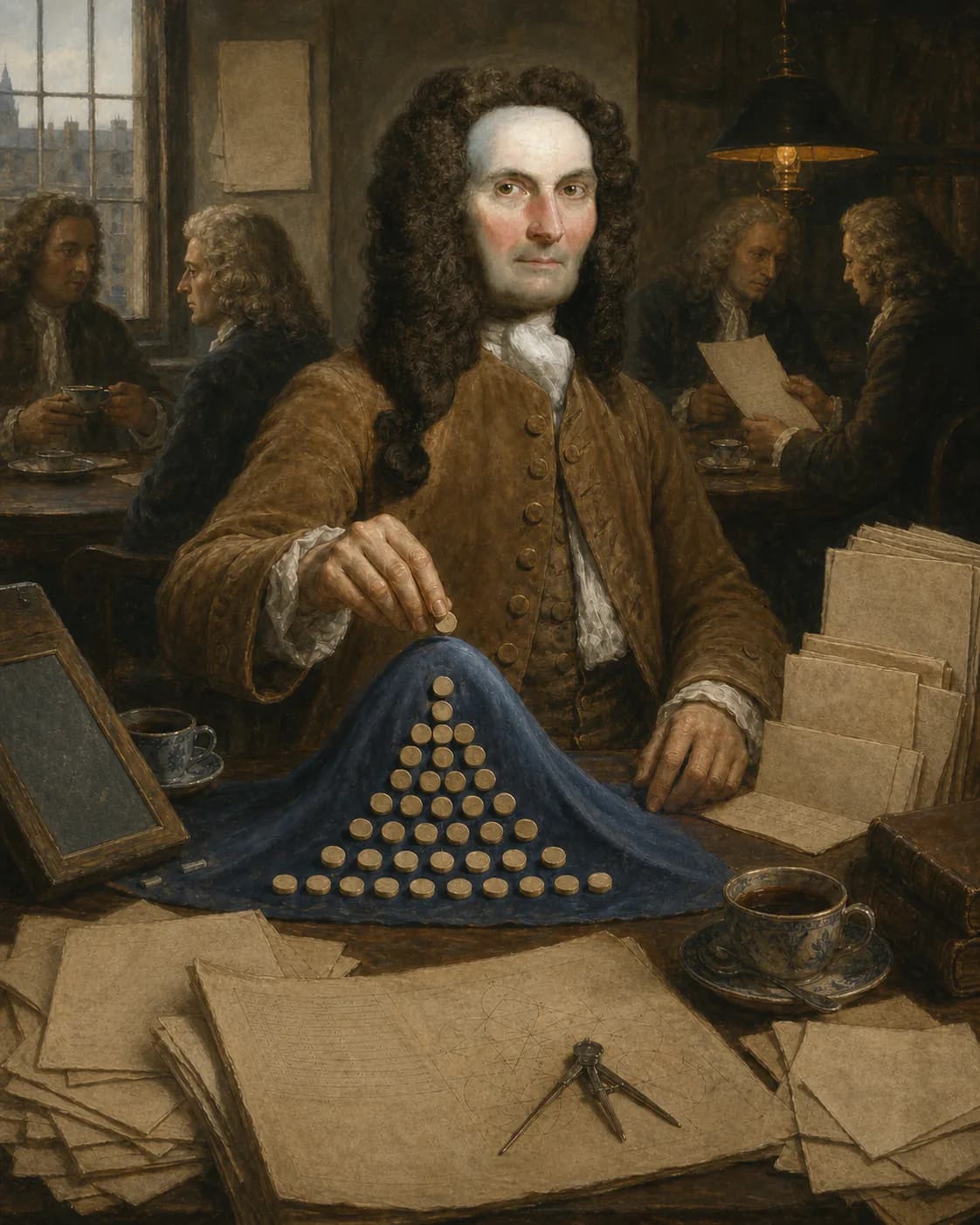
Abraham de Moivre
Life
A Huguenot mathematician who fled persecution in France and worked in London as a teacher and probability calculator. He developed de Moivre's formula, wrote The Doctrine of Chances, and in 1733 approximated a large binomial distribution by a bell-shaped curve. The story that he predicted his death by extrapolating his increasing sleep is famous but not secure contemporary evidence.
Decisive moments
Moving to England after the revocation of the Edict of Nantes
LondonAmid persecution of Huguenots he left France for London, supported himself through teaching and calculation, and worked within Royal Society networks.
Normal approximation to the binomial
He approximated large binomial probabilities with a bell-shaped exponential form, a result later generalized by Laplace and absorbed into central-limit theory.
The death-prediction story — a later anecdote
The sleep-based death prediction is memorable, but it lacks the contemporary support required to present it with the same confidence as his mathematics.
If this person hadn't existed
This is a thought experiment about influence, not a verified historical fact.
Beginners can watch a coin-count histogram become bell-shaped; intermediate learners calculate binomial probabilities. Advanced learners derive the de Moivre–Laplace approximation with Stirling's formula, and experts compare central-limit assumptions and error bounds.
Influence network
Beyond MathVoyage
Loading…