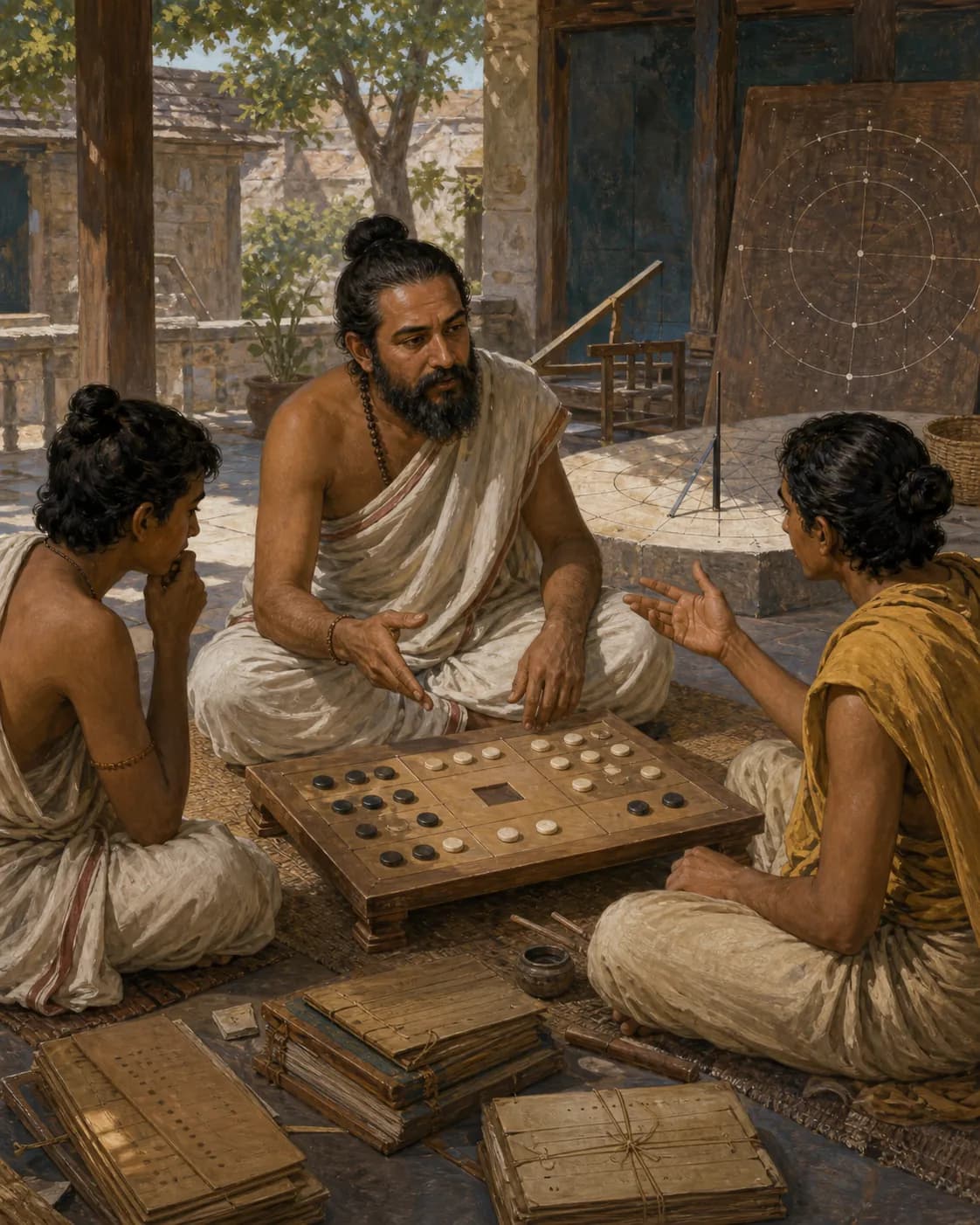
Brahmagupta

Brahmagupta

AD 598 - AD 668
Born in Bhillamala
Active in Ujjain
Indian Mathematical Traditions

LifeDeep Story

A seventh-century Indian mathematician-astronomer who placed zero and negative numbers inside a shared system of arithmetic rules. In the Brāhmasphuṭasiddhānta, written at Bhillamala in 628, Brahmagupta recorded rules such as 0 + a = a, a − a = 0, and 0 × a = 0, along with arithmetic for fortunes and debts. Because zero notation and place value have a longer, many-stranded history, calling him the lone inventor of zero is misleading. His extension was not flawless: he left a nonzero number over zero as a fraction with zero denominator and incorrectly stated 0 ÷ 0 = 0. The error makes the story more instructive — accepting a new number and defining every operation consistently are different achievements. His astronomy and computation later traveled into Arabic-language scholarship.

In one line
When a number is subtracted from itself, the result is śūnya (zero). Zero is neither positive nor negative.

Decisive moments

AD 628

Brāhmasphuṭasiddhānta written

Bhillamala

An astronomical-mathematical treatise written at Bhillamala. It explicitly organized addition, subtraction, and multiplication with zero and arithmetic with positive and negative numbers, while retaining errors about division by zero.

AD 665

Division by zero — the problem he could not crack

Brahmagupta wrote 0 ÷ 0 = 0, while Bhāskara II linked division of a nonzero number by zero with infinity; neither rule is valid in modern arithmetic. Calculus can evaluate limits that take a 0/0 form, whose values depend on the functions involved, but it does not assign a single value to 0 ÷ 0 itself.

If this person hadn't existed

This is a thought experiment about influence, not a verified historical fact.

Indian place-value notation and other computational traditions would have continued without Brahmagupta. What we would lose is one of the earliest explicit surviving records that places zero, positives, and negatives in one table of rules. Modern binary computation cannot be attributed directly to one seventh-century author.

Beyond MathVoyage

Loading…