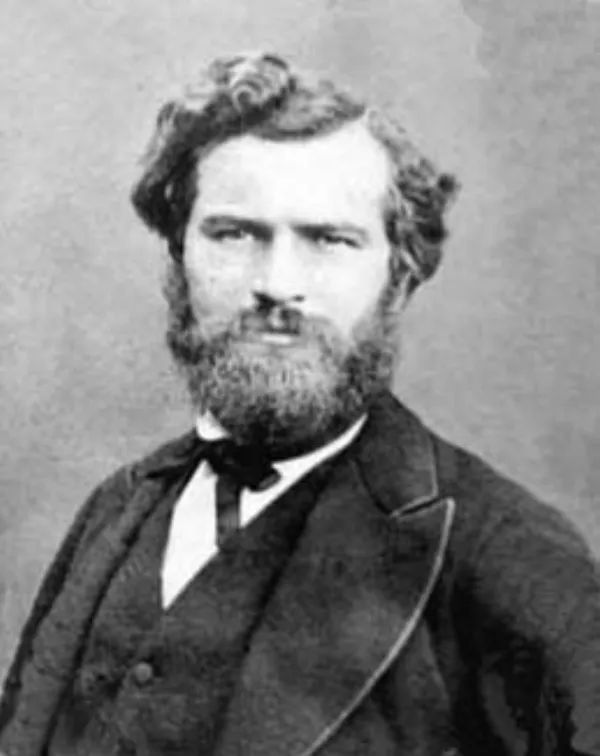
Camille Jordan
Life
A mathematician who moved between pictures that look obvious and algebraic forms made computable. Jordan’s name remains attached to the curve theorem, canonical form, measure, and Jordan–Hölder theorem. His 1870 Treatise on Substitutions and Algebraic Equations organized the theory of permutation groups and equations developed after Galois and greatly helped group theory circulate. Calling it the solitary first textbook made directly from Galois’s scattered notes would erase the intervening research network. The attribution and formulation of Jordan form also involve earlier and later work. In 1887 he stated that a simple closed plane curve separates an inside from an outside, but the rigor of his argument was disputed; Veblen supplied a new proof in 1905. The story shows why an obvious-looking claim may still demand difficult definitions and proof.
Decisive moments
Traité des substitutions — organizing group theory
ParisThe treatise assembled post-Galois research on permutation groups and algebraic equations into a large system. It became an important vehicle for spreading group theory through research and teaching.
Jordan form — reading missing eigenvectors through blocks
Over an algebraically closed field, a square matrix can be represented in blocks built from generalized eigenvectors. Uniqueness is only up to block order, and numerical work must also account for instability.
Jordan curve theorem — turning the obvious into a proof problem
The complement of a simple closed plane curve has two connected components, an inside and an outside. Debate over Jordan’s argument was followed by Veblen’s new proof in 1905.
If this person hadn't existed
This is a thought experiment about influence, not a verified historical fact.
Beginners draw a loop and test whether a point lies inside or outside. Intermediate learners simplify matrices into eigenvalue blocks. Advanced learners study the exact hypotheses of the Jordan curve theorem and generalized eigenvectors. Experts compare Jordan’s argument with Veblen’s later proof and examine the layered attribution of canonical form.
Influence network
Beyond MathVoyage
Loading…