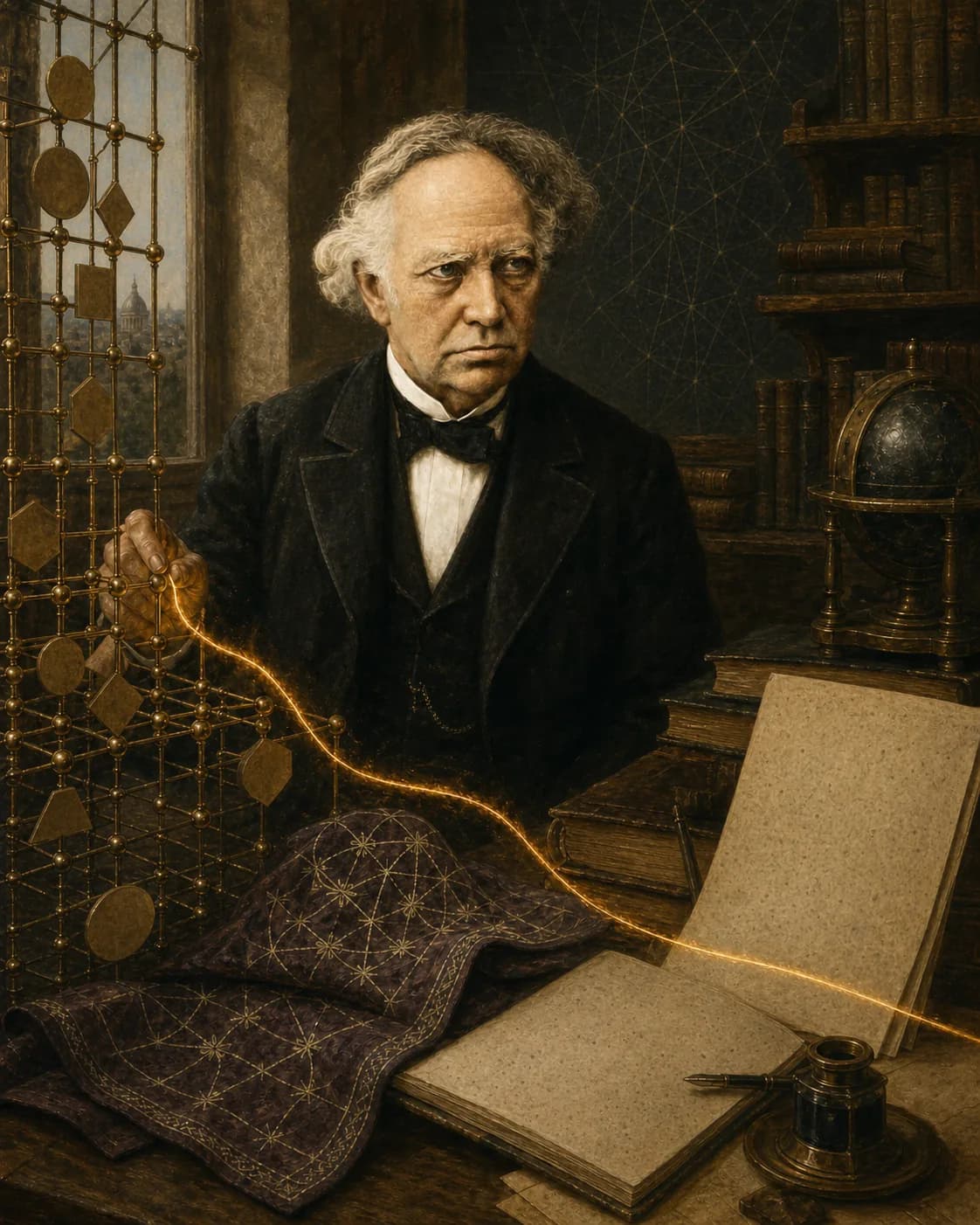
Charles Hermite

Charles Hermite

AD 1822 - AD 1901
Born in Dieuze
Active in Paris
Enlightenment

Life

A profoundly modest French mathematician who, despite a lifelong limp from a clubfoot, refused all academic limelight while quietly reshaping analysis. In 1858 he expressed the general quintic through elliptic modular functions, moving beyond the universal formula by arithmetic and radicals that Abel had proved impossible. In 1873 he proved e is transcendental, and Lindemann adapted the method nine years later to settle π and close the 2,000-year squaring-the-circle problem. His name persists in Hermitian matrices, Hermite polynomials, and Hermite forms. He taught Poincaré.

In one line
There exists, if I am not mistaken, an entire world which is the totality of mathematical truths, to which we have access only with our mind.

Decisive moments

AD 1858

Solving the quintic with elliptic functions

Paris

He expressed solutions of the general quintic through elliptic modular functions, going beyond the universal arithmetic-and-radicals formula Abel had ruled out. The roots were not absent; the permitted language changed.

AD 1873

Proving e is transcendental

Paris

In Sur la fonction exponentielle he proved that e is not the root of any polynomial with integer coefficients (transcendental). A new frontier was drawn in the kinds of numbers themselves.

AD 1882

His student Lindemann's π is transcendental

Adapting his method, Lindemann proved π is transcendental — settling the 2,000-year squaring-the-circle problem as impossible with compass and straightedge.

If this person hadn't existed

This is a thought experiment about influence, not a verified historical fact.

Without Hermite's 1873 proof that e is transcendental, Lindemann's 1882 proof for π — and thus the resolution of the 2,000-year squaring-the-circle problem — would have arrived later. Without Hermitian matrices, the standard mathematical language of quantum mechanics would have taken a different shape.

Beyond MathVoyage

Loading…