Central anchor7/11
Information Entropy
Can uncertainty be measured without reading what a message means?
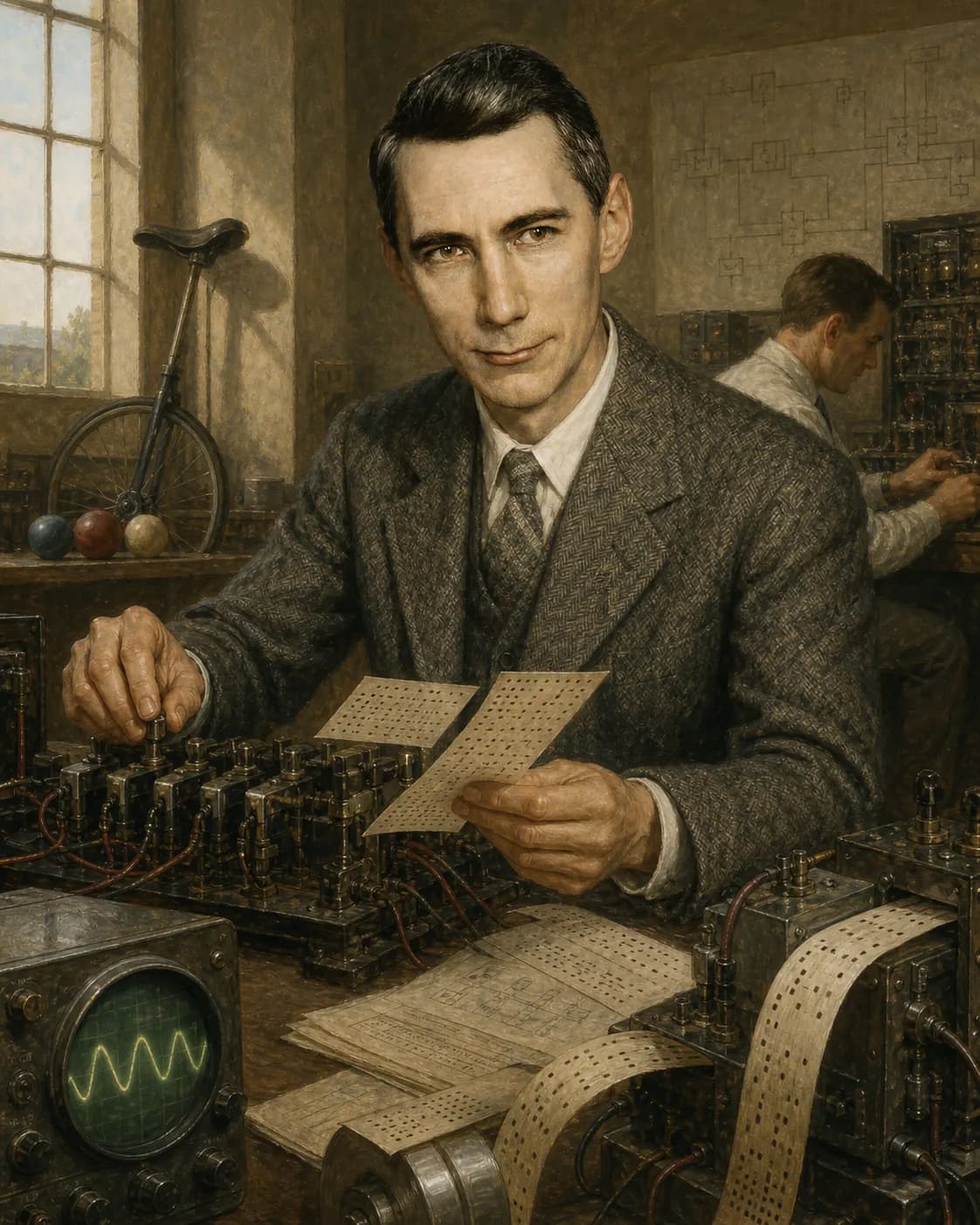
Measuring how information can cross through noise
The face draws on surviving photographs of Shannon, but this Bell Labs scene is not one experiment combining his 1937 relay thesis, 1948 information theory, and 1949 cryptography work. Channel capacity bounds arbitrarily low error under stated conditions rather than magical zero-error transmission, and the term “bit” was suggested by John Tukey. The unicycle and balls evoke documented playfulness, not a specific research event.
MathVoyage editorial direction · OpenAI image generation · historical photograph reference · 2026-08-07
Remember the mind, not only the dates
The idea to carry forward
Information is the resolution of uncertainty.Enter through one scene
His MIT thesis represented and simplified switching circuits with logical expressions, connecting earlier relay and logic work into a powerful design method.
Questions this person helps open
These are reverse projections of existing editorial routes, not claims of direct influence or sole invention.
Can uncertainty be measured without reading what a message means?
Through Cryptography and Information: How can repeated signals emerge from a single uncertain event?
PROFILE 02 · DEEP VOYAGE
Instead of memorizing more dates, follow the world that shaped this mind, the scenes that changed its direction, and the questions carried onward.
CHAPTER 01 · PERSON AND PERIOD
Before the finished achievement, read what this person treated as a problem and where the surviving evidence reaches its limit.
A mathematician and engineer whose 1937 thesis applied Boolean algebra to relay switching circuits. His 1948 paper quantified information and established coding limits for noisy channels. Under stated probabilistic conditions and with long codes, rates below capacity can achieve arbitrarily small error probability—not magically error-free communication in every channel.
CHAPTER 02 · TURNING SCENES
Follow the moments when the idea moved one step further. Every scene continues through an evidenced place or an honestly labelled time context.
Scene 1 / 3
His MIT thesis represented and simplified switching circuits with logical expressions, connecting earlier relay and logic work into a powerful design method.
Scene 2 / 3
It unified information, entropy, and channel capacity. Below capacity, sufficiently long codes can make error probability arbitrarily small under the model; this is not a promise that every finite transmission has zero errors.
Scene 3 / 3
He defined when a ciphertext reveals no information about the plaintext. A one-time pad meets the condition only with a secret uniformly random key at least as long as the message and never reused.
THOUGHT EXPERIMENT · NOT A FACT CLAIM
This is a thought experiment about influence, not a verified historical fact.
Beginners can compare the surprise of coin tosses in bits; intermediate learners connect entropy to compression. Advanced learners inspect the hypotheses behind capacity and error-correcting codes, while experts can question both the power and limits of a model that abstracts away meaning.
STANDING ON SHOULDERS · EVIDENCED CONNECTIONS
We do not draw a line merely because two people shared an era. Only connections traced through works, problems, or teaching appear with an explanation and evidence.
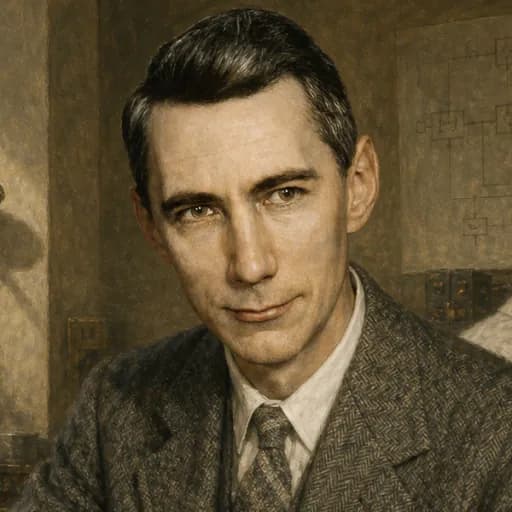
Claude Shannon
Modern Era
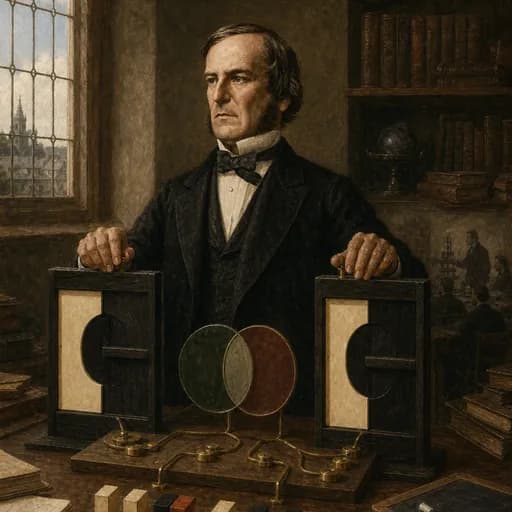
Logical algebra becomes a tool for switching circuits
In his 1937 master’s thesis, Shannon applied Boolean algebra to the combination and simplification of relay and switching circuits. That connection became a central tool of digital logic design, alongside device physics, electrical engineering, and fabrication.
Evidence for this connectionCurated sources and problems. Bring one discovery back from OEIS, Project Euler, MathOverflow, or arXiv.