Edward Witten
Life
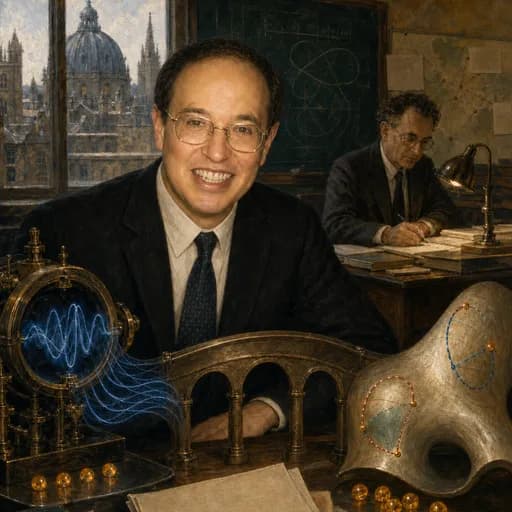
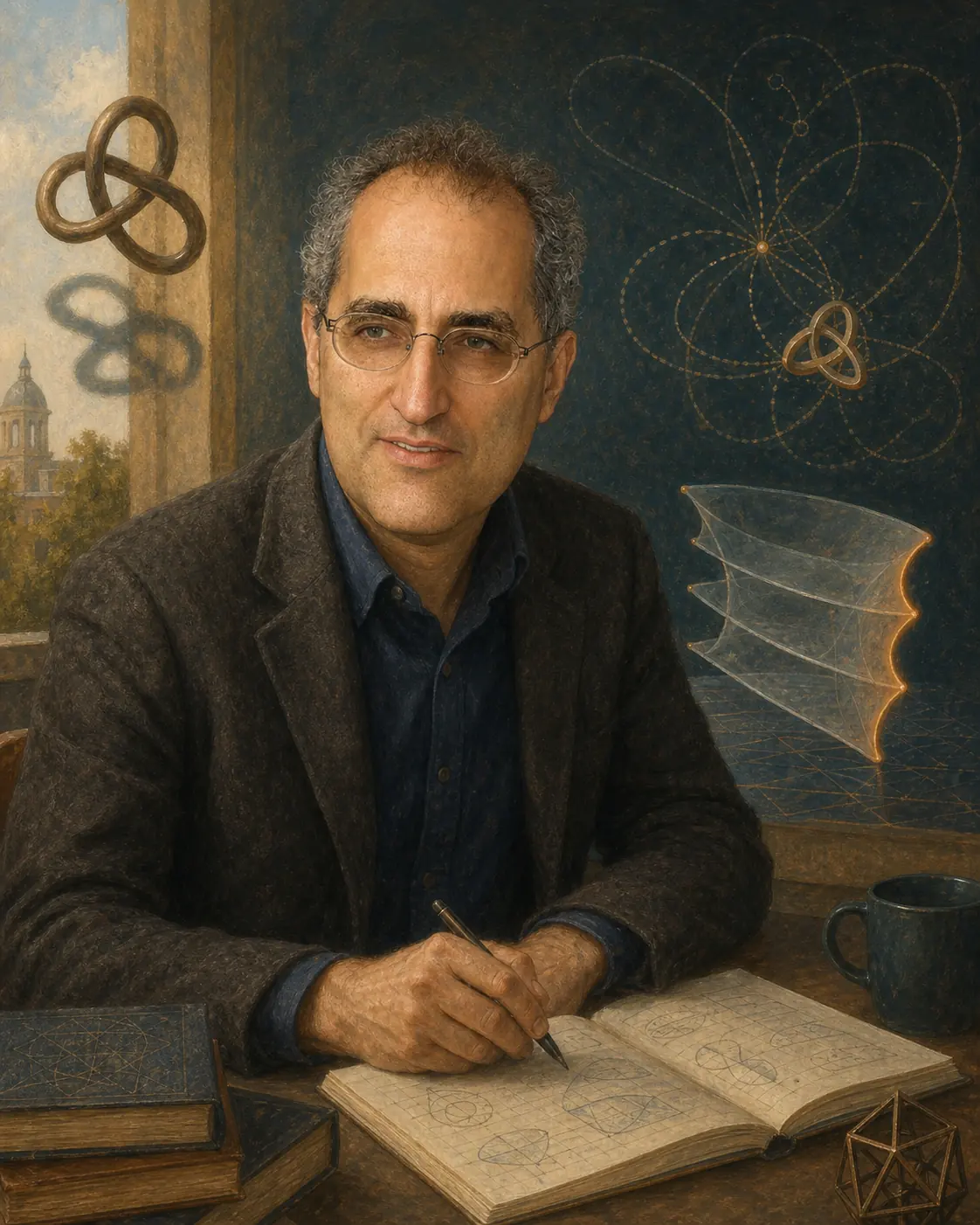
Edward Witten has expanded the boundary between mathematics and theoretical physics. After studying history at Brandeis, he earned a physics PhD at Princeton and joined the Institute for Advanced Study faculty in 1987. His work connected gauge theory with topology, interpreted the Jones polynomial through Chern-Simons theory, and developed string-theory dualities and the M-theory proposal. He became the first theoretical physicist to receive a Fields Medal in 1990.
Decisive moments
Topological Quantum Field Theory — quantum fields = topological invariants
PrincetonWitten showed that quantum-field amplitudes on a space can equal topological invariants of that space — opening a new physics-to-mathematics direction. Donaldson polynomials, Seiberg-Witten invariants, and Gromov-Witten invariants were all later born within this frame.
Chern-Simons interpretation of the Jones polynomial — knot theory becomes physics
PrincetonWitten interpreted Vaughan Jones's 1984 knot polynomial as a path integral in 3-dimensional Chern-Simons gauge theory — a stunning equation linking topological knot invariants to physical quantum amplitudes. Jones won the Fields Medal in 1990.
Fields Medal — the first theoretical physicist recipient
PrincetonAt the Kyoto ICM, Witten became the first theoretical physicist to receive the Fields Medal. The IMU citation emphasized his ability to turn physical insight into new mathematical theorems and problems.
M-theory — unifying the five string theories
PrincetonAt USC's Strings 95 conference, Witten conjectured that the five then-known string theories are different limits of a single 11-dimensional theory — M-theory. The conjecture launched the late-20th-century string theory renaissance.
If this person hadn't existed
This is a thought experiment about influence, not a verified historical fact.
Without Witten's work, common languages connecting the Jones polynomial with quantum field theory and four-dimensional topology with gauge theory would have had to emerge through other researchers. The delay cannot be measured, but the route between mathematics and physics would likely have looked quite different.
Influence network
Beyond MathVoyage
Loading…