Another viewpoint6/16
Prime Numbers
As numbers grow, do primes fade away—or reveal a hidden order?
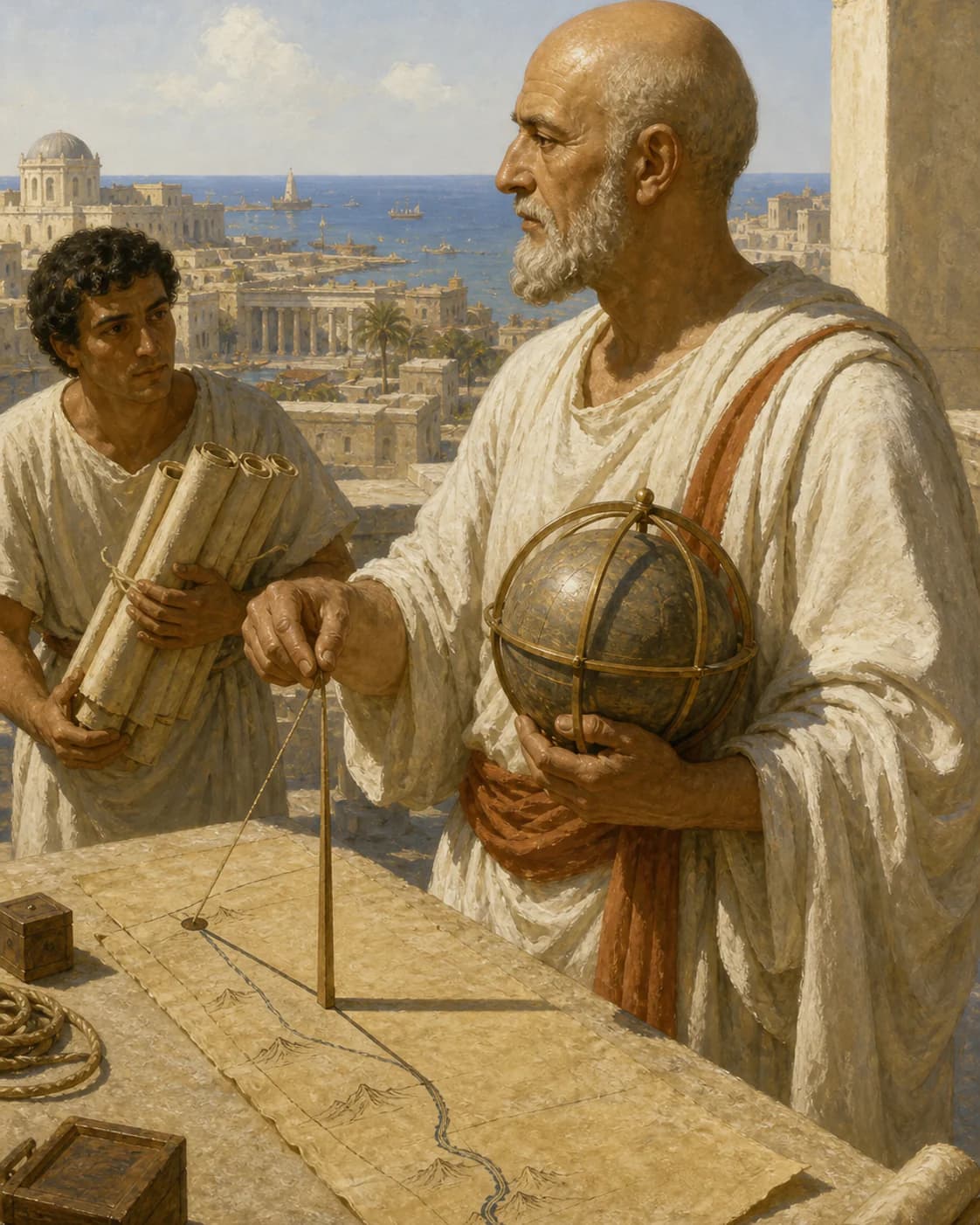
Measuring the whole Earth from the difference between two shadows
No verified lifetime portrait or original measurement account of Eratosthenes survives; the method is known through later writing. The bald dome, short beard, and sharp profile use later engraving conventions only for recognition. The face and demonstration are modern interpretations, not claims that he entered a well, observed both cities simultaneously, or paced the route himself, and uncertainty in the stadion and route remains visible.
MathVoyage editorial direction · OpenAI image generation · later engraving iconography reference · no verified lifetime likeness · 2026-08-07
Remember the mind, not only the dates
The idea to carry forward
A fraction of a full angle can reveal the same fraction of Earth’s circumference.Enter through one scene
A later account says he used the difference in solar altitude at Syene and Alexandria together with the estimated distance between them. The method is powerful, but uncertain inputs and units make the modern error percentage interpretation-dependent.
Questions this person helps open
These are reverse projections of existing editorial routes, not claims of direct influence or sole invention.
As numbers grow, do primes fade away—or reveal a hidden order?
PROFILE 02 · DEEP VOYAGE
Instead of memorizing more dates, follow the world that shaped this mind, the scenes that changed its direction, and the questions carried onward.
CHAPTER 01 · PERSON AND PERIOD
Before the finished achievement, read what this person treated as a problem and where the surviving evidence reaches its limit.
An Alexandrian scholar remembered for turning two shadows into a calculation of Earth’s size. His own account is lost; the later writer Cleomedes describes a method using the difference in solar altitude at Syene and Alexandria and an estimated distance between them. The result is reported as 250,000 or 252,000 stadia, but uncertainty about the stadion and the geographical assumptions prevents a single trustworthy modern error percentage. The geometric idea remains elegant and reproducible. The sieve bearing his name, along with his work on chronology and geography, shows a much wider range. The nickname Beta and the story that he fasted after losing his sight belong to later tradition.
CHAPTER 02 · TURNING SCENES
Follow the moments when the idea moved one step further. Every scene continues through an evidenced place or an honestly labelled time context.
Scene 1 / 3
A later account says he used the difference in solar altitude at Syene and Alexandria together with the estimated distance between them. The method is powerful, but uncertain inputs and units make the modern error percentage interpretation-dependent.
Scene 2 / 3
Starting at 2, cross out multiples of each surviving prime. It is a hand-worked puzzle for beginners and leads to segmented sieves and complexity analysis at advanced levels.
Scene 3 / 3
A tradition says that after losing his sight in old age he ended his life by fasting, but it is not supported by the same kind of direct evidence as his mathematical work.
THOUGHT EXPERIMENT · NOT A FACT CLAIM
This is a thought experiment about influence, not a verified historical fact.
Beginners compare two shadows with a lamp and sticks; intermediate learners turn the angle into a fraction of a circle. Advanced learners model errors from a non-spherical Earth and cities that are not exactly on one meridian. Experts compare Cleomedes’s account, possible stadion lengths, and route estimates to see why converting an ancient result into one modern accuracy claim is difficult.
Curated sources and problems. Bring one discovery back from OEIS, Project Euler, MathOverflow, or arXiv.