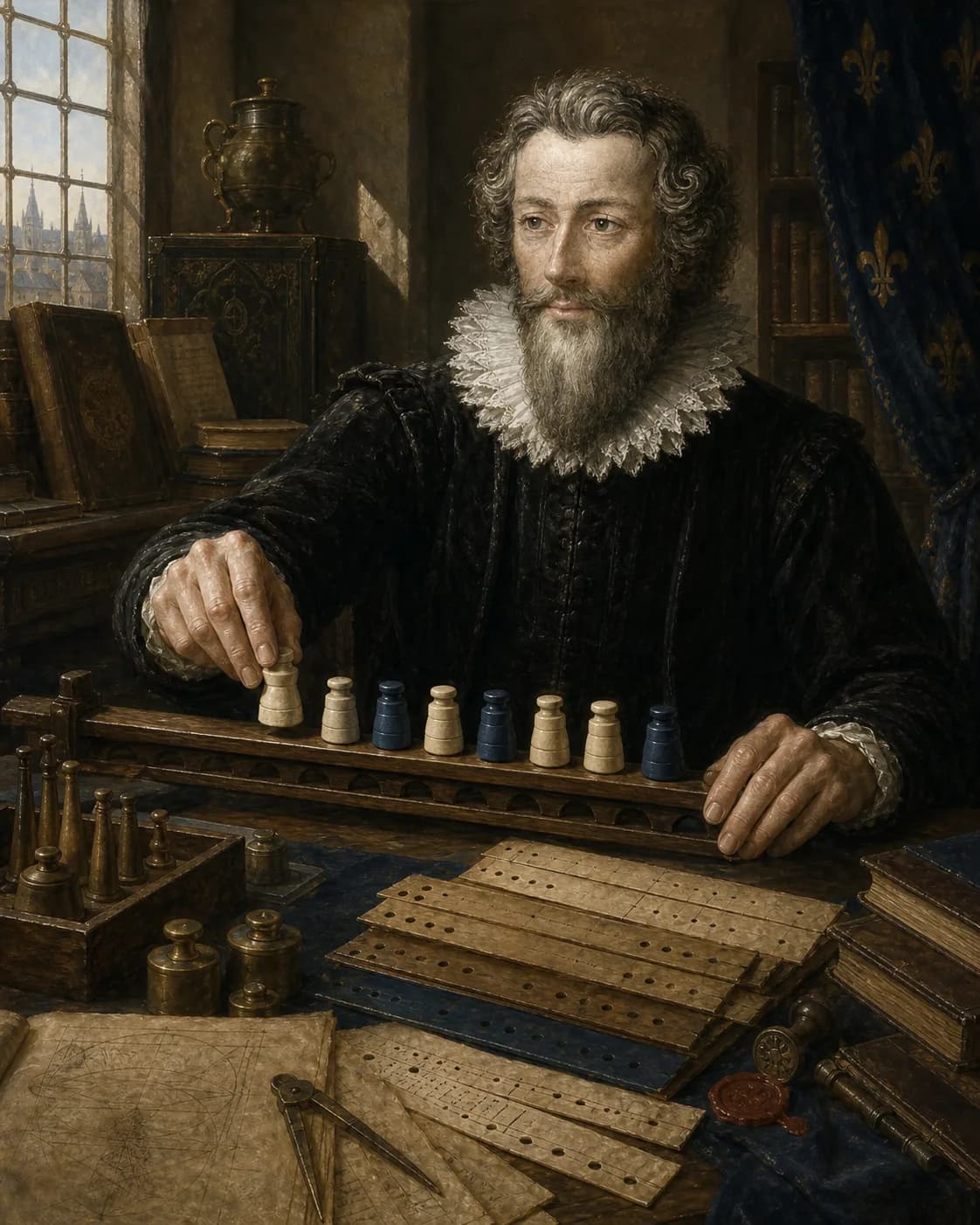
François Viète

François Viète

AD 1540 - AD 1603
Born in Fontenay-le-Comte
Active in Paris
Renaissance

Life

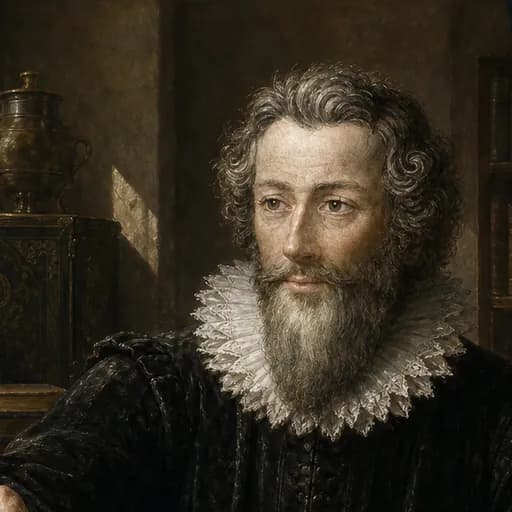
A lawyer and royal counsellor who made major contributions to algebraic notation and codebreaking. In his 1591 In artem analyticem isagoge, Viète systematically used vowels for unknowns and consonants for known quantities, allowing both to be manipulated symbolically. Building on earlier Greek, Islamic, and European algebra, this was an important stage toward the notation later developed by Descartes and others. In 1590 he also decoded a complex Spanish diplomatic cipher for Henri IV; Spain complained to the Pope that magic must have been involved.
In one line
With symbols for unknowns, algebra moves from words to mathematics.

Decisive moments

AD 1590

Breaking Spain's diplomatic cipher

Paris

Viète decoded a complex diplomatic message from Philip II's side for Henri IV and delivered the complete decipherment in March 1590. Spain later complained to the Pope that magic must have been used.

AD 1591

In artem analyticem isagoge — birth certificate of symbolic algebra

Paris

Introduction to the Analytical Art — the first systematisation of vowels (A, E, I, O, U) for unknowns and consonants (B, C, D, …) for known quantities. The concept of species abstracts algebraic quantities. The decisive shift from rhetorical algebra (in words) to symbolic algebra. 47 years later Descartes simplified it into the end and start of the alphabet.

AD 1591

Viète's formulas — relations between roots and coefficients of a polynomial

Paris

Sum of the two roots of x² + px + q = 0 = -p, product = q — Viète systematically derived these root-coefficient relations for general polynomials, including the cubic and quartic. The 241-year-earlier algebraic intuition that Galois's 1832 group theory would later abstract as symmetry.

If this person hadn't existed

This is a thought experiment about influence, not a verified historical fact.

Without Viète's notation, symbolic algebra would have developed through other mathematicians. The form and spread of the notation used by Descartes and later writers might have differed, but there is no basis for claiming that calculus would have been impossible.

Influence network

Influenced

Beyond MathVoyage

Loading…