Central anchor1/8
Set Theory
If all mathematics is built from collections, what becomes possible—and what breaks?
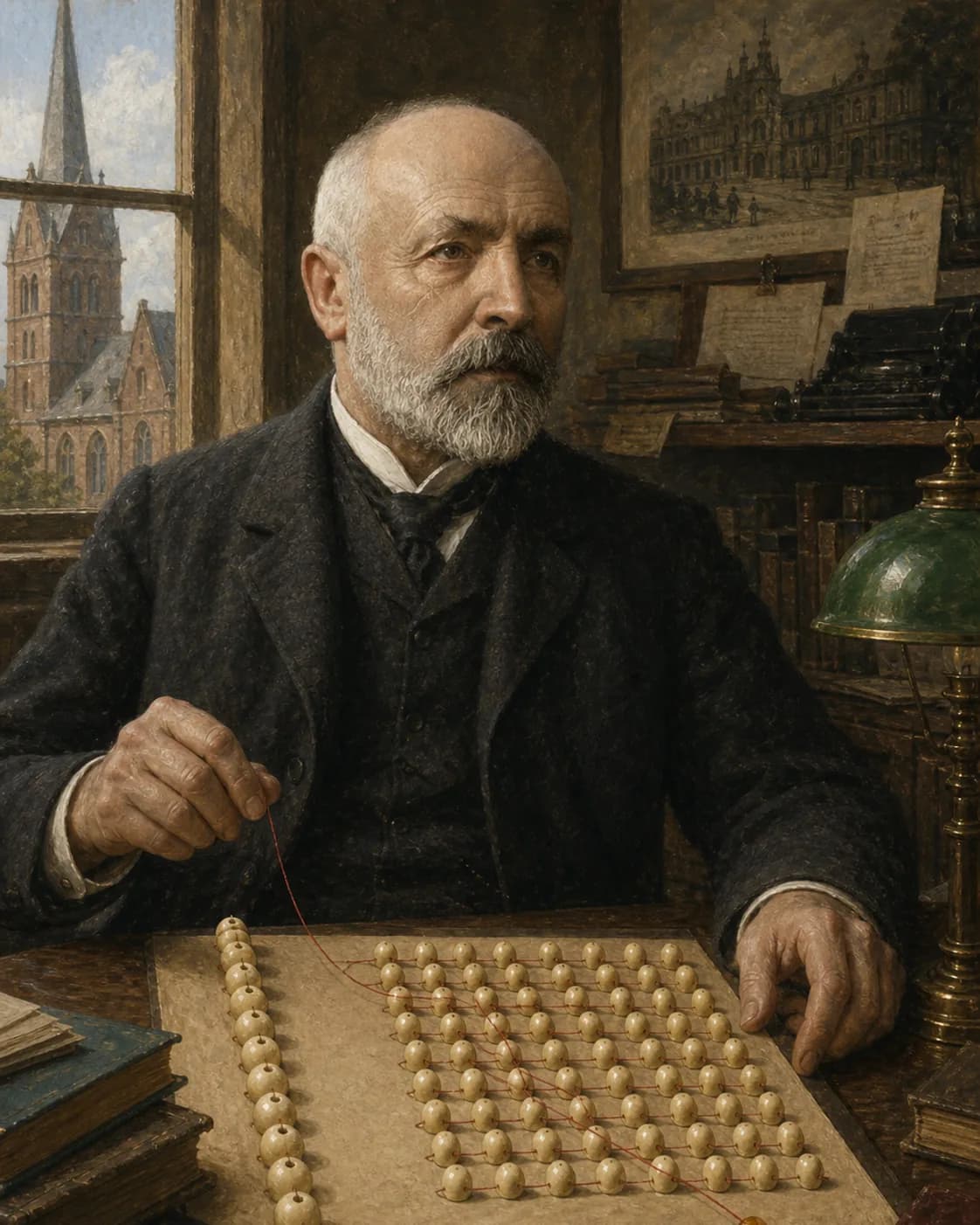
Even endless collections had to be tested for equal size
The face uses a surviving late-life photograph for recognition. The Halle scene compresses the 1874 uncountability proof, 1877 Dedekind correspondence, and 1891 diagonal argument; it does not claim that infinity or conflict with Kronecker caused Cantor's recurrent depression.
MathVoyage editorial direction · OpenAI image generation · historical photograph identity reference · 2026-08-07
Remember the mind, not only the dates
The idea to carry forward
On the 1877 square–line correspondence: “I see it, but I do not believe it.”Enter through one scene
A short paper proving that the reals cannot be put in one-to-one correspondence with the naturals — the first demonstration that infinities come in different sizes.
Suppose an infinite list claims to contain every binary sequence. Follow the diagonal—first digit of row one, second of row two—and flip each digit. The constructed sequence differs from every listed row somewhere.
Mark the diagonal, then flip every diagonal digit.
Use two steps to see why the new sequence escapes every row one by one.
Questions this person helps open
These are reverse projections of existing editorial routes, not claims of direct influence or sole invention.
If all mathematics is built from collections, what becomes possible—and what breaks?
Can one endless thing be larger than another?
Through Axiom of Choice: How far can mathematics control its own infinities, paradoxes, and limits of proof?
PROFILE 02 · DEEP VOYAGE
Instead of memorizing more dates, follow the world that shaped this mind, the scenes that changed its direction, and the questions carried onward.
CHAPTER 01 · PERSON AND PERIOD
Before the finished achievement, read what this person treated as a problem and where the surviving evidence reaches its limit.
A mathematician at Halle who made infinite sets comparable through one-to-one correspondence, proved that the naturals and reals have different cardinalities, and developed transfinite numbers. His ideas met serious opposition but also gained supporters during his lifetime. His recurrent depression should not be reduced to one opponent or one unsolved problem.
CHAPTER 02 · TURNING SCENES
Follow the moments when the idea moved one step further. Every scene continues through an evidenced place or an honestly labelled time context.
Scene 1 / 3
A short paper proving that the reals cannot be put in one-to-one correspondence with the naturals — the first demonstration that infinities come in different sizes.
Scene 2 / 3
A more elegant proof that the infinity of the reals exceeds that of the naturals. The same technique now powers proofs of the halting problem in computer science.
Scene 3 / 3
He spent his life asking is there an infinity between |ℕ| and |ℝ|? and could not solve it. Gödel’s 1940 relative-consistency result for CH and Cohen’s 1963 result for ¬CH together established independence from ZFC.
CHAPTER 04 · TOOLS LEFT BEHIND
The useful question is not a star rating, but what remained available for solving another problem.
Established a mathematical framework for studying infinity.
THOUGHT EXPERIMENT · NOT A FACT CLAIM
This is a thought experiment about influence, not a verified historical fact.
Infinite sets were studied before Cantor. His decisive move was to make “which infinity is larger?” a provable question through bijections, cardinality, and diagonal arguments. Later mathematics rebuilt and extended that language across set theory, analysis, topology, and logic.
STANDING ON SHOULDERS · EVIDENCED CONNECTIONS
We do not draw a line merely because two people shared an era. Only connections traced through works, problems, or teaching appear with an explanation and evidence.
Georg Cantor
Nineteenth-Century Mathematics
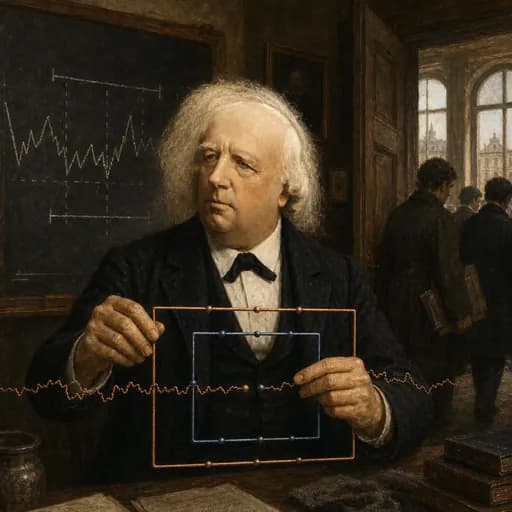
From trigonometric-series lectures to infinite sets
Cantor’s early work on trigonometric series clearly reflects Weierstrass’s Berlin teaching. Tracking exceptional sets in function theory helped lead him toward set theory and sizes of infinity.
Evidence for this connection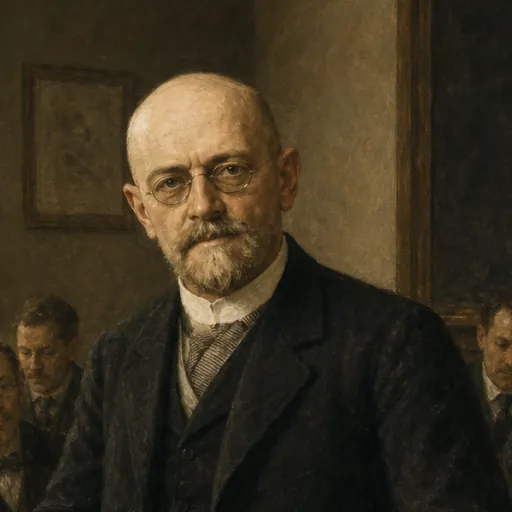
Making infinite sets a central mathematical problem
Hilbert strongly defended Cantor’s set theory and made the continuum hypothesis his first 1900 problem, placing sizes of infinity at the center of twentieth-century foundations.
Evidence for this connectionCurated sources and problems. Bring one discovery back from OEIS, Project Euler, MathOverflow, or arXiv.