Another viewpoint3/18
Calculus
How can instantaneous speed and distance over time become the same calculation?
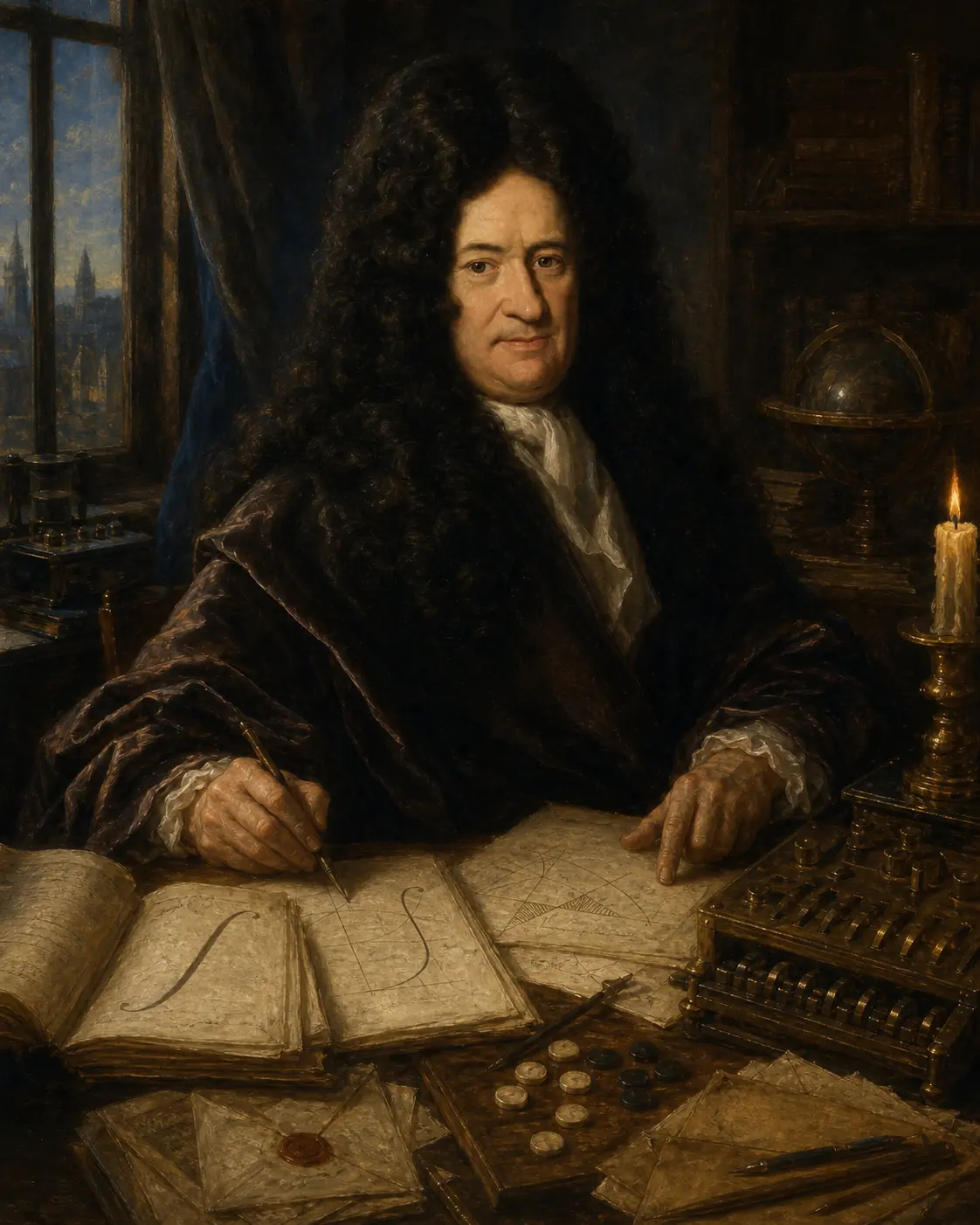
Notation compresses thought into an instrument other people can use
The face draws on the familiar Leibniz portrait tradition, but this Paris desk does not reproduce one manuscript or day. Leibniz developed calculus independently of Newton in the 1670s, and his notation gained power through publication, correspondence, and later users; the scene does not stage the priority dispute or a lone-inventor myth.
MathVoyage editorial direction · OpenAI image generation · historical likeness reference · 2026-08-07
Remember the mind, not only the dates
The idea to carry forward
Why is there something rather than nothing?Enter through one scene
His notes used the elongated S, ∫, for sums and developed rules with dx and dy. The notation matured through publication and use by colleagues.
Questions this person helps open
These are reverse projections of existing editorial routes, not claims of direct influence or sole invention.
How can instantaneous speed and distance over time become the same calculation?
PROFILE 02 · DEEP VOYAGE
Instead of memorizing more dates, follow the world that shaped this mind, the scenes that changed its direction, and the questions carried onward.
CHAPTER 01 · PERSON AND PERIOD
Before the finished achievement, read what this person treated as a problem and where the surviving evidence reaches its limit.
A philosopher, diplomat, jurist, historian, and mathematician, Leibniz developed calculus independently of Newton and published it first. His dx, dy, and ∫ notation became the standard language of calculus. He also systematized binary arithmetic and imagined a formal calculus of reasoning — ideas that later readers connected to digital computation, although modern computers were not a direct implementation of a single Leibniz design.
CHAPTER 02 · TURNING SCENES
Follow the moments when the idea moved one step further. Every scene continues through an evidenced place or an honestly labelled time context.
Scene 1 / 3
His notes used the elongated S, ∫, for sums and developed rules with dx and dy. The notation matured through publication and use by colleagues.
Scene 2 / 3
A short paper published differential rules. Newton had earlier unpublished work; publication, independence, and priority later became a bitter dispute.
Scene 3 / 3
He explained how to represent and calculate with integers using 0 and 1. Digital circuitry emerged much later from several logical and engineering traditions.
THOUGHT EXPERIMENT · NOT A FACT CLAIM
This is a thought experiment about influence, not a verified historical fact.
Leibnizian notation was not merely prettier: it exposed product, chain, and integration rules in manipulable symbols that others could learn and extend. Binary arithmetic and a universal symbolic language were separate intellectual experiments.
STANDING ON SHOULDERS · EVIDENCED CONNECTIONS
We do not draw a line merely because two people shared an era. Only connections traced through works, problems, or teaching appear with an explanation and evidence.
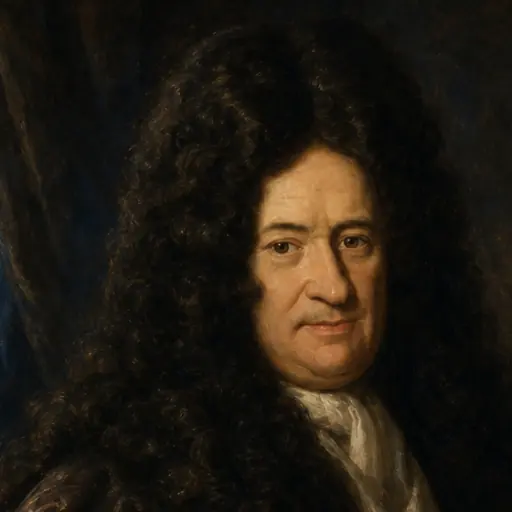
Gottfried Wilhelm Leibniz
Enlightenment
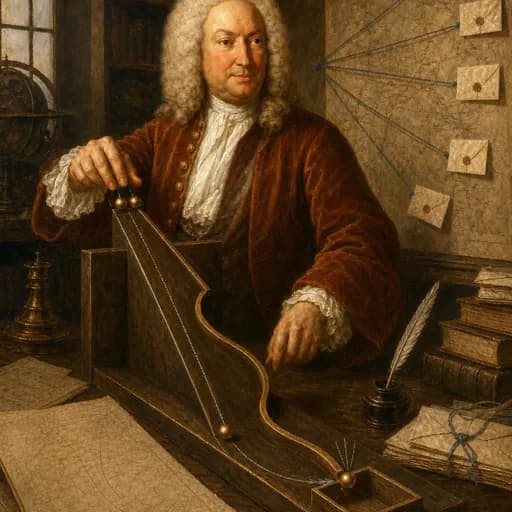
The most forceful carrier of Leibnizian calculus
Johann Bernoulli learned and developed the new calculus through correspondence with Leibniz. His problems, teaching, and students spread Leibnizian notation and methods across Europe.
Evidence for this connectionCurated sources and problems. Bring one discovery back from OEIS, Project Euler, MathOverflow, or arXiv.