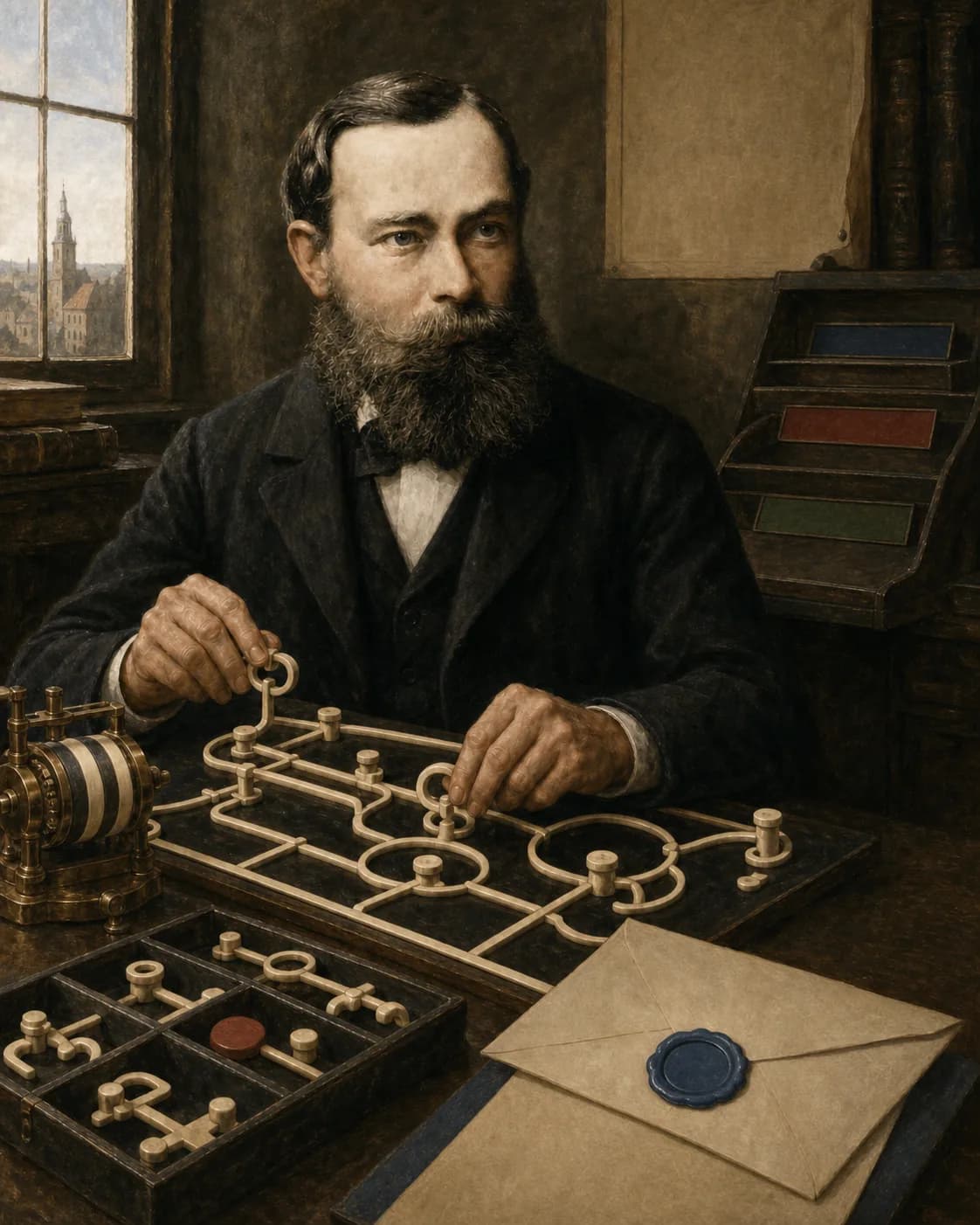
Gottlob Frege

Gottlob Frege

AD 1848 - AD 1925
Born in Wismar
Active in Jena
Modern Era

Life

In June 1902, when a letter arrived from 30-year-old Bertrand Russell in Cambridge, volume II of Frege's Grundgesetze der Arithmetik was in press. Russell's briefly stated paradox exposed an inconsistency tied to Basic Law V. Earlier, while Frege taught at Jena, Louis Nebert had published Begriffsschrift in Halle in 1879. It formalized quantification and function–argument analysis, laying foundations for modern predicate logic. Frege did not use the modern ∀/∃ glyphs there, and his mature treatment of truth-values belongs to later work. Few contemporaries read the book, but Russell, Husserl, and others carried its ideas forward.

In one line
Arithmetic is an extension of logic, and numbers are purely logical objects.

Decisive moments

AD 1879

Begriffsschrift — a foundation of modern predicate logic

Halle

While Frege taught at Jena, Louis Nebert published the work in Halle. It formalized quantification and function–argument analysis, laying foundations for modern predicate logic, but it did not use today's ∀/∃ glyphs and should not be credited with Frege's later mature truth-value theory.

AD 1893

Grundgesetze I — the attempt to reduce mathematics to logic

Jena

In volume I of the Basic Laws of Arithmetic, Frege treated the number of a concept F as the extension of the concept equinumerous with F, seeking to derive arithmetic from logic. Russell’s 1902 letter exposed the contradiction tied to Basic Law V, which governed extensions.

AD 1902

Russell's letter — exposing the problem with Basic Law V

Jena

On 16 June 1902, 30-year-old Russell wrote from Cambridge to explain the briefly stated paradox he had discovered in 1901. Frege publicly acknowledged the problem with his system in an appendix to Grundgesetze II.

If this person hadn't existed

This is a thought experiment about influence, not a verified historical fact.

Frege's Begriffsschrift (1879) presented a formal language combining quantification with function–argument analysis and laid foundations for modern predicate logic. It became an important antecedent for Russell's logicism, Hilbert's proof theory, and later work by Gödel, Church, and Turing on logic and computation. Russell's 1902 letter exposed the contradiction tied to Basic Law V, which Frege discussed publicly in an appendix to volume II of Grundgesetze.

Influence network

Beyond MathVoyage

Loading…