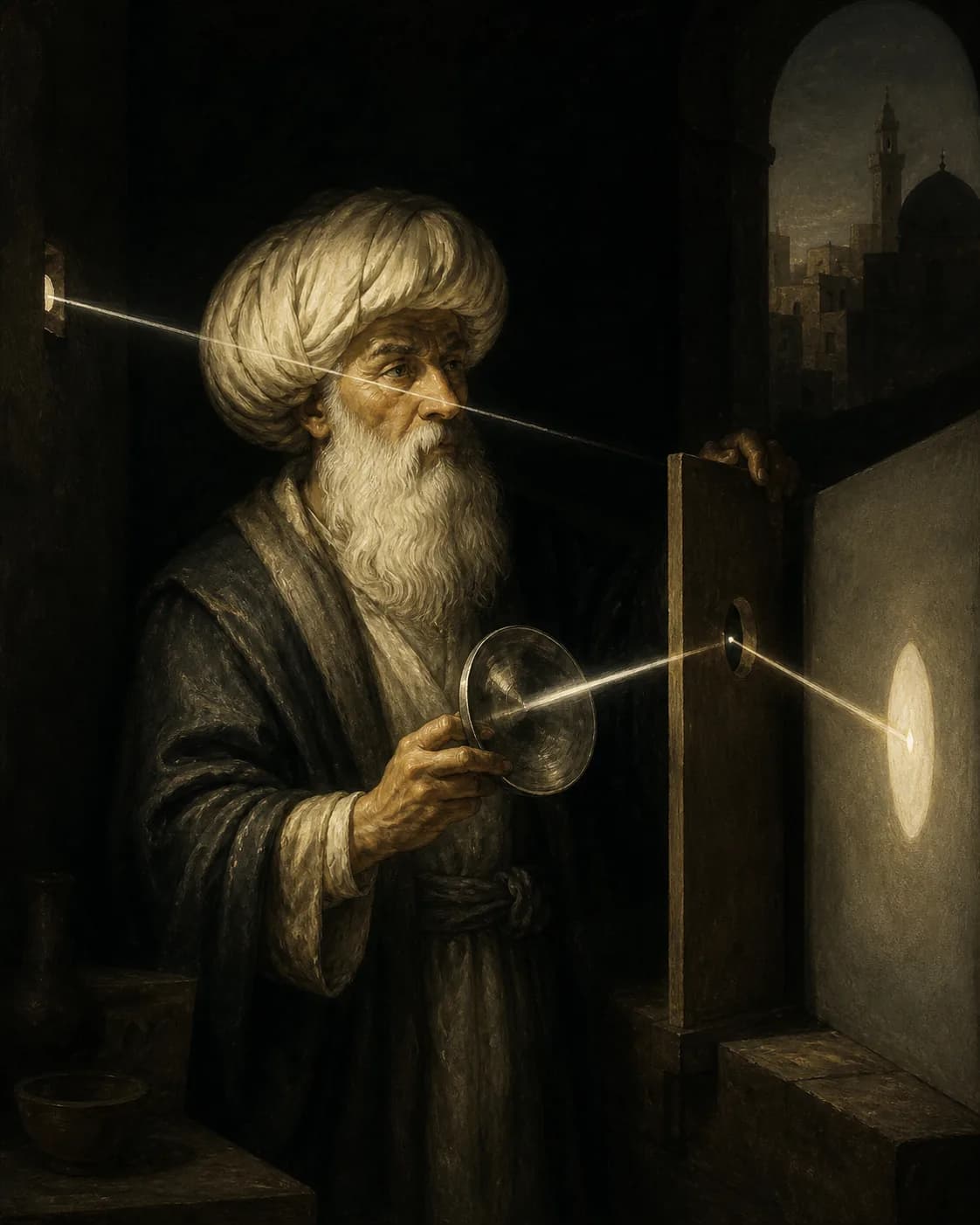
An editorial interpretation of Ibn al-Haytham, distinguished by later-print iconography, comparing a ray through an aperture with a mirror and screen in a Cairo-like dark room
AI editorial interpretation

Testing where light travels inside a darkened room

No verified lifetime portrait of Ibn al-Haytham or record of this exact experiment survives. The layered turban and long pale beard draw only on conventions in much later prints and banknotes, not evidence of his appearance. The room and apparatus condense geometry and observation in the Book of Optics without casting him as the sole inventor of scientific method or turning the Nile and confinement traditions into one heroic episode.

MathVoyage editorial direction · OpenAI image generation · later print/banknote iconography reference · no verified lifetime likeness · 2026-08-07

Remember the mind, not only the dates

Ibn al-Haytham

AD 965 - AD 1040 (estimated)
Thinking ground · Cairo
Islamic Golden AgeLight travels into the eyeComparing controlled conditionsA dialogue between geometry and observation

The idea to carry forward

The seeker after truth is one who suspects all that he reads.

Enter through one scene

AD 1011

A later biography of the Nile project and confinement

A later biography says he feigned madness under al-Hakim after recognizing that a Nile project was impossible. The story is influential but its details are not contemporary testimony.

Questions this person helps open

Concept ports to revisit, not another achievement list

These are reverse projections of existing editorial routes, not claims of direct influence or sole invention.

No concept port has yet been reviewed for this person.

Browse every concept route

PROFILE 02 · DEEP VOYAGE

How Ibn al-Haytham’s ideas moved

Instead of memorizing more dates, follow the world that shaped this mind, the scenes that changed its direction, and the questions carried onward.

CHAPTER 01 · PERSON AND PERIOD

What questions surrounded Ibn al-Haytham?

Before the finished achievement, read what this person treated as a problem and where the surviving evidence reaches its limit.

About 1 min read

A major author on optics who combined geometry, observation, and designed experiments to analyze light and vision. Later biographical stories about the Nile project and confinement must be distinguished from the surviving scientific works.

CHAPTER 02 · TURNING SCENES

3 turning scenes

Follow the moments when the idea moved one step further. Every scene continues through an evidenced place or an honestly labelled time context.

  1. Scene 1 / 3

    AD 1011Cairo

    A later biography of the Nile project and confinement

    A later biography says he feigned madness under al-Hakim after recognizing that a Nile project was impossible. The story is influential but its details are not contemporary testimony.

  2. Scene 2 / 3

    AD 1021Cairo· Geographic context

    Book of Optics — testing light and vision

    He combined geometric ray models with observation and experiment to analyze reflection, refraction, and vision while criticizing and synthesizing older theories.

  3. Scene 3 / 3

    AD 1200Cairo· Geographic context

    Movement into the Latin optical tradition

    Twelfth- and thirteenth-century Latin translations influenced the perspectivist and optical tradition leading through Bacon, Witelo, and Kepler.

THOUGHT EXPERIMENT · NOT A FACT CLAIM

Erase Ibn al-Haytham from the map

This is a thought experiment about influence, not a verified historical fact.

No single person invented the scientific method. Ibn al-Haytham shows a sophisticated medieval Arabic combination of observation, controlled tests, geometric models, and critical reading that strongly influenced Latin optics.

Beyond MathVoyage

Curated sources and problems. Bring one discovery back from OEIS, Project Euler, MathOverflow, or arXiv.