Central anchor8/13
Knot Theory
Through Knot Theory: What survives when shapes change, and which rules divide one world from another?
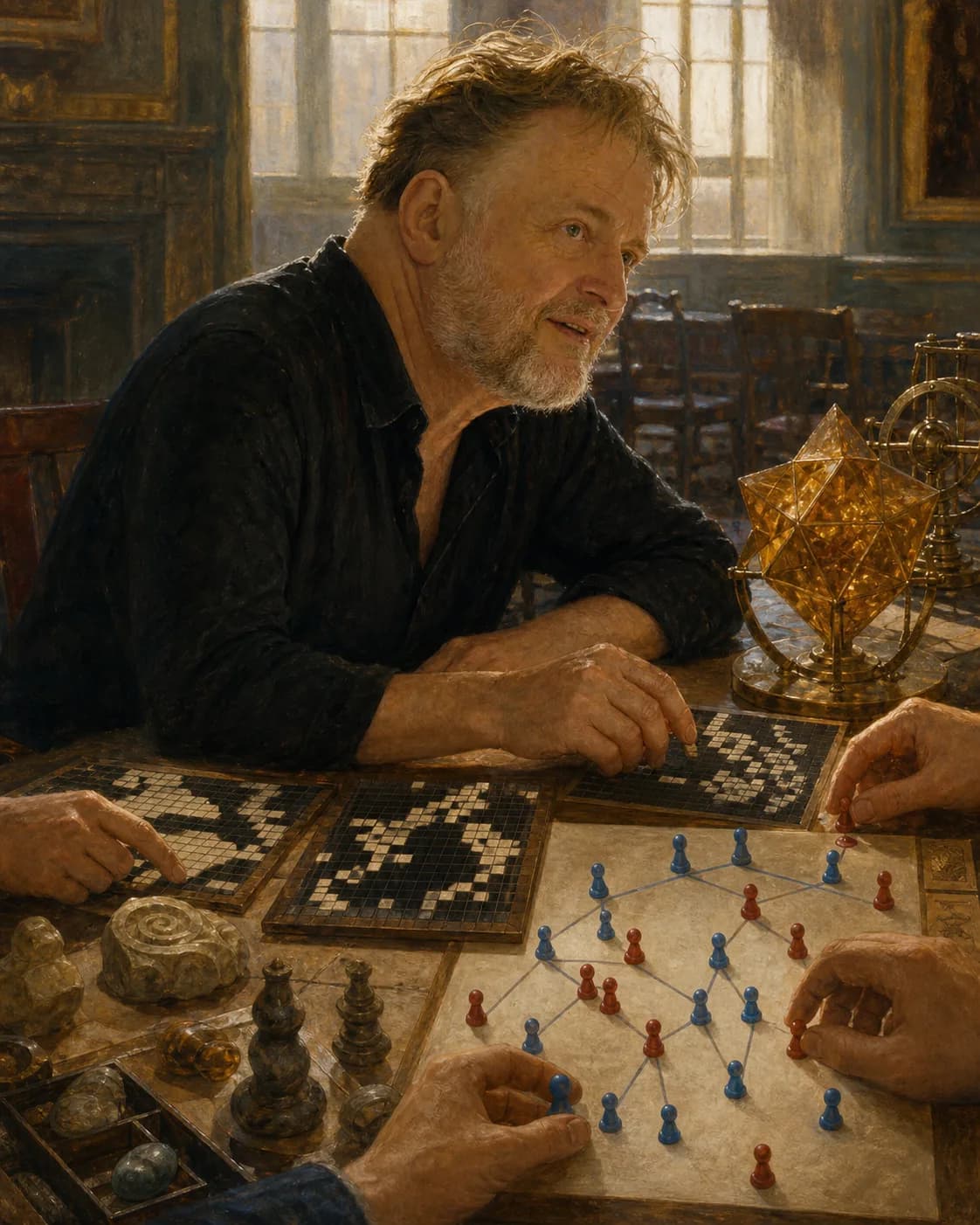
A few rules opening worlds of numbers, games, life, and symmetry
The face uses a public photograph. The common room compresses cellular automata, combinatorial games, surreal numbers, and group symmetry from different periods; it is not a class record. The Game of Life is one doorway among many, and later universality constructions or his death from COVID-19 are not consumed as one-instant invention or tragedy spectacle.
MathVoyage editorial direction · OpenAI image generation · historical photograph identity reference · 2026-08-07
Remember the mind, not only the dates
The idea to carry forward
Reduce the rules to a few lines, then play to see how complex their world can become.Enter through one scene
Two states and a neighbor-count rule produce still lifes, oscillators, and gliders. Later constructions demonstrated logic circuits and universal computation. Gardner’s 1970 column triggered widespread experimentation.
Questions this person helps open
These are reverse projections of existing editorial routes, not claims of direct influence or sole invention.
Through Knot Theory: What survives when shapes change, and which rules divide one world from another?
PROFILE 02 · DEEP VOYAGE
Instead of memorizing more dates, follow the world that shaped this mind, the scenes that changed its direction, and the questions carried onward.
CHAPTER 01 · PERSON AND PERIOD
Before the finished achievement, read what this person treated as a problem and where the surviving evidence reaches its limit.
A mathematician who used play as an entrance to research and then pursued the underlying structure deeply. Conway created the Game of Life in 1970, determining a cell’s survival from its number of neighbors; Martin Gardner’s column made it widely known. The emergence of gliders and computational complexity from simple rules is easy to explore directly. His research was much broader. Surreal numbers, developed through combinatorial games, contain the reals, ordinals, and many infinities and infinitesimals, although not every game is itself a number. McKay’s initial observation connecting the Monster group with coefficients of the j-function was developed by Thompson, Conway, Norton, and others, and Borcherds later proved the moonshine conjecture. Together with the Conway groups and work across knots, number theory, and geometry, this shows that play and depth need not be opposites.
CHAPTER 02 · TURNING SCENES
Follow the moments when the idea moved one step further. Every scene continues through an evidenced place or an honestly labelled time context.
Scene 1 / 4
Two states and a neighbor-count rule produce still lifes, oscillators, and gliders. Later constructions demonstrated logic circuits and universal computation. Gardner’s 1970 column triggered widespread experimentation.
Scene 2 / 4
In On Numbers and Games he constructed surreal numbers recursively from left and right options. They include reals, ordinals, and many infinities and infinitesimals, while combinatorial games form a wider class. Knuth’s 1974 novella popularized the name and idea.
Scene 3 / 4
After initial observations by McKay and Thompson, Conway and Norton developed the relation between Monster representations and j-function coefficients into detailed conjectures. Borcherds proved them using vertex operator algebras and received the 1998 Fields Medal.
Scene 4 / 4
After 25 years at Cambridge he moved to Princeton, remaining active for 33 more years — work on number theory, the Free Will Theorem with Simon Kochen (2006), and much more. He died of COVID-19 in April 2020.
THOUGHT EXPERIMENT · NOT A FACT CLAIM
This is a thought experiment about influence, not a verified historical fact.
Beginners hunt for blinkers and gliders on a small grid. Intermediate learners code the update rule and classify periods or growth. Advanced learners study universal computation in Life and values of combinatorial games. Experts continue to the recursive construction of surreal numbers or the moonshine link between Monster representations and modular functions.
Curated sources and problems. Bring one discovery back from OEIS, Project Euler, MathOverflow, or arXiv.