Another viewpoint5/5
Game Theory
If my best move depends on yours, where does rationality live?
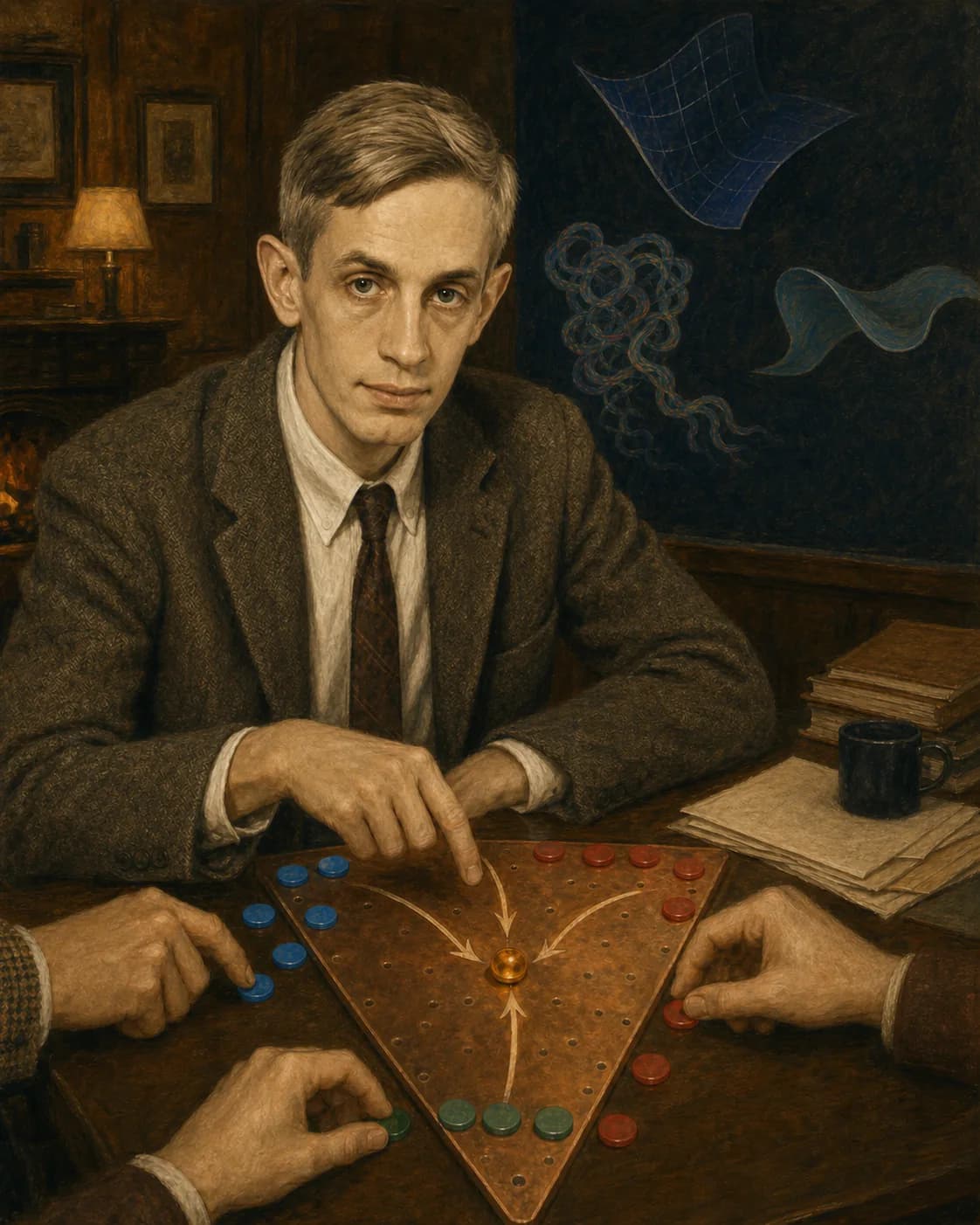
Stable not because everyone is satisfied, but because no one gains by deviating alone
Durable cues from a known later photograph are re-aged toward Nash at about 22 in 1950. The room combines mixed-strategy equilibrium in finite noncooperative games with distinct embedding and nonlinear-PDE work; it is not one proof moment. Equilibrium is not equated with social optimality, and schizophrenia, hospitalization, recovery, film, prizes, and death do not precede the mathematics.
MathVoyage editorial direction · OpenAI image generation · historical photograph identity reference · age and generated-text correction · 2026-08-07
Remember the mind, not only the dates
The idea to carry forward
An equilibrium is not a state where everyone is happy; it is one where no player gains by deviating alone.Enter through one scene
His Princeton thesis proved existence of equilibrium for finite noncooperative games when mixed strategies are allowed. It is not an unconditional claim about every possible game.
Questions this person helps open
These are reverse projections of existing editorial routes, not claims of direct influence or sole invention.
If my best move depends on yours, where does rationality live?
PROFILE 02 · DEEP VOYAGE
Instead of memorizing more dates, follow the world that shaped this mind, the scenes that changed its direction, and the questions carried onward.
CHAPTER 01 · PERSON AND PERIOD
Before the finished achievement, read what this person treated as a problem and where the surviving evidence reaches its limit.
A mathematician who formalized a state in which, given everyone else’s choices, no player can gain by changing strategy alone. Nash’s 1950 thesis proved that every finite noncooperative game has at least one equilibrium when mixed strategies are allowed; the finiteness and mixed-strategy hypotheses matter. His work also reached far beyond game theory, including the Nash embedding theorem and nonlinear partial differential equations. From 1959, schizophrenia and hospitalizations severely interrupted his research and life, and his symptoms eased gradually over many years. That experience should not be consumed as “thirty lost years,” a campus ghost, or a miraculous recovery owed to one person. In 1994 he shared the economics prize with Harsanyi and Selten for equilibrium analysis, and in 2015 shared the Abel Prize with Nirenberg for nonlinear PDE. He and his wife Alicia died in a traffic accident later that year.
CHAPTER 02 · TURNING SCENES
Follow the moments when the idea moved one step further. Every scene continues through an evidenced place or an honestly labelled time context.
Scene 1 / 4
His Princeton thesis proved existence of equilibrium for finite noncooperative games when mixed strategies are allowed. It is not an unconditional claim about every possible game.
Scene 2 / 4
Schizophrenia and several hospitalizations seriously affected his research and family life. The later easing of symptoms was a nonlinear process across many years.
Scene 3 / 4
He shared the prize with Harsanyi and Selten for pioneering analysis of equilibria in noncooperative games.
Scene 4 / 4
They were honored for nonlinear partial differential equations and geometric analysis. After returning from Norway, Nash and Alicia died in a traffic accident in New Jersey.
THOUGHT EXPERIMENT · NOT A FACT CLAIM
This is a thought experiment about influence, not a verified historical fact.
Beginners see why a fixed choice in rock–paper–scissors can be exploited. Intermediate learners find best responses and pure or mixed equilibria in payoff tables. Advanced learners follow the finite-game existence proof through Brouwer’s fixed-point theorem. Experts study equilibrium selection, refinements, computational complexity, and the difference between strategic stability and social desirability.
STANDING ON SHOULDERS · EVIDENCED CONNECTIONS
We do not draw a line merely because two people shared an era. Only connections traced through works, problems, or teaching appear with an explanation and evidence.
John Nash
Modern Era
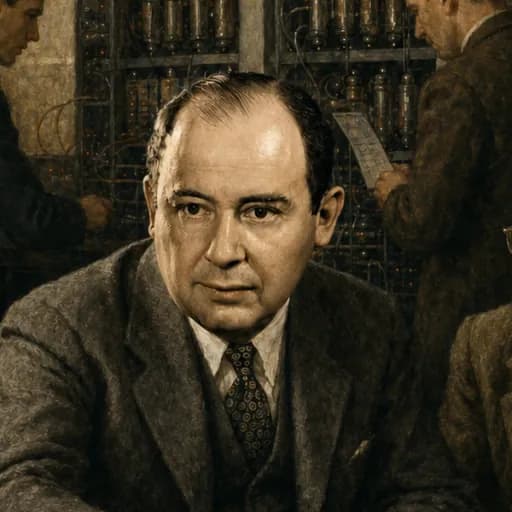
From zero-sum games to equilibrium for every player
After von Neumann and Morgenstern developed game theory around strategic and largely zero-sum settings, Nash generalized equilibrium to n-player games mixing competition and cooperation.
Evidence for this connectionCurated sources and problems. Bring one discovery back from OEIS, Project Euler, MathOverflow, or arXiv.