Another viewpoint1/13
Pythagorean Theorem
Why did one right-triangle equation crack the world of fractions?
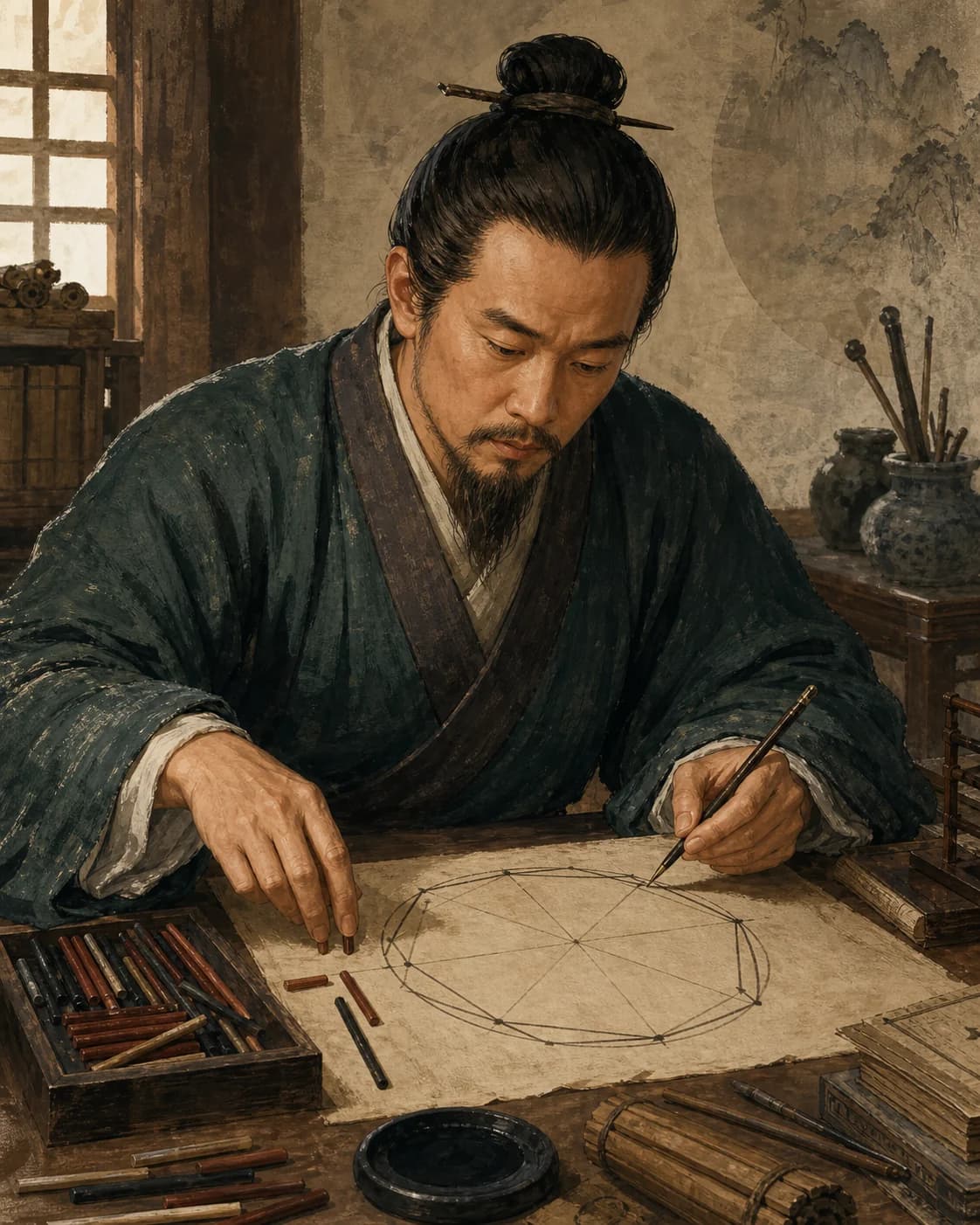
A mathematician who narrows error instead of merely declaring an answer
No verified lifetime portrait of Liu Hui is known. The clothing, face, and study are a modern evocation of third-century Chinese calculation and commentary.
MathVoyage editorial direction · OpenAI image generation · 2026-08-07
Remember the mind, not only the dates
The idea to carry forward
Increasing the sides of an inscribed regular polygon refines the approximation of π.Enter through one scene
He added explanations to procedures involving fractions, ratios, systems of equations, areas, volumes, and right triangles, and examined approximation accuracy and gaps in some arguments.
Instead of measuring a circle directly, place a regular polygon inside it and keep adding sides. Liu Hui’s crucial move was not merely to report a number, but to reason about why the leftover pieces and error became smaller.
What changes when the number of sides keeps doubling?
Choose a side count and compare the polygon with π.
Polygon lower bound
3.000000
Gap to π
0.141593
This is a modern lower-bound visualization from the perimeter of a regular polygon inside a unit circle. It is not an exact reconstruction of Liu Hui’s diagrams or calculation procedure.
Questions this person helps open
These are reverse projections of existing editorial routes, not claims of direct influence or sole invention.
Why did one right-triangle equation crack the world of fractions?
How can one table hold a rule that moves many numbers at once?
PROFILE 02 · DEEP VOYAGE
Instead of memorizing more dates, follow the world that shaped this mind, the scenes that changed its direction, and the questions carried onward.
CHAPTER 01 · PERSON AND PERIOD
Before the finished achievement, read what this person treated as a problem and where the surviving evidence reaches its limit.
A mathematician of third-century Cao Wei China. Little is known about his life, but his commentary on the Nine Chapters on the Mathematical Art, dated around 263, and the Sea Island Mathematical Manual survive. He added explanations of why many procedures work, treating systems of linear equations with positive and negative numbers, areas and volumes, and right-triangle relations. By repeatedly increasing the number of sides of an inscribed regular polygon, he obtained π ≈ 3.1416 and examined the accuracy of approximations. The nine problems of the Sea Island Mathematical Manual use observations from two positions and right-triangle relations to determine inaccessible heights and distances.
CHAPTER 02 · TURNING SCENES
Follow the moments when the idea moved one step further. Every scene continues through an evidenced place or an honestly labelled time context.
Scene 1 / 3
He added explanations to procedures involving fractions, ratios, systems of equations, areas, volumes, and right triangles, and examined approximation accuracy and gaps in some arguments.
Scene 2 / 3
By repeatedly doubling the sides of an inscribed regular polygon, Liu Hui refined the approximation of π to 3.1416. The method combines the idea of polygons approaching a circle with checks on approximation error.
Scene 3 / 3
Nine problems use observations from two positions and right-triangle relations to determine values that are hard to measure directly, such as an island’s height, a valley’s depth, or a river’s width.
THOUGHT EXPERIMENT · NOT A FACT CLAIM
This is a thought experiment about influence, not a verified historical fact.
Without Liu Hui’s commentary, an important record explaining and testing procedures in the Nine Chapters would have been lost. It would be too strong to say that all Chinese mathematics would therefore have lacked reasoning, but the route by which later scholars studied and extended this classic might have differed.
Curated sources and problems. Bring one discovery back from OEIS, Project Euler, MathOverflow, or arXiv.