Another viewpoint3/18
Calculus
How can instantaneous speed and distance over time become the same calculation?
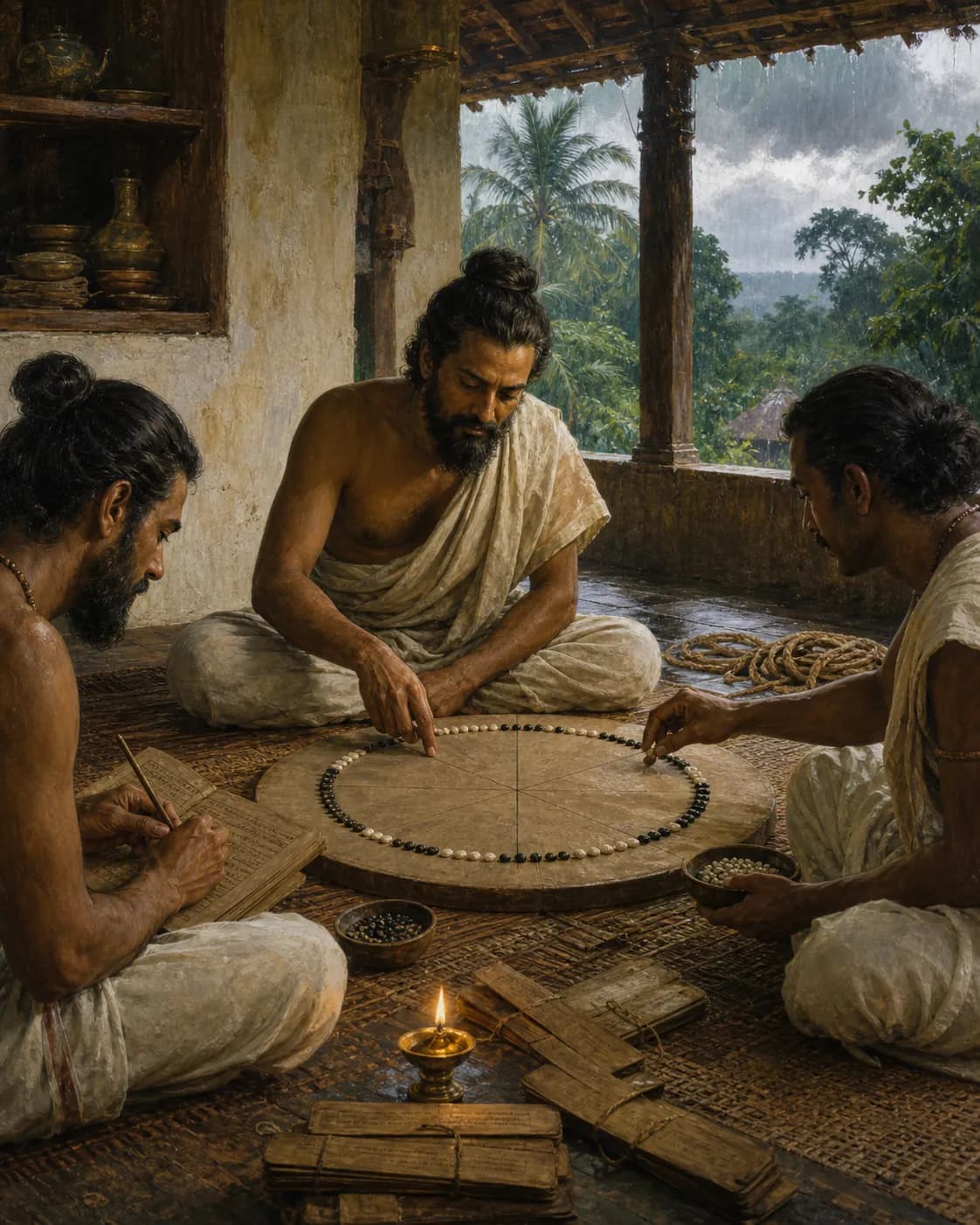
Approaching the circle by correcting an endless sum
No verified lifetime portrait or original mathematical work by Madhava survives; his results are transmitted through later Kerala authors. The face and study circle are modern interpretations, not claims that he completed modern calculus alone or that his results passed directly to Newton and Leibniz.
MathVoyage editorial direction · OpenAI image generation · no verified lifetime likeness · 2026-08-07
Remember the mind, not only the dates
The idea to carry forward
The circumference equals four times the diameter, minus one-third, plus one-fifth, minus one-seventh… without end.Enter through one scene
He used the series π/4 = 1 - 1/3 + 1/5 - 1/7 + … together with correction terms that accelerate convergence, obtaining an eleven-decimal approximation of π. Comparable series reappeared in Europe more than two centuries later.
π/4=1−1/3+1/5−1/7+… is simple and startlingly slow. The Kerala tradition matters not only for summing indefinitely, but also for reasoning about the remainder and correcting it.
Increase the term count and watch the distance to π.
Move from 1 to 1,000 terms and see that “continues forever” is not the same as “approaches quickly.”
Partial sum × 4
4.00000000
Gap to π
8.58e-1
The screen computes modern raw partial sums without correction terms. It is not an exact reconstruction of the corrections or eleven-decimal value attributed to Madhava in later Kerala texts.
Questions this person helps open
These are reverse projections of existing editorial routes, not claims of direct influence or sole invention.
How can instantaneous speed and distance over time become the same calculation?
PROFILE 02 · DEEP VOYAGE
Instead of memorizing more dates, follow the world that shaped this mind, the scenes that changed its direction, and the questions carried onward.
CHAPTER 01 · PERSON AND PERIOD
Before the finished achievement, read what this person treated as a problem and where the surviving evidence reaches its limit.
A mathematician of late-fourteenth-century Kerala who studied infinite series for π and trigonometric functions. Madhava’s mathematical writings are lost, but later Kerala authors including Nilakantha and Jyesthadeva report results attributed to him. They include the π/4 series now often called the Gregory-Leibniz series, series corresponding to sin, cos, and arctan, an approximation of π to eleven decimal places, and correction terms that improve convergence. These results predate comparable European rediscoveries by more than two centuries. Direct transmission from Kerala to Europe has been proposed, but the surviving evidence does not establish a specific route. Madhava’s work is therefore most safely understood as an achievement of an independently developed Kerala mathematical tradition.
CHAPTER 02 · TURNING SCENES
Follow the moments when the idea moved one step further. Every scene continues through an evidenced place or an honestly labelled time context.
Scene 1 / 3
He used the series π/4 = 1 - 1/3 + 1/5 - 1/7 + … together with correction terms that accelerate convergence, obtaining an eleven-decimal approximation of π. Comparable series reappeared in Europe more than two centuries later.
Scene 2 / 3
Later Kerala texts attribute to Madhava results equivalent to the modern series expansions of sin, cos, and arctan. The work predates comparable European developments by more than two centuries.
Scene 3 / 3
Madhava’s mathematical writings are lost, but later authors such as Nilakantha and Jyesthadeva recorded results attributed to him. Jyesthadeva’s sixteenth-century Yuktibhāṣā preserves explanations and arguments for related series.
THOUGHT EXPERIMENT · NOT A FACT CLAIM
This is a thought experiment about influence, not a verified historical fact.
Without Madhava’s work, the Kerala school’s development of infinite series and numerical approximation might have followed a different path. European calculus arose within separate traditions, so its existence cannot be made to depend on one person; earlier circulation of Madhava’s work could nevertheless have changed patterns of exchange and the way this history was later told.
Curated sources and problems. Bring one discovery back from OEIS, Project Euler, MathOverflow, or arXiv.