Maria Agnesi

Maria Agnesi

AD 1718 - AD 1799
Milan
Enlightenment

Life

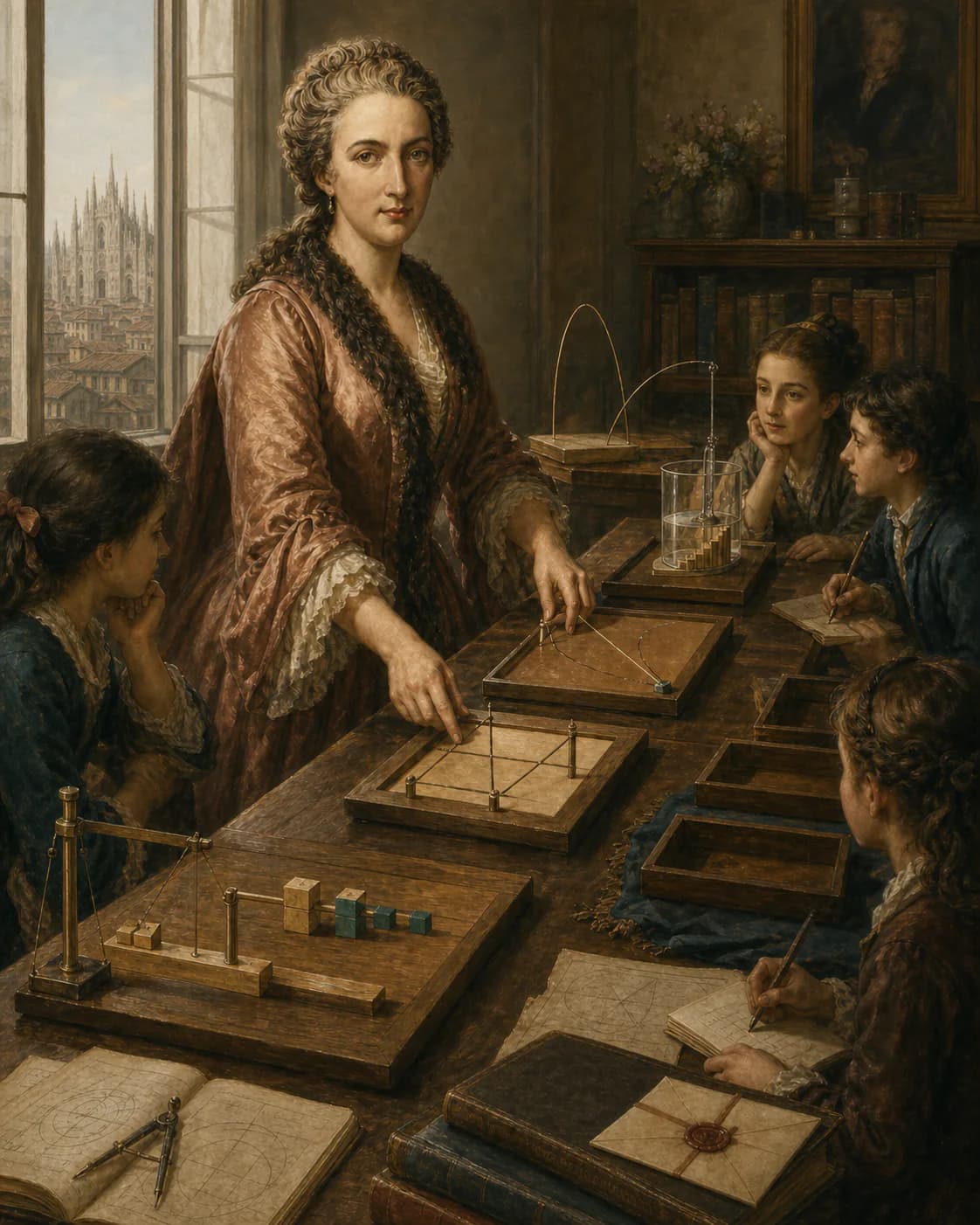
Maria Agnesi wrote an important systematic textbook of eighteenth-century calculus. Published in Milan in two volumes in 1748 and 1749, her Instituzioni analitiche ad uso della gioventù italiana organized algebra, analytic geometry, differential calculus, and integral calculus into a connected course. Pope Benedict XIV praised the work, and in 1750 Agnesi was offered a mathematics chair at the University of Bologna. Her name remained on the university rolls, but she never taught there. She later devoted most of her life to religious work and care for poor and ill people in Milan. The name “Witch of Agnesi” is commonly explained as a confusion that arose while translating the Italian word versiera into English.

In one line
y(x² + a²) = a³ — one form of the curve known as the Witch of Agnesi.

Decisive moments

AD 1748

Instituzioni analitiche — a course from algebra through calculus

Milan

Published in two volumes in 1748 and 1749, Analytical Institutions for the use of Italian Youth connected algebra, analytic geometry, differential calculus, and integral calculus in a systematic course. Later French and English translations made it widely known in European mathematics education.

AD 1748

The Witch of Agnesi — a name shaped by translation

Milan

The curve, which can be written as y(x² + a²) = a³, was known before Agnesi but became widely associated with her textbook. The English word “witch” is commonly explained as a translation-era confusion between the Italian words versiera and avversiera.

AD 1750

Offer of a mathematics chair at Bologna

Milan

With the support of Pope Benedict XIV, Agnesi was offered a mathematics chair at the University of Bologna. Her name remained on the university rolls for many years, but she did not go to Bologna to teach.

If this person hadn't existed

This is a thought experiment about influence, not a verified historical fact.

Without Agnesi's textbook, one major route for learning algebra, analytic geometry, and calculus as a connected course would have been absent from eighteenth-century Europe. Other textbooks would have filled part of the gap, but the public precedent of a woman being recognized as the author of a large mathematical work might have looked different.

Beyond MathVoyage

Loading…