Maryam Mirzakhani

Maryam Mirzakhani

AD 1977 - AD 2017
Born in Tehran
Active in Stanford
Modern Era

Life

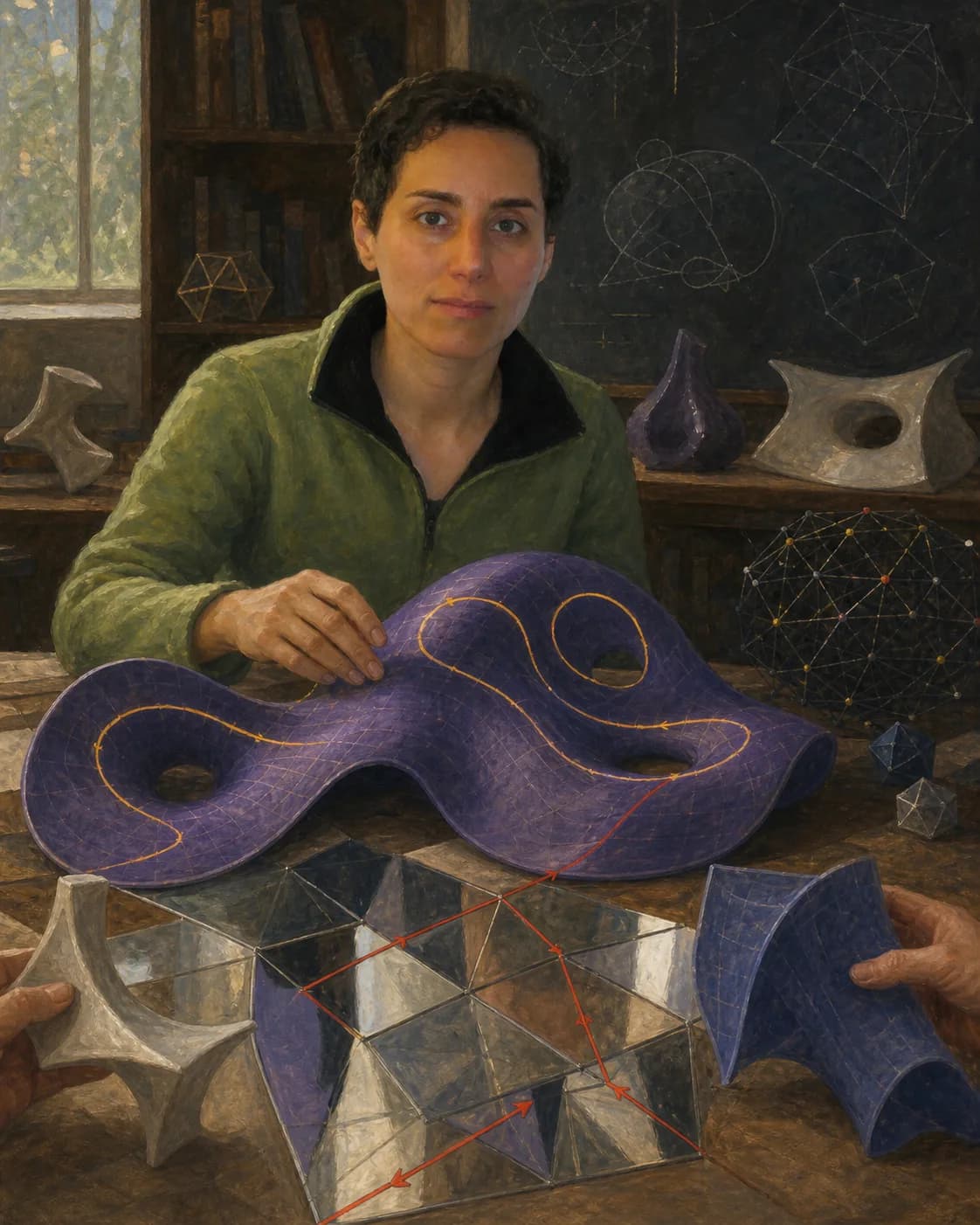
A mathematician who connected counting closed paths on surfaces with volumes and dynamics on moduli spaces. In 1994 Mirzakhani and Roya Beheshti became the first girls on Iran’s International Mathematical Olympiad team and won gold; Mirzakhani earned a perfect-score gold in 1995. Her 2004 Harvard thesis studied the growth of simple closed geodesics on hyperbolic Riemann surfaces, and its recursion gave a new route from Weil–Petersson volumes to Witten’s conjecture. She later studied dynamics of translation surfaces with Eskin and others. In 2014 she became the first woman to receive the Fields Medal, for the dynamics and geometry of Riemann surfaces and their moduli spaces. That institutional first matters, but her mathematics should not be reduced to gender or to her death from breast cancer in 2017; the route leads through actual problems about surfaces, geodesics, and orbit behavior.
In one line
Count closed paths on one surface, and the volume of the space of all such surfaces begins to appear.

Decisive moments

AD 1994

One of the first two girls on Iran’s IMO team

Tehran

With Roya Beheshti she became one of the first two girls on Iran’s team, scoring 41/42 for gold. In 1995 she returned with a perfect 42/42 gold.

AD 2004

Harvard PhD — moduli spaces

Cambridge, MA

She studied how the number of simple closed geodesics below a length bound grows on a hyperbolic Riemann surface and connected the count to recursions for volumes of moduli spaces.

AD 2014

First woman to win the Fields Medal

Seoul

She became the first woman Fields Medalist, recognized for the dynamics and geometry of Riemann surfaces and their moduli spaces.

AD 2017

Death from breast cancer

She died at 40. Her work continues through active research in moduli spaces, hyperbolic geometry, and dynamics.

If this person hadn't existed

This is a thought experiment about influence, not a verified historical fact.

Beginners draw nonintersecting loops on a sphere and a torus. Intermediate learners compare geodesics on hyperbolic surfaces of different genus. Advanced learners follow recursions for moduli-space volumes. Experts study the SL(2,R) action on translation surfaces and the Eskin–Mirzakhani measure-classification theorem.

Influence network

Influenced by

Beyond MathVoyage

Loading…