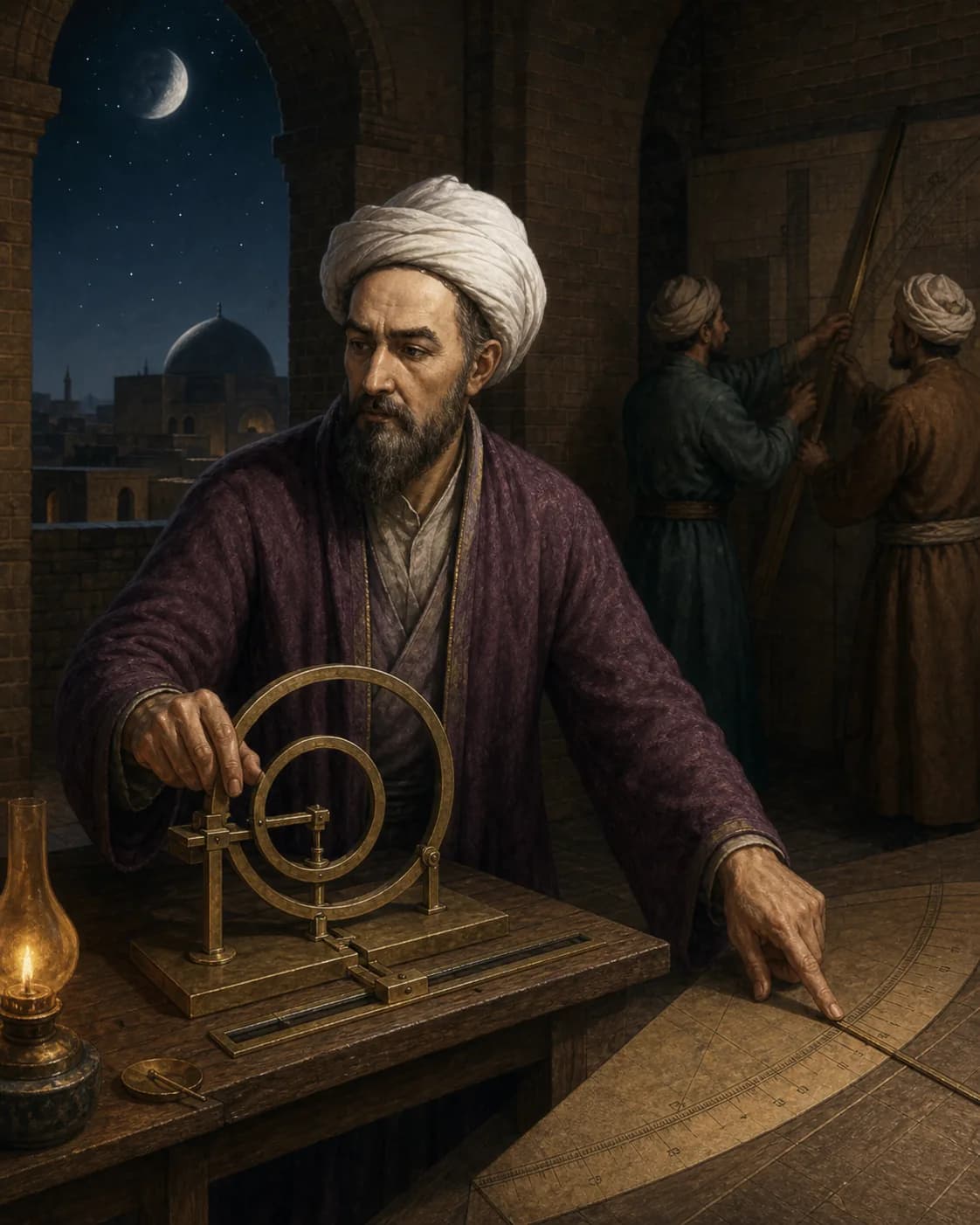
Nasir al-Din al-Tusi

Nasir al-Din al-Tusi

AD 1201 - AD 1274
Born in Tus
Active in Maragheh
Islamic Golden Age

Life

A Persian scholar who reorganized geometry and observation amid conquest and changing systems of patronage. Born in Tus, al-Tusi spent many years at fortresses of the Nizari Ismailis. Whether different periods of that residence were patronage or confinement remains disputed. After Alamut surrendered to Mongol forces in 1256, he served as an adviser to Hulagu and led the creation of the Maragheh observatory, gathering scholars, instruments, and books from several regions. The story that he personally rescued the last documents of Baghdad’s House of Wisdom in 1258 lacks adequate evidence. His Treatise on the Complete Quadrilateral was an important systematic account of plane and spherical trigonometry. The Tusi couple combines two circular motions to produce linear oscillation and was used to revise Ptolemaic planetary models. A strikingly similar construction appears in Copernicus, but the route of transmission remains debated.

In one line
Combine two circular motions and a point can oscillate along a straight line.

Decisive moments

AD 1256

A new patronage system after Alamut’s surrender

Alamut

After Alamut surrendered in 1256, he became an adviser to Hulagu. His position in the Nizari fortresses and his choices under Mongol rule are more complex than a simple captivity-and-rescue story.

AD 1259

Maragheh observatory — organizing observation institutionally

Maragheh

With Hulagu’s patronage he led a research institution gathering scholars, books, and large observational instruments. Long-term observations bringing together several regional traditions produced the Ilkhanic Tables.

AD 1260

Shakl al-qatta — a system of plane and spherical trigonometry

Maragheh

Using the complete quadrilateral, he developed relations for plane and spherical triangles, including the sine rule. It was an important step from astronomical examples toward a general theory of trigonometry.

AD 1261

Tusi couple — from circular motion to linear oscillation

Maragheh

When a smaller circle rotates oppositely inside a circle of twice its radius, a point on the smaller circle oscillates along a diameter. Copernicus used a similar construction, but its route of transmission is not established.

If this person hadn't existed

This is a thought experiment about influence, not a verified historical fact.

Beginners watch a point move along a line as a small circle rolls inside a larger one. Intermediate learners calculate the radius and angular-speed ratios; advanced learners prove the motion with parametric equations or complex numbers. Experts compare Maragheh manuscripts, Copernican diagrams, and possible routes of transmission to ask how historians distinguish influence from independent rediscovery.

Beyond MathVoyage

Loading…