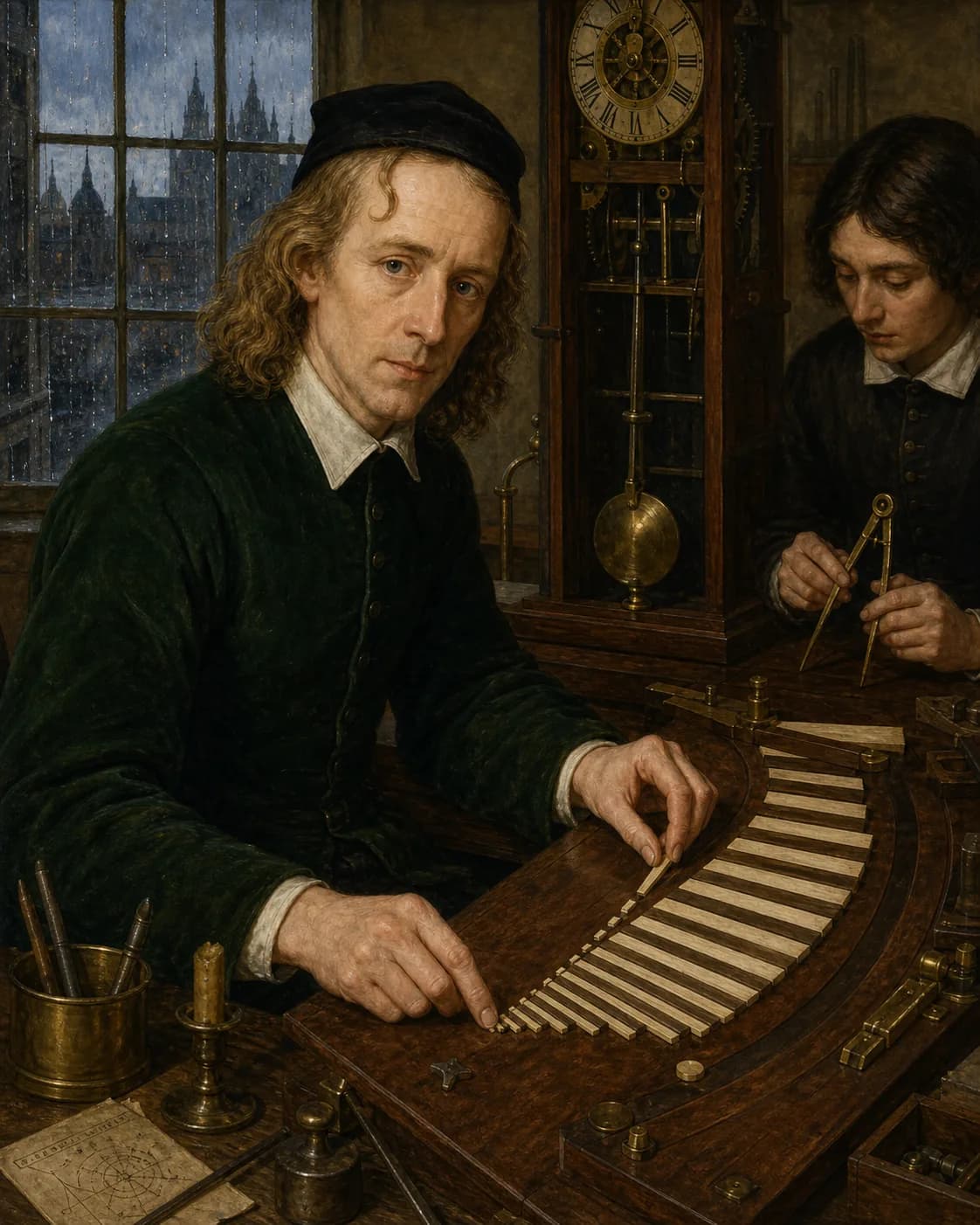
CHAPTER 01 · PERSON AND PERIOD
What questions surrounded Nicolaus Mercator?
Before the finished achievement, read what this person treated as a problem and where the surviving evidence reaches its limit.
A seventeenth-century mathematician who connected the computation of logarithm tables with infinite series. Nicolaus Mercator was not Gerardus Mercator, the cartographer associated with the map projection. In his 1668 Logarithmotechnia, Nicolaus published the expansion now called the Mercator series, ln(1+x)=x−x²/2+x³/3−…. It converges for −1<x≤1, but is very slow near x=1, so it did not replace every logarithm table “in a few lines.” A practical algorithm must first move the input closer to zero with identities and then control truncation error. Newton was also studying binomial series and term-by-term integration more generally around this period; priority in early calculus and series cannot be reduced to one publication date. Mercator’s example is a good entrance to why a formula’s interval of convergence and efficiency matter as much as memorizing it.