Another viewpoint3/13
Non-Euclidean Geometry
If one rule about parallel lines changes, does the shape of the universe change too?
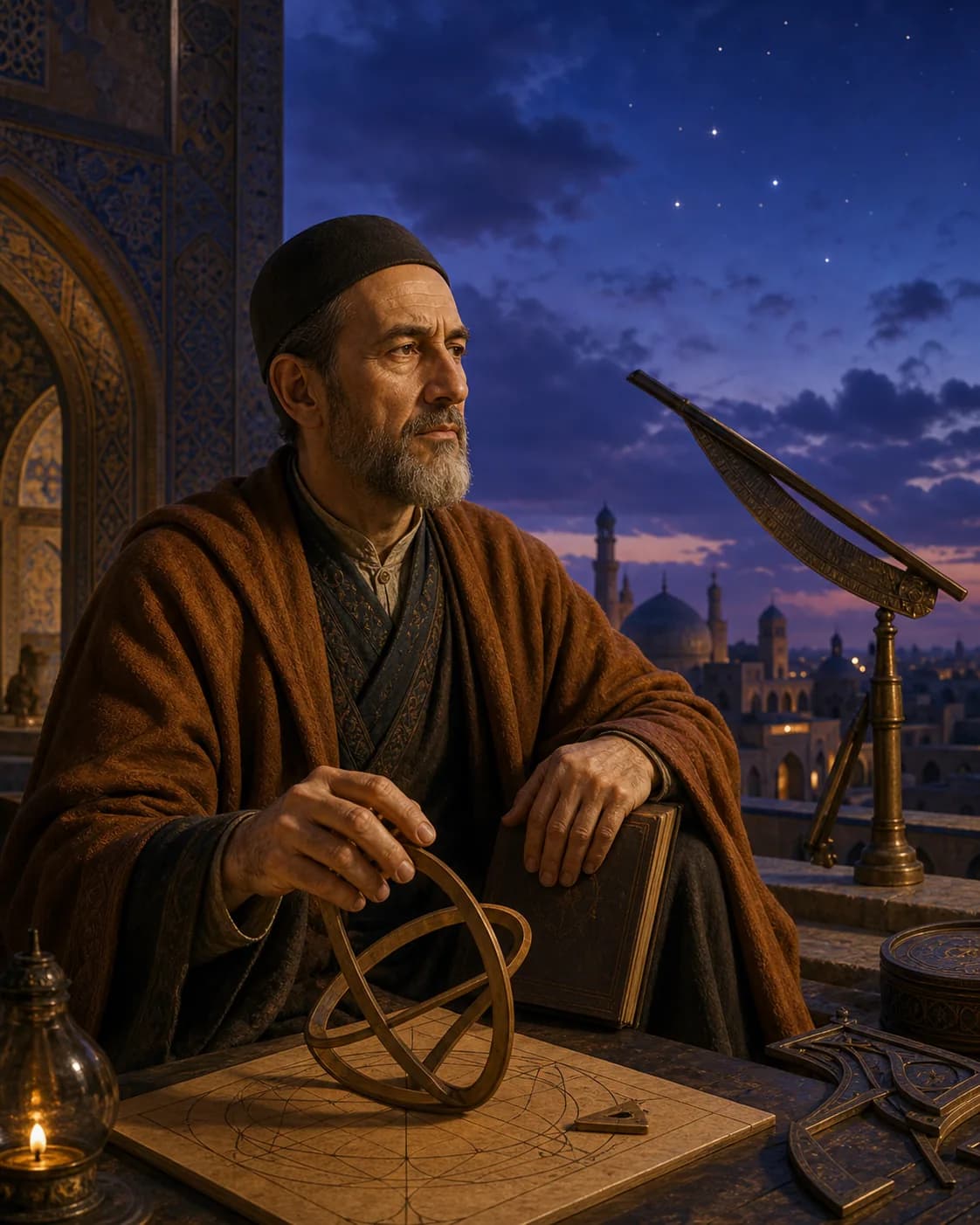
Where conics meet, a cubic root appears as a length
No verified lifetime portrait of Omar Khayyam or record of this workshop survives. The low cap and neat beard draw on much later commemorative sculpture only for recognition, not as evidence of his appearance. The face and Isfahan setting join his geometric classification of cubics with calendar reform without projecting a general algebraic formula, modern coordinate geometry, or a telescope back onto his work.
MathVoyage editorial direction · OpenAI image generation · later commemorative sculpture reference · no verified lifetime likeness · 2026-08-07
Remember the mind, not only the dates
The idea to carry forward
The Moving Finger writes; and, having writ, moves on.Enter through one scene
He classified types of cubic equations and constructed positive roots through conic intersections, within conventions different from modern treatments of negative, zero, and multiple roots.
Questions this person helps open
These are reverse projections of existing editorial routes, not claims of direct influence or sole invention.
If one rule about parallel lines changes, does the shape of the universe change too?
PROFILE 02 · DEEP VOYAGE
Instead of memorizing more dates, follow the world that shaped this mind, the scenes that changed its direction, and the questions carried onward.
CHAPTER 01 · PERSON AND PERIOD
Before the finished achievement, read what this person treated as a problem and where the surviving evidence reaches its limit.
A mathematician, astronomer, and philosopher who classified cubic equations and constructed positive solutions with intersecting conics. His conventionally cited 1048 birth is reconstructed from a horoscope reported in a later biography, while manuscript wording leaves the death year disputed; the displayed 1048–1131 span is therefore approximate. Calendar-accuracy slogans and the authorship of many attributed quatrains also require qualification.
CHAPTER 02 · TURNING SCENES
Follow the moments when the idea moved one step further. Every scene continues through an evidenced place or an honestly labelled time context.
Scene 1 / 3
He classified types of cubic equations and constructed positive roots through conic intersections, within conventions different from modern treatments of negative, zero, and multiple roots.
Scene 2 / 3
Under Seljuk patronage he participated in observation and calendar reform. The Jalali calendar was highly accurate, but its historical intercalation rule is not reconstructed as one simple modern formula.
Scene 3 / 3
FitzGerald's free English reworking created global fame while leaving questions about translation and the attribution of the underlying quatrains.
THOUGHT EXPERIMENT · NOT A FACT CLAIM
This is a thought experiment about influence, not a verified historical fact.
Khayyam's cubics show that geometry and algebra do not form separate linear histories. Constructing roots by conic intersections and seeking later radical formulas are connected but different questions.
Curated sources and problems. Bring one discovery back from OEIS, Project Euler, MathOverflow, or arXiv.